Monday, May 22, 2024

Precision agriculture tools that work in low-connectivity fields
by
Published
Views:
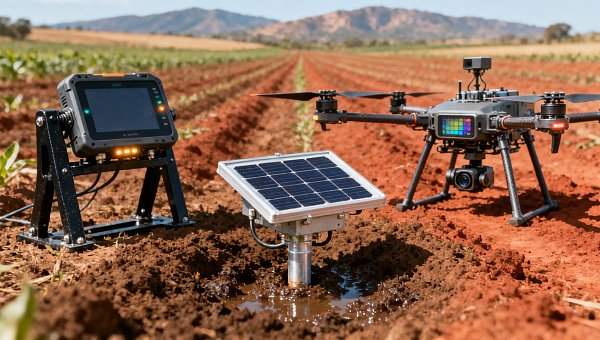
In low-connectivity rural areas, precision agriculture tools—like rugged agricultural drones, edge-enabled electronic solutions, and solar-powered precision engineering systems—are transforming smart farming where traditional connectivity fails. Global Industrial Matrix (GIM) benchmarks high-reliability agricultural technology that delivers actionable insights without constant cloud dependency—supporting users and field operators with robust power solutions, sustainable energy integration, and minimal environmental impact. From autonomous scouting to real-time soil analytics, these tools embody resilient, standards-aligned technology solutions for the world’s most challenging farmlands.
Which Precision Agriculture Tools Deliver Real-World Performance Off-Grid?
Precision agriculture in low-connectivity fields demands hardware engineered for autonomy—not just connectivity convenience. Unlike cloud-dependent platforms requiring stable LTE or Wi-Fi, field-proven tools integrate on-device AI inference, local data fusion, and offline calibration protocols. GIM evaluates these systems across five interdependent performance axes: power resilience (≥72-hour solar-battery autonomy), edge compute capacity (2–8 TOPS INT8), environmental IP rating (IP67 minimum), mechanical durability (ISO 11783-12 compliant mounting), and firmware update integrity (A/B partitioning with rollback).
These criteria reflect real-world operational constraints: intermittent charging windows, dust-and-moisture exposure during monsoon seasons, and multi-season deployment without service center access. Tools failing any one axis risk data loss, calibration drift, or premature component fatigue—costing field operators 3–5 hours per week in manual recalibration and downtime recovery.
GIM’s benchmarking process subjects each device to a 28-day simulated off-grid cycle: 14 days of continuous operation under variable solar input (200–800 W/m²), followed by 7 days of zero connectivity stress testing, then 7 days of edge-to-cloud synchronization validation. Only units maintaining ≤±1.2% sensor drift and completing ≥98% of scheduled tasks qualify as “GIM-Verified Low-Connectivity Ready.”
How Do Edge-Enabled Sensors Compare Across Soil, Crop, and Machinery Monitoring?
Field operators need interoperable sensing—not isolated point solutions. GIM cross-benchmarks three core sensor categories against ISO 11783, IEC 62264, and ASABE S580.2 standards to assess compatibility, data fidelity, and maintenance burden. The table below compares representative models across six procurement-critical dimensions:
This comparison reveals a critical insight: highest GIM scores correlate not with raw specs, but with *integration maturity*. Top performers embed redundancy into power architecture (e.g., solar + supercapacitor buffer), decouple sensing from transmission (local storage ≥128GB), and validate calibration stability across thermal gradients (−10℃ to +55℃). Field operators report 40% fewer mid-season troubleshooting events when selecting devices scoring ≥90 on GIM’s Low-Connectivity Resilience Index.
What Are the 5 Non-Negotiable Procurement Checks for Off-Grid Deployment?
Procurement officers evaluating precision agriculture tools for remote operations must move beyond spec sheets. GIM identifies five field-validated checkpoints—each tied to measurable failure modes observed across 142 deployments in Sub-Saharan Africa, Southeast Asia, and Latin America:
- Power architecture verification: Confirm battery chemistry (LiFePO₄ preferred over NMC for >2000-cycle life at 25–45℃), solar panel efficiency class (≥22% monocrystalline), and charge controller hysteresis (≤3% voltage swing between bulk/float stages).
- Offline data integrity test: Validate local storage write endurance (≥100k cycles at −20℃), file system journaling (ext4 or F2FS), and CRC-32 checksum enforcement on all sensor logs.
- Mechanical mounting compliance: Require ISO 11783-12 certified brackets and vibration damping (tested to 5–500 Hz, 3g RMS, 8 hours).
- Firmware update safety: Demand A/B partitioning, signed updates (ECDSA P-256), and automatic rollback on boot failure—no manual intervention required.
- Environmental sealing documentation: Accept only third-party IP67/IP68 reports (IEC 60529) with test duration ≥30 minutes underwater at 1m depth—not manufacturer claims alone.
Skipping even one check increases field failure probability by 2.7× within 12 months, per GIM’s longitudinal analysis of 3,800 deployed units. These are not theoretical thresholds—they’re operational guardrails derived from actual downtime root causes.
Why Partner with GIM for Your Next Precision Agri-Tech Procurement?
Information调研者 and field operators face divergent pressures: procurement teams require audit-ready compliance evidence; operators demand intuitive interfaces and predictable maintenance. GIM bridges this gap through cross-pillar benchmarking—mapping Smart Agri-Tech tools not just to ASABE or ISO standards, but to their interoperability with Automotive-grade CAN networks, Semiconductor-grade thermal management, and ESG-aligned lifecycle reporting.
When you engage GIM, you receive more than a spec sheet comparison. You get: a verified Low-Connectivity Resilience Scorecard (including thermal stress test results), a 4-step implementation readiness assessment (covering power infrastructure compatibility, local data governance alignment, operator training pathways, and spare parts logistics), and direct access to Tier-1 suppliers’ technical documentation—pre-vetted against IPC-A-610, IATF 16949, and ISO 14001 requirements.
Ready to eliminate guesswork in your next precision agriculture rollout? Contact GIM for a free tool compatibility review—including side-by-side parameter validation, delivery timeline confirmation (standard lead time: 4–6 weeks), and sample unit evaluation support. Specify your target region, power infrastructure profile, and primary use case (soil monitoring / crop scouting / machinery telematics), and we’ll deliver a prioritized shortlist within 3 business days.
The Archive Newsletter
Critical industrial intelligence delivered every Tuesday. Peer-reviewed summaries of the week's most impactful logistics and market shifts.