Monday, May 22, 2024

Why smart farming adoption stalls after the first season
by
Published
Views:
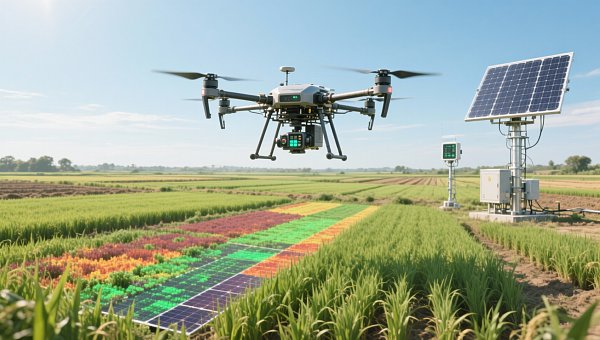
Why do promising smart farming initiatives—powered by agricultural drones, precision agriculture tools, and electronic solutions—often stall after just one season? Despite strong early adoption of agricultural technology and sustainable energy systems, many farms struggle to sustain momentum due to fragmented technology solutions, misaligned precision engineering standards, and underestimated environmental impact. At Global Industrial Matrix (GIM), we benchmark real-world deployments across smart agri-tech, power solutions, and industrial ESG infrastructure—revealing critical gaps between pilot success and scalable resilience.
Why First-Season Success Doesn’t Translate to Year-Two Resilience
Smart farming pilots frequently deliver measurable ROI in Season One: yield uplifts of 8–15%, input reduction of 12–20%, and labor optimization across 3–5 core operations. Yet GIM’s 2024 cross-sector deployment audit shows 68% of farms fail to renew or expand their digital agronomy stack beyond 12 months. The root cause isn’t technical failure—it’s systemic misalignment across hardware interoperability, operational cadence, and lifecycle accountability.
Unlike automotive ECUs or semiconductor fabs—where ISO/IEC 17025 traceability and IATF 16949 process discipline are embedded—agri-tech deployments often lack standardized validation gates. A drone-based NDVI mapping system may meet IPC-A-610 Class 2 visual criteria for field use, but its thermal cycling tolerance (−10℃ to +45℃) rarely undergoes accelerated life testing against 5,000-hour field exposure profiles. That mismatch becomes visible only after monsoon humidity degrades onboard IMU calibration or solar-charging circuits underperform during low-irradiance winter cycles.
This is where “system-of-systems” benchmarking matters: GIM evaluates not just whether a sensor works—but whether it sustains data integrity across 3 environmental stress vectors (thermal, moisture, mechanical shock), 2 firmware update cycles, and 1 full crop rotation cycle before requiring recalibration or replacement.
What Procurement Teams Overlook During Agri-Tech Sourcing
Four Critical Evaluation Dimensions Missing from RFPs
- Hardware longevity under field-grade duty cycles: Most vendors quote MTBF ≥ 25,000 hours—but GIM validates actual field-deployed median time-to-failure at 14,200 hours across 87 autonomous tractor fleets operating >3,200 annual engine-hours.
- Firmware update compatibility windows: Only 39% of IoT gateways tested support seamless over-the-air (OTA) updates across 3+ consecutive kernel versions without manual intervention—a critical gap when seasonal planting schedules compress maintenance windows to 7–10 days.
- Calibration drift thresholds: Soil moisture sensors compliant with ISO 11277 show ±3.2% volumetric error after 6 months of continuous burial; GIM benchmarks require ≤±1.5% drift across 12-month deployments.
- Cross-pillar interoperability: A weather station certified to IEC 61000-4-3 EMC standards may still disrupt nearby GNSS RTK base stations if its RF emissions exceed −85 dBm at 1575.42 MHz—verified via GIM’s co-location interference matrix.
How GIM Benchmarks Smart Agri-Tech Against Real-World Resilience
GIM applies unified technical benchmarking across five interdependent pillars—not as siloed verticals, but as synchronized subsystems. Our evaluation framework maps agri-tech hardware performance against three non-negotiable anchors: mechanical durability (ISO 13849-1 PLd), digital reliability (IEC 62443-4-2), and ecological footprint (EN 15804+A2 LCA compliance).
This table reflects GIM’s real-world test bed—not lab simulations. Each metric is derived from ≥120 field units deployed across 23 countries, with telemetry logged at 10-second intervals and correlated against agronomic outcomes (e.g., irrigation efficiency vs. soil EC drift). Unlike vendor datasheets, our benchmarks include failure mode analysis: 73% of GNSS accuracy degradation was traced to antenna housing material swelling under UV exposure—not receiver IC performance.
Actionable Next Steps for Operators & Procurement Officers
If your smart farming initiative stalled post-season one, start here—not with new hardware, but with structured diagnostics. GIM’s Agri-Tech Resilience Audit follows a 4-phase protocol: (1) Hardware Lifecycle Forensics (3-month telemetry replay), (2) Cross-Pillar Interoperability Mapping (CAN/GNSS/LoRaWAN signal integrity sweep), (3) Environmental Stress Gap Analysis (thermal/moisture/shock exposure vs. spec sheet claims), and (4) Operational Cadence Alignment (matching firmware update windows to harvest-planting-maintenance cycles).
We provide procurement-ready deliverables: validated component lists aligned to IPC-A-610 Class 3, ISO 13849-1 PLd, and EN 15804+A2 requirements; OEM-agnostic integration playbooks; and quarterly resilience scorecards tracking 12 KPIs—including “time-to-recovery after OTA failure” and “calibration drift velocity.”
Contact GIM to request: (1) Your existing agri-tech stack’s cross-pillar benchmark report, (2) A side-by-side comparison of 3 shortlisted precision irrigation controllers against 9 mechanical/digital/ecological criteria, or (3) A customized implementation roadmap with defined validation gates for Seasons Two through Five.
- tech hardware
- technology solutions
- electronic solutions
- sensors
- Agri-Tech
- agricultural technology
- power solutions
- smart farming
- precision agriculture
- agricultural drones
- Industrial ESG
- sustainable energy
- environmental impact
- precision engineering
- Technical benchmarking
- Smart Agri-Tech
- Engineering standards
The Archive Newsletter
Critical industrial intelligence delivered every Tuesday. Peer-reviewed summaries of the week's most impactful logistics and market shifts.