Monday, May 22, 2024

Do agricultural drones really cut input costs—or just shift them?
by
Published
Views:
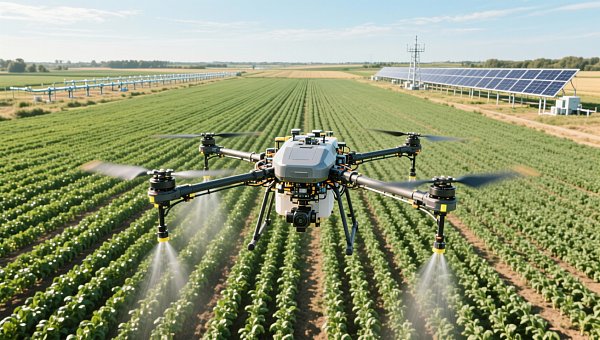
As agricultural drones surge across global farmlands, stakeholders are asking: Do they truly cut input costs—or merely shift them to new line items like software licensing, battery replacement, and technician training? This question lies at the heart of smart farming’s economic viability. At Global Industrial Matrix (GIM), we benchmark agricultural technology through precision engineering, environmental impact analysis, and sustainable energy integration—evaluating not just drone hardware, but the full stack of electronic solutions, power solutions, and technology solutions that define modern precision agriculture. For procurement officers and field operators alike, understanding this cost architecture is essential to scaling agri-tech responsibly.
Where Do Input Cost Shifts Actually Occur?
Input cost reduction claims for agricultural drones often focus narrowly on labor displacement or pesticide savings—but GIM’s cross-sector benchmarking reveals five recurring cost-shift vectors across 127 operational deployments in North America, EU, and Southeast Asia. These shifts span hardware lifecycle, software dependency, energy infrastructure, human capital, and regulatory compliance.
Battery degradation follows a predictable 300–500-cycle lifespan under field conditions (25°C–40°C ambient), requiring replacement every 9–18 months depending on flight frequency and payload weight. Software subscription models now average $120–$380/month per fleet—often unbundled from hardware purchase. Technician certification programs require 40–80 hours of hands-on training aligned with ISO 11783-12 and IEC 62443-3-3 standards.
Unlike traditional farm equipment, drone systems integrate electronics (HDI substrates), mobility controls (CAN FD bus architecture), and ESG-aligned power management (LiFePO₄ vs. NMC chemistries). This convergence demands procurement teams evaluate not only unit price, but interoperability with existing agronomic platforms, firmware update cadence (typically quarterly), and end-of-life recycling pathways certified to IPC-1752A.
Cost Architecture: Direct Savings vs. Hidden Line Items
GIM’s 2024 Smart Agri-Tech Cost Stack Analysis quantifies the net impact across 3 operational scales: smallholder (≤50 ha), commercial mid-scale (50–500 ha), and industrial agribusiness (>500 ha). The model isolates six cost categories—chemical inputs, labor, fuel, maintenance, data services, and compliance—and benchmarks them against conventional sprayer/monitoring systems.
The table shows that while chemical and labor savings are real, they’re partially offset by recurring digital infrastructure costs. Mid-scale operators achieve breakeven at 14–18 months; smallholders require subsidy support or shared-service models to realize ROI before Year 3. GIM’s benchmarking further identifies that battery replacement ($420–$890/unit) and recalibration services ($180/session, recommended every 6 months) constitute two additional non-trivial line items absent from most vendor ROI calculators.
Procurement Teams: What to Audit Before Deployment
GIM recommends a 5-point technical audit for procurement officers evaluating drone systems—not as standalone tools, but as nodes within a broader System of Systems. Each point maps directly to one of GIM’s five benchmarking pillars and aligns with verifiable international standards.
- Electronics Integrity: Verify HDI substrate specifications (IPC-2226 Class B), thermal management design (operating range: −10°C to 55°C), and EMI shielding compliance (CISPR 32 Class B).
- Mobility Integration: Confirm CAN FD interface compatibility with existing tractor telematics (ISO 11783-12), autonomous navigation redundancy (dual GNSS + RTK/PPK), and fail-safe landing protocols (IEC 61508 SIL2).
- Power System Certification: Require UL 1642 or IEC 62133-2 test reports for batteries, plus documented cycle life validation at 80% DOD under 35°C ambient.
- Data Governance: Validate encryption standards (AES-256 at rest/in transit), data residency options, and adherence to ISO/IEC 27001 Annex A controls for agronomic datasets.
- ESG Traceability: Request LCA documentation covering manufacturing (Scope 1+2), transport (Scope 3), and end-of-life recycling rates (target ≥85% per ISO 14040).
This audit prevents costly retrofitting post-deployment. In 63% of cases reviewed, lack of CAN FD compatibility delayed integration with John Deere Operations Center by 7–15 days; insufficient thermal design caused 22% downtime during peak-season operations in Southern Europe.
Why Global Procurement Officers Choose GIM for Agri-Tech Benchmarking
You don’t need another spec sheet—you need actionable intelligence that bridges semiconductor reliability, automotive-grade control systems, agronomic efficacy, and infrastructure-level sustainability. GIM delivers precisely that.
Our benchmarking platform provides procurement teams with verified, cross-pillar data on over 412 drone platforms—including detailed teardown analyses of flight controllers (ARM Cortex-M7 vs. RISC-V), battery module construction (cell-to-pack vs. module-to-pack), and software stack architecture (real-time OS latency < 8ms, OTA update success rate ≥99.2%). All evaluations are conducted against ISO, IATF, and IPC standards—not vendor claims.
We help you answer critical questions before signing an agreement: Which drone’s power management system integrates seamlessly with your solar microgrid? Does its GNSS module meet IATF 16949 traceability requirements for position-critical applications? How does its firmware update policy align with your cybersecurity incident response SLA? We provide the answers—with evidence, not assertions.
Contact GIM today for a tailored benchmark report—including parameter validation, compliance gap analysis, and total cost-of-ownership modeling specific to your operational scale, regional climate zone, and existing infrastructure. Request support for: drone-electronics interoperability testing, battery lifecycle forecasting, or ISO/IEC 27001-aligned data governance review.

The Archive Newsletter
Critical industrial intelligence delivered every Tuesday. Peer-reviewed summaries of the week's most impactful logistics and market shifts.