Monday, May 22, 2024

MARA Releases Revised Pig Production Control Plan, Accelerating FAO Alignment for Smart Feeding & Agri-Drones
by
Published
Views:
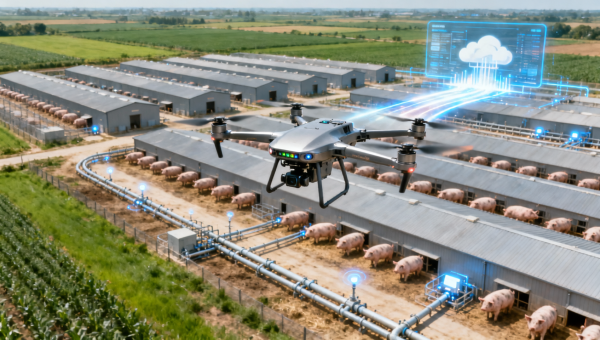
On May 15, 2026, China’s Ministry of Agriculture and Rural Affairs (MARA) issued the revised Implementation Plan for Comprehensive Regulation of Pig Production Capacity. The update introduces mandatory technical requirements for large-scale pig farms—including integration of smart feeding systems with the national Livestock Cloud Platform and ≥85% drone-based field inspection coverage. This policy shift directly impacts manufacturers and exporters of autonomous tractors, agricultural drones, and smart irrigation systems, particularly those targeting Southeast Asia and the Middle East with hardware validated under China’s scaled-up farming conditions.
Event Overview
On May 15, 2026, MARA officially released the revised Implementation Plan for Comprehensive Regulation of Pig Production Capacity. For the first time, the plan stipulates two technical thresholds as hard admission criteria for规模化 pig farms: (1) real-time data connectivity from intelligent feeding systems to the national Livestock Cloud Platform; and (2) unmanned aerial vehicle (UAV)-based farm inspection coverage of no less than 85%. The policy mandates that domestic manufacturers of autonomous tractors, agricultural drones (Agri-Drones), and smart irrigation equipment accelerate alignment with FAO and ISO 20192 standards for agricultural IoT—primarily to support export readiness for procurement entities in Southeast Asia and the Middle East.
Industries Affected
Smart Agriculture Hardware Manufacturers
Manufacturers of autonomous tractors, Agri-Drones, and smart irrigation controllers are directly affected because their products must now meet newly codified interoperability and data-reporting requirements for domestic farm准入. The mandate triggers immediate pressure to revise firmware, adopt standardized data schemas (e.g., ISO 20192), and obtain third-party verification for FAO-aligned performance claims.
Export-Oriented Agri-Tech Trade Firms
Firms specializing in cross-border sales of Chinese-made smart farming hardware face revised buyer expectations. Procurement delegations from Southeast Asia and the Middle East are increasingly referencing China’s new farm-level adoption benchmarks—not just product specs—as de facto validation criteria. This elevates demand for documentation proving operational deployment at scale within China’s regulated pig farming sector.
Agricultural IoT System Integrators
System integrators delivering end-to-end farm management solutions must now ensure compatibility across multiple vendor platforms—including feed system APIs, UAV telemetry feeds, and cloud platform ingestion protocols. The requirement for unified data flow into the national Livestock Cloud Platform increases integration complexity and testing timelines for multi-device deployments.
Key Focus Areas and Recommended Actions for Stakeholders
Monitor official technical annexes and implementation guidance
MARA has not yet published detailed specifications for ‘data connectivity’ or ‘drone inspection coverage’ measurement methodology. Stakeholders should track forthcoming technical annexes and provincial-level implementation notices, especially regarding data format (e.g., JSON-LD vs. MQTT), latency tolerances, and audit mechanisms for coverage compliance.
Prioritize ISO 20192 conformance for core data interfaces
Analysis shows that ISO 20192 (Agricultural IoT—Data Interoperability Framework) is emerging as the primary technical reference—not FAO guidelines alone—for domestic certification pathways. Firms should allocate engineering resources toward validating sensor metadata tagging, device identity registration, and secure OTA update capabilities against this standard.
Distinguish between policy signal and near-term enforcement scope
Observably, the regulation applies only to farms above a defined scale threshold (not yet publicly specified) and does not retroactively apply to existing installations. Exporters and integrators should avoid assuming universal applicability; instead, verify whether target customers fall under MARA’s definition of ‘large-scale’ operations before committing to full-stack compliance upgrades.
Prepare documentation packages for international buyers
Current more actionable preparation includes compiling evidence of verified deployment—such as anonymized cloud platform dashboards, drone flight logs with geotagged coverage maps, and third-party verification reports—tailored for procurement due diligence in ASEAN and GCC markets.
Editorial Perspective / Industry Observation
This policy is better understood as a regulatory signal than an immediate market transformation. From an industry perspective, it formalizes China’s role as a testbed for scalable, data-integrated livestock management—not merely a manufacturing base. The linkage between domestic farm-level mandates and export-standard alignment suggests a deliberate strategy to anchor global procurement decisions in China’s operational experience. However, actual export acceleration remains contingent on concurrent developments: harmonization of FAO/ISO interpretation across importing countries, availability of accredited conformity assessment bodies, and buyer-side capacity to interpret China-validated data outputs. Continued observation is warranted on how provincial authorities implement verification protocols—and whether MARA publishes benchmark datasets or API sandbox environments for developers.
Conclusion: The revised plan marks a structural pivot—from promoting smart agriculture as optional efficiency tools to treating them as foundational infrastructure for national production stability. For stakeholders, it signals growing convergence between domestic regulatory compliance and international market access. It is more accurately interpreted as a phased alignment initiative than a sudden compliance deadline; its long-term significance lies in institutionalizing data interoperability as a non-negotiable layer of agri-tech trade.
Source: Ministry of Agriculture and Rural Affairs of the People’s Republic of China (MARA), official notice dated May 15, 2026. Note: Specific thresholds for farm scale classification, technical annexes, and provincial implementation timelines remain pending publication and are subject to ongoing monitoring.

The Archive Newsletter
Critical industrial intelligence delivered every Tuesday. Peer-reviewed summaries of the week's most impactful logistics and market shifts.