Monday, May 22, 2024

Choosing a Solar Water Pump Manufacturer for Long-Term Field Reliability
by
Published
Views:
Selecting the right solar water pump manufacturer is a strategic decision that affects uptime, lifecycle cost, and field performance across demanding environments. For project managers and engineering leads, long-term reliability depends not only on pump efficiency, but also on component quality, compliance standards, service support, and supply chain stability. This guide outlines the key evaluation factors needed to reduce project risk and secure dependable operation.
Why a checklist-based approach is the safest way to evaluate a solar water pump manufacturer
For field projects, procurement mistakes usually come from incomplete evaluation rather than obviously bad products. A solar water pump manufacturer may present strong headline specifications, but real-world reliability depends on how the entire system performs under fluctuating irradiance, variable water depth, dust, heat, voltage instability, and long service intervals. That is why project leaders should avoid making decisions based only on price, catalog flow rate, or a single lab efficiency figure.
A checklist method helps teams compare suppliers on the factors that actually determine long-term value: motor durability, controller design, corrosion resistance, certification discipline, spare parts planning, and service responsiveness. It also makes internal approvals easier, because engineering, sourcing, ESG, and operations teams can align around a shared decision framework rather than subjective preferences.
The first-pass screening checklist: what to confirm before technical deep review
Before requesting detailed drawings or arranging pilot tests, use a fast screening checklist to remove high-risk suppliers. This saves time and keeps the project focused on qualified candidates.
- Verify whether the solar water pump manufacturer has proven export or deployment history in climates similar to your project environment.
- Confirm product range coverage for the required head, flow, bore size, and water quality conditions.
- Check whether the supplier provides complete system matching, including pump, motor, controller, solar array recommendations, protection logic, and cable guidance.
- Review warranty terms carefully, especially what is excluded under dry running, sand content, voltage fluctuation, or installation error.
- Ask whether critical parts are standardized and available for at least five to ten years.
- Confirm responsiveness: technical answers, documentation quality, and sample lead times usually reflect future service performance.
If a supplier fails at this stage, a deeper audit rarely changes the outcome. Strong manufacturers tend to be organized early, transparent with data, and consistent in communication.
Core technical checks that influence long-term field reliability
1. Pump hydraulic design and operating window
Do not evaluate a pump only at nominal conditions. Ask the solar water pump manufacturer for performance curves across changing solar input and variable total dynamic head. Reliable field operation requires acceptable output during morning and afternoon low-irradiance periods, not only at peak noon conditions. Also confirm whether the pump can tolerate off-design operation without excessive wear, overheating, or unstable starts.
2. Motor type, insulation, and thermal tolerance
Motor selection is central to service life. Brushless DC and AC submersible systems each have valid use cases, but reliability depends on insulation class, winding quality, bearing selection, sealing strategy, and heat dissipation. In hot regions or enclosed boreholes, inadequate thermal design can shorten life dramatically. Request data on insulation class, maximum ambient and water temperature, start-stop cycles, and thermal protection logic.
3. Controller quality and protection architecture
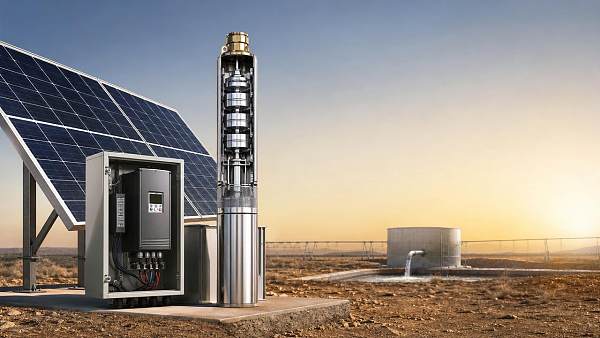
The controller is often the hidden weak point. A capable solar water pump manufacturer should provide protections for dry run, overvoltage, undervoltage, overload, overtemperature, reverse polarity, and surge events where relevant. Ask whether the controller uses MPPT, how quickly it tracks irradiance changes, and how fault logs are stored. In remote deployments, fault visibility can be more valuable than a small gain in advertised efficiency.
4. Materials compatibility with water chemistry
Stainless steel alone is not enough as a quality claim. You need to know the grade, elastomer selection, shaft material, impeller construction, and tolerance to sand, salinity, and corrosive water. For agriculture, livestock, rural water supply, and infrastructure projects, premature failure often comes from mismatch between materials and local water chemistry rather than motor defects.
5. Mechanical sealing, bearings, and sand tolerance
Where wells contain suspended solids, ask for allowable sand content, expected wear behavior, and maintenance intervals. Review bearing brand policy, sealing configuration, and field replacement practicality. If the solar water pump manufacturer cannot explain wear mechanisms under real bore conditions, reliability claims should be treated cautiously.
Compliance and quality assurance checks that procurement teams should not skip
For multinational sourcing or public-sector tenders, compliance discipline is a major indicator of supplier maturity. It does not guarantee reliability by itself, but it reduces uncertainty and improves traceability.
For organizations working across sectors, this is where a technical benchmarking mindset matters. GIM-style cross-industry evaluation shows that the strongest industrial suppliers are usually those that combine process control, documented testing, and transparent corrective action systems.
Scenario-based evaluation: the same solar water pump manufacturer may not fit every project
Agricultural irrigation projects
Prioritize variable demand handling, abrasion tolerance, easy field maintenance, and compatibility with storage tanks or drip systems. Seasonal workload swings matter more than perfect steady-state efficiency.
Rural or community water supply
Focus on reliability under low-maintenance conditions, spare parts simplicity, local technician training, and controller fault diagnostics. Downtime cost is social as well as operational.
Industrial ESG and infrastructure programs
Projects tied to water stewardship, off-grid resilience, or sustainability reporting need stronger documentation, more rigorous supplier governance, and predictable lifecycle support. Here, the right solar water pump manufacturer is often the one with the clearest traceability and service framework, not simply the lowest quotation.
Commonly overlooked risks that cause expensive failures later
- Underspecified cables, connectors, or junction protection in high-heat outdoor installations.
- No verified match between solar array sizing and real seasonal irradiance profile.
- Ignoring borehole variation, water level drop, or pump placement depth changes over time.
- Assuming warranty support is global when actual service is limited to factory return only.
- No plan for spare controllers, seals, or wear parts at regional stock locations.
- Relying on one production site without assessing capacity bottlenecks or geopolitical supply risk.
These issues rarely appear in marketing brochures, yet they are exactly the factors that determine whether a solar pumping system remains dependable after two, five, or ten years in the field.
How to run a practical supplier evaluation process
- Define duty conditions precisely: daily water volume, head range, water chemistry, solids content, ambient conditions, and seasonal solar profile.
- Shortlist suppliers using the first-pass checklist and eliminate those with weak documentation or vague support commitments.
- Request a structured technical package from each solar water pump manufacturer, including curves, BOM-level material details, controller protections, certifications, and warranty conditions.
- Score suppliers with weighted criteria such as reliability, serviceability, compliance, lifecycle cost, and lead time stability.
- Run reference checks in similar climates or applications, and ask specifically about failure modes, parts availability, and support responsiveness.
- If project scale justifies it, require a pilot installation or witnessed test before full deployment.
Questions to ask before awarding the contract
A final commercial discussion should not focus only on unit price. To select the right solar water pump manufacturer, project teams should confirm several contract-critical points: What are the guaranteed operating conditions? Which failures are covered in warranty? How fast are replacement parts shipped? Can the controller firmware or settings be documented and locked? Are field technicians trained locally? What is the escalation path for repeated failures? Can the supplier support future expansion using the same architecture?
These questions convert a technical preference into a procurement-grade decision. They also reduce disputes later, because expectations are defined before the system enters service.
Final decision guidance for project managers and engineering leads
The best solar water pump manufacturer is not necessarily the one with the highest advertised efficiency or the cheapest initial offer. For long-term field reliability, the stronger choice is usually the supplier that can demonstrate controlled manufacturing, robust protection design, materials matched to water conditions, transparent test data, and dependable after-sales support. In other words, reliability is a system outcome, not a single product feature.
If your team is moving toward supplier selection, prepare the application profile first: required flow and head, site climate, water chemistry, maintenance capability, expected design life, budget limits, and service expectations. Then ask shortlisted manufacturers to respond against the same checklist. If further confirmation is needed, prioritize discussions around parameter matching, lifecycle cost assumptions, spare parts planning, lead time security, compliance evidence, and local support structure before signing. That approach gives your project a far better chance of achieving stable, low-risk solar pumping performance over the long term.

The Archive Newsletter
Critical industrial intelligence delivered every Tuesday. Peer-reviewed summaries of the week's most impactful logistics and market shifts.