Monday, May 22, 2024

Do smart garden watering systems work without a Wi-Fi connection?
by
Published
Views:
Yes—smart garden watering systems can work without Wi-Fi, provided the controller stores and runs watering schedules locally. A lost connection may stop phone-based control, weather updates, and notifications without interrupting the next scheduled watering cycle. But a system that relies on cloud commands, or has not yet been configured, may behave differently.
The buying question is therefore not simply whether a product is “Wi-Fi enabled.” It is whether watering decisions are made inside the controller or depend on an online service. For reliable watering during an outage—or in a garden with no wireless coverage—look for documented offline scheduling, usable local controls, and clear behavior after a power interruption.
“Without Wi-Fi” can mean different things
A home internet outage, a weak wireless signal at the garden tap, and a property with no router are different operating conditions. A controller may handle one successfully while being unsuitable for another.
If your internet service stops but the router remains on, the controller may still be connected to the home network. Cloud-based access will be unavailable, but an app with genuine local-network control could still work. An app that communicates only through the manufacturer’s servers will not regain control merely because your phone and controller share the same router.
If the controller loses its Wi-Fi connection entirely, locally stored schedules can still run if the product supports autonomous operation. However, changing those schedules may require physical buttons, a display, or a separate Bluetooth connection.
A garden that will never have Wi-Fi needs a stricter assessment. Some connected controllers require an internet connection for account registration, initial setup, or schedule creation. They may tolerate an outage after installation without supporting permanent offline use. “Continues watering when disconnected” does not necessarily mean “can be installed and managed without internet.”
The important distinction: stored schedules versus online commands
A locally scheduled controller keeps watering instructions in its own memory and uses an internal clock to start each cycle. If it retains the schedule and remains powered, it does not need a new message from the internet every time a valve opens.
A cloud-dependent arrangement can work differently. An online service may calculate watering needs or issue commands that the device then carries out. Such a system needs a documented fallback if the connection disappears. That fallback might be a saved fixed schedule, a previously downloaded program, or suspended watering. These outcomes are not interchangeable.
Even local storage needs closer examination. Nonvolatile memory can preserve a program through a power cut, but the controller must also know the correct time when it restarts. A device that retains its schedule yet waits for internet time synchronization may not immediately resume normal operation. Schedule memory, clock backup, and automatic restart are separate specifications.
For a garden left unattended, the strongest arrangement is not merely “settings saved.” It is a controller that can execute an appropriate schedule, retain its clock or recover it independently, and resume predictably without requiring someone to open an app.
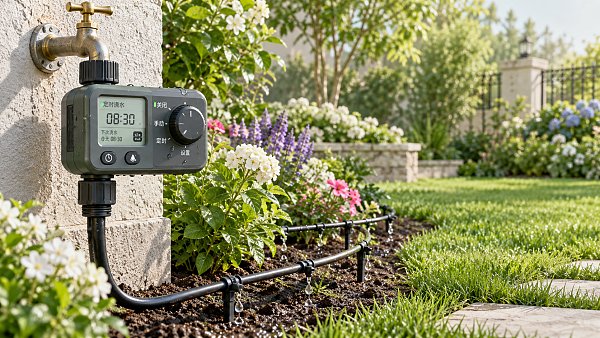
Which smart features continue working offline?
Basic scheduled watering and smart adjustments should be assessed separately. A controller can keep the garden watered while temporarily losing the features that make it responsive to changing conditions.
Scheduled watering and manual operation
Saved start times, watering durations, and selected watering days can continue when the controller executes them locally. Confirm whether this applies to every zone and to features such as repeated short watering cycles with soak intervals. A general claim about offline operation may not describe every programming mode.
Physical manual controls provide a way to start or stop watering without a phone. Check what those controls actually do: a button may start a preset cycle but offer no way to change its duration or edit the weekly schedule. Being able to stop water locally is particularly useful when a hose disconnects or a sprinkler is damaged.
Weather-based adjustments
Weather services require a working connection to deliver fresh forecasts or weather observations. During an outage, the controller might use the last downloaded watering plan, return to a baseline schedule, or follow another manufacturer-defined fallback.
The practical risk is not always missed watering. A fixed schedule may continue through rainfall because the controller no longer receives updated rain information. Conversely, an earlier reduction in watering may persist into hotter conditions if the fallback retains that adjustment. Check both the offline schedule and how long previously downloaded weather decisions remain active.
Rain and soil-moisture sensors
A sensor can remain useful offline when its readings reach the controller through a local connection and the controller applies them locally. A wired rain sensor, for example, may interrupt watering without needing an internet weather service, provided the controller supports that behavior.
Do not assume every wireless sensor is equally independent. Some communicate directly with a controller or local hub; others rely on an online platform for processing or automation. Ask whether the sensor can actually prevent or adjust watering during an internet outage—not merely whether it continues measuring conditions.
Remote access, alerts, and watering history
Controlling the garden from another location needs a working communication path. If the system depends on home broadband, remote access disappears when that connection fails. Voice-assistant integrations may also stop working if they rely on cloud services.
Likewise, an offline controller may keep watering without delivering leak alerts, low-battery warnings, or completion notifications. Some devices store activity records and synchronize later; others provide limited retrospective information. An app showing a scheduled event is not proof that water flowed, especially without flow monitoring.
Choosing a system for a garden with little or no Wi-Fi
The appropriate choice depends on whether you need occasional adjustments beside the tap, control from inside the house, or supervision while away. Paying for more connectivity does not automatically improve offline reliability.
For a simple, repeatable watering routine
A standalone programmable hose timer can be sufficient for pots, a vegetable bed, or a small drip installation. It does not need Wi-Fi if programming and scheduling are handled on the device. Battery operation can also avoid dependence on household electricity, although depleted batteries remain a failure risk.
This option makes sense when seasonal adjustments can be made manually and remote alerts are unnecessary. Check programming flexibility, accessible controls, battery warnings, and the permitted water pressure. A connection-free timer still needs to match the watering equipment it controls.
For phone-based adjustments near the garden
A Bluetooth timer can offer app-based programming without a Wi-Fi network at the watering point. For independent operation, the timer must store and execute its schedule after the phone leaves range.
Bluetooth access is proximity-based rather than remote access. Walls, enclosures, and distance affect usability, so advertised range should not be treated as a guarantee for your installation. Also check whether app login, initial activation, or account recovery requires internet access, even if routine device communication uses Bluetooth.
For several watering zones with occasional outages
A Wi-Fi irrigation controller with autonomous scheduling can combine remote convenience with basic offline continuity. It is a suitable approach when internet access is normally available but must not become a single point of failure for scheduled watering.
Prioritize local schedule execution and accessible manual controls over the number of app integrations. If weather-responsive watering matters, examine the fallback settings and whether a compatible local rain sensor can still stop unnecessary irrigation.
For a remote plot that needs off-site supervision
Cellular connectivity can provide remote access without home Wi-Fi, subject to coverage at the installation point. Subscription costs, power requirements, and service availability become part of the decision.
A proprietary radio link or long-range gateway can also connect a distant valve to a nearby hub. However, removing Wi-Fi from the valve does not necessarily remove internet dependence from the system. Establish where schedules are stored, whether the gateway must remain powered, and what happens if its internet connection fails.
What to verify before buying
Product descriptions such as “smart,” “wireless,” and “works offline” leave room for materially different behavior. The manual or a precise support response should answer these questions:
- Can setup be completed without internet? Distinguish first-time installation from operation after successful setup.
- Where is the schedule executed? Look for an explicit statement that the controller runs saved programs without Wi-Fi or cloud access.
- Can schedules be edited offline? Confirm whether changes use physical controls, Bluetooth, or genuine local-network access.
- What happens after a restart while disconnected? Check schedule retention, clock behavior, and whether watering resumes automatically.
- What replaces weather-based programming? Identify the fallback schedule rather than assuming the last app settings remain suitable indefinitely.
- Which sensors remain effective? Verify local rain interruption or moisture-based control under disconnected conditions.
- Can watering be stopped at the device? An accessible stop control matters when the app is unavailable.
Power-backup language deserves particular attention. A backup battery may preserve the clock and settings without supplying enough power to operate irrigation valves. Similarly, a battery-powered hose timer is independent of household electricity but may have a model-specific response when its battery becomes weak. Check the documented valve behavior rather than assuming it always fails closed.
For a cloud-connected product, offline capability also affects its useful life. If the online service becomes unavailable, a controller that retains editable local schedules remains more useful than one that can only repeat an old program. Local control provides flexibility beyond temporary router problems.
Test the fallback before leaving the garden unattended
Once installed, a short supervised test can reveal whether the system behaves as expected. Save a brief watering cycle and disconnect the home internet while leaving the router powered. Observe whether watering starts and stops correctly, and whether local app access remains available.
Then test loss of Wi-Fi separately, following the device instructions and without resetting it. If continuous operation after a power interruption matters, check recovery under supervision as well. Restore connectivity afterward and confirm that schedules, time settings, and weather adjustments are correct.
Keep these tests short and watch the actual water outlet. A valve command does not confirm adequate flow: a closed tap, blocked filter, weak pump supply, or disconnected hose can defeat a correctly functioning controller. Connectivity resilience cannot compensate for a water-supply fault.
For a garden without Wi-Fi, choose a system that can be configured, adjusted, and operated locally—not merely one that survives a temporary disconnection. For a connected garden, choose a controller whose saved schedules and outage behavior are clearly documented. Remote features are useful conveniences; reliable watering depends on what the device can still do when those conveniences disappear.

The Archive Newsletter
Critical industrial intelligence delivered every Tuesday. Peer-reviewed summaries of the week's most impactful logistics and market shifts.