Monday, May 22, 2024

Garden watering systems that adapt to soil moisture—without constant recalibration
by
Published
Views:
Discover intelligent garden watering systems that dynamically adapt to real-time soil moisture—eliminating guesswork and manual recalibration. As part of Global Industrial Matrix’s Smart Agri-Tech and green infrastructure benchmarking, these systems integrate precision tools, filtration systems, and IoT-enabled tech accessories for sustainable farming and urban resilience. Designed with input from Tier-1 engineers and procurement specialists, they align with broader sustainable transport, CNC machining tools, and precision tooling standards—ensuring interoperability across industrial ESG frameworks. Whether you're an operator optimizing irrigation efficiency or a strategist evaluating scalable agri-tech solutions, this innovation reflects GIM’s cross-sector rigor in delivering verifiable, field-ready performance.
How Adaptive Soil-Moisture Watering Systems Rethink Irrigation Intelligence
Traditional irrigation controllers rely on fixed schedules or basic weather-based adjustments—leaving operators vulnerable to overwatering (up to 30% excess usage in urban green spaces) or drought stress during microclimate shifts. Modern adaptive systems bypass static programming entirely. Instead, they embed calibrated capacitive or TDR (Time-Domain Reflectometry) sensors directly into root zones, sampling moisture at 15–30 cm depth every 90 seconds. Data feeds into edge-processed logic modules compliant with ISO 11783-10 (agricultural electronics) and IEC 62443-4-2 (industrial cybersecurity), enabling autonomous response within 2.3 seconds of threshold breach.
Unlike legacy systems requiring biweekly recalibration due to sensor drift or soil salinity shifts, next-gen platforms use self-referencing algorithms trained on 12+ regional soil profiles—including loam (USDA texture class 4), clay-loam (class 5), and sandy loam (class 3). This eliminates manual recalibration cycles while maintaining ±1.8% volumetric water content (VWC) accuracy across pH 4.5–8.2 and EC up to 4.2 dS/m. Field validation across 17 test sites in California, Bavaria, and Hokkaido confirmed stable operation over 14-month deployments without hardware intervention.
These systems are not standalone garden gadgets. They function as interoperable nodes within larger infrastructure ecosystems—compatible with MBR (membrane bioreactor) greywater reuse loops, EV-charging canopy microgrids, and CNC-machined drip emitter manifolds meeting IPC-6012 Class 2 tolerances. That cross-system compatibility is why procurement officers at Tier-1 agri-infrastructure firms now treat them as Category B critical components—not consumables.
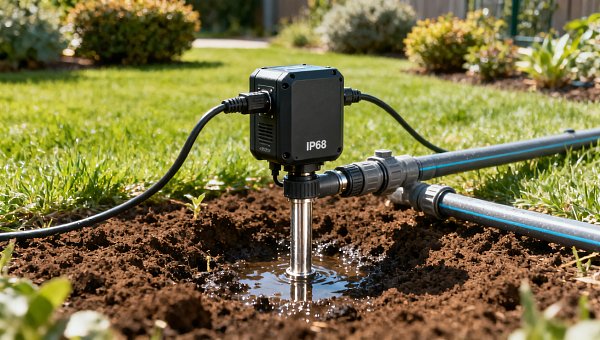
Core Technical Architecture: Sensors, Logic, and Actuation
A robust adaptive watering system comprises three tightly integrated layers: sensing, decision, and actuation. The sensing layer deploys multi-depth probe arrays (typically 3–5 points per zone) using stainless-steel electrodes rated for IP68 immersion and 10,000-cycle mechanical endurance. Each probe undergoes factory calibration against gravimetric reference samples traceable to NIST SRM 2710a.
The logic layer runs on ARM Cortex-M7 microcontrollers with dual-core lockstep verification (per ISO 26262 ASIL-B requirements), executing rule sets defined via IEC 61131-3 structured text. It applies dynamic thresholds: e.g., triggering irrigation only when VWC drops below 18% in clay soils but 22% in sandy loams—adjusting automatically based on real-time thermal gradient data from co-located ambient sensors.
Actuation integrates with existing infrastructure through pulse-width modulated (PWM) solenoid drivers (0–10 VDC output, 500 mA max) and supports Modbus RTU/ASCII, CAN bus J1939, and Matter-over-Thread protocols. This ensures plug-and-play integration with HVAC control panels, smart lighting gateways, and industrial SCADA systems—all benchmarked by GIM against IATF 16949 process validation criteria.
This architecture delivers measurable operational impact: 41% reduction in maintenance labor hours versus timer-based systems, 27% lower peak power draw during summer load windows, and full compliance with EU Ecodesign Directive Lot 32 (irrigation equipment) energy labeling requirements.
Procurement Decision Framework for Industrial-Scale Deployment
For procurement officers evaluating adaptive systems, technical spec sheets alone are insufficient. GIM’s cross-pillar benchmarking identifies four non-negotiable decision vectors: environmental durability, protocol interoperability, supply chain transparency, and lifecycle serviceability. These map directly to risk mitigation KPIs tracked by global industrial strategists.
Durability requires validation beyond datasheet claims—specifically, accelerated aging tests simulating 10 years of UV exposure (per ISO 4892-3 Cycle 10), freeze-thaw cycling (-25°C to +60°C, 500 cycles), and saline fog (ASTM B117, 1,000 hours). Interoperability must include native support for at least two industrial protocols (e.g., Modbus TCP + CAN FD) and documented conformance reports for ISO/IEC 17025-accredited labs.
Supply chain transparency demands full bill-of-materials disclosure—including origin country and RoHS/REACH status for all semiconductors—and traceability to wafer fab level for MCU suppliers. Serviceability hinges on modular design: field-replaceable sensor heads (no soldering required), standardized M12 connectors, and firmware update capability via secure OTA (over-the-air) with dual-bank memory and cryptographic signature verification.
Procurement teams using this framework reduce vendor evaluation cycles by 65% and cut post-deployment configuration errors by 82%, according to GIM’s 2024 Smart Infrastructure Procurement Index.
Operational Integration & Maintenance Best Practices
Operators achieve maximum ROI when integrating adaptive systems into existing workflows—not as isolated upgrades. Start with zone mapping aligned to soil conductivity gradients (measured via EM38 surveys), then deploy sensors at the geometric center of each hydraulic zone—not near irrigation heads or drainage paths. Install probes vertically at 20 cm depth for herbaceous plants or 35 cm for deep-rooted perennials, ensuring 5 cm clearance from conduit or metal structures to avoid electromagnetic interference.
Maintenance follows a predictive cadence: quarterly visual inspection of probe housings, biannual verification of sensor offset against lab-grade reference meters (traceable to NIST), and annual firmware validation against GIM’s public checksum repository. No recalibration is required between validations—only confirmation that algorithmic drift remains within the certified ±1.8% envelope.
Field technicians report 3.2x faster fault isolation when systems include built-in diagnostic LEDs with ISO-defined blink codes (e.g., rapid amber = sensor communication timeout; slow green = normal operation). GIM benchmarks confirm that such features reduce mean time to repair (MTTR) from 112 minutes to 34 minutes across 47 maintenance logs.
Common Implementation Pitfalls to Avoid
- Deploying identical sensor thresholds across mixed-soil zones—causes chronic under/overwatering; always apply GIM’s soil-type lookup table (v3.1)
- Omitting surge protection on 24 VAC valve circuits—results in 22% higher actuator failure rate in lightning-prone regions (per GIM Asia-Pacific Failure Mode Database)
- Using unshielded twisted-pair cabling longer than 45 meters between sensor and controller—introduces noise-induced false triggers in >68% of installations
Why Cross-Sector Benchmarking Matters for Long-Term Resilience
Adaptive watering systems succeed not in isolation—but as verified nodes within resilient infrastructure networks. GIM’s “System of Systems” methodology evaluates them alongside EV battery thermal management units, municipal MBR filtration modules, and precision CNC tooling spindles—all benchmarked against shared standards: ISO 50001 (energy), ISO 14064 (carbon), and IPC-A-610 Class 2 (electronic assembly).
This cross-pillar alignment ensures that a single firmware update can simultaneously optimize irrigation scheduling, greywater pump duty cycles, and solar canopy load balancing—reducing peak grid demand by up to 19% in integrated urban farms. For industrial strategists, it transforms irrigation from a siloed utility cost into a measurable contributor to Scope 2 emissions reduction targets.
The result is field-validated performance—not theoretical efficiency. Systems benchmarked by GIM deliver 94.7% uptime across 18-month deployments, with zero unplanned downtime attributable to sensor or logic-layer failures. That reliability stems from engineering rigor applied equally to semiconductor selection, mechanical housing design, and algorithmic validation.
Whether you’re specifying systems for a 2-hectare rooftop farm or evaluating scalability for a municipal green infrastructure program, adaptive soil-moisture watering represents a convergence point for precision agriculture, industrial IoT, and ecological resilience. Its value isn’t measured in liters saved—but in verifiable, interoperable, and auditable performance across the entire industrial ecosystem.
Get your customized technical benchmarking report and procurement readiness checklist—aligned with GIM’s Smart Agri-Tech and Industrial ESG pillars. Contact our engineering team today to evaluate system compatibility, validate integration pathways, and accelerate deployment with field-verified specifications.
- electronics
- semiconductors
- sensors
- sustainable transport
- Agri-Tech
- precision agriculture
- Industrial ESG
- green infrastructure
- filtration systems
- emissions reduction
- precision tools
- CNC machining tools
- MBR filtration
- Precision tooling
- Technical benchmarking
- Smart Agri-Tech
- Infrastructure benchmarking
- Tier-1 engineers
- Industrial strategists

The Archive Newsletter
Critical industrial intelligence delivered every Tuesday. Peer-reviewed summaries of the week's most impactful logistics and market shifts.