Monday, May 22, 2024

Smart Farming Trends in 2026: Automation, Water Use, and Yield Planning
by
Published
Views:
Smart Farming in 2026 is no longer a narrow technology topic. It is becoming a strategic operating model shaped by automation, stricter water control, and more disciplined yield planning.
That shift matters because agriculture now sits inside a wider industrial system. Farm equipment, sensors, irrigation assets, software platforms, and environmental infrastructure are increasingly linked through shared data and performance standards.
For organizations assessing resilience across supply chains, Smart Farming now affects cost stability, input efficiency, land productivity, and long-term sourcing confidence.
Why Smart Farming is gaining urgency in 2026
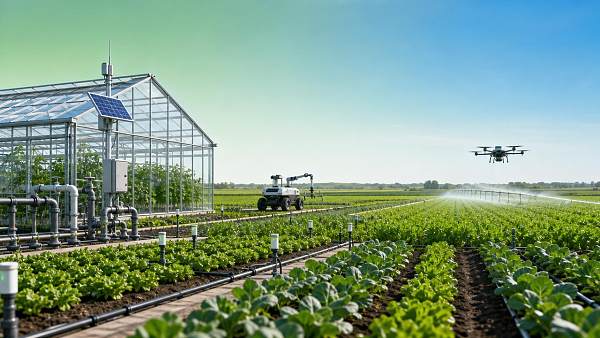
The pressure is coming from several directions at once. Water stress is intensifying, labor availability remains uneven, and crop planning is more exposed to climate volatility than many operating models assume.
At the same time, farms are generating more usable data than before. Machine telemetry, soil sensing, weather feeds, and satellite imagery now support decisions that used to depend mainly on experience and timing.
What changes in 2026 is not just technology maturity. It is the business expectation that agricultural operations should be measurable, auditable, and adaptable in the same way as other industrial assets.
This is where a cross-sector view becomes valuable. The same benchmarking logic applied to automotive systems, electronics quality, or water treatment modules increasingly applies to Smart Farming infrastructure.
A practical definition of Smart Farming
Smart Farming combines physical equipment, digital monitoring, and operational decision rules to improve agricultural performance with less waste and less uncertainty.
In practice, it often includes autonomous or assisted machinery, connected irrigation controls, field sensors, remote imaging, and software that converts raw signals into action plans.
The goal is not automation for its own sake. The goal is more precise use of water, fertilizers, labor, energy, and land while protecting output quality and planning reliability.
That is why Smart Farming should be read as an operating framework, not a single product category.
Automation is moving from pilot projects to core operations
Automation in Smart Farming is broadening beyond large machinery. It now includes route optimization, variable-rate application, irrigation scheduling, greenhouse control, and automated data capture across the crop cycle.
The key advantage is not simply reduced manual work. It is more consistent execution. Fields are treated at the right time, with fewer gaps between observation and response.
Autonomous tractors and implements get attention, but smaller automation layers often deliver faster returns. Examples include pump controls linked to moisture thresholds and spraying programs adjusted by field condition data.
What makes automation viable
Three conditions usually determine success: hardware durability, data interoperability, and a clear rule set for when systems act automatically and when human review is required.
Without those conditions, Smart Farming tools can create fragmented workflows rather than operational clarity.
- Durable field hardware reduces downtime and protects data continuity.
- Interoperable platforms prevent sensor, equipment, and software silos.
- Clear escalation rules keep automation aligned with agronomic judgment.
Water use is becoming the defining management metric
Water is no longer treated as a background input. In many regions, it is becoming the most strategic constraint in Smart Farming decisions.
That changes how irrigation systems are evaluated. Volume alone is not enough. The focus is moving toward timing precision, application uniformity, leakage control, and the ability to match water delivery to crop stage.
This is also where agriculture meets environmental infrastructure. Filtration, pumping efficiency, storage, reuse systems, and monitoring networks increasingly influence field performance as much as agronomy does.
A stronger water strategy often starts with visibility. Organizations need to know where water is used, where it is lost, and which zones consistently underperform despite similar input levels.
From irrigation schedules to water intelligence
In advanced Smart Farming models, water decisions are informed by live field conditions rather than fixed calendars. Soil moisture, evapotranspiration, weather risk, and crop stress indicators are combined into daily operating choices.
That approach lowers risk in two ways. It helps avoid over-irrigation during uncertain weather and reduces the hidden yield penalty caused by delayed watering.
Yield planning is becoming more predictive and more financial
Yield planning used to be largely seasonal. In 2026, Smart Farming is pushing it toward continuous forecasting linked to operations, procurement, and risk review.
This matters because yield is not only a farm output metric. It influences contract confidence, storage needs, logistics timing, hedging assumptions, and sourcing strategies across the value chain.
Better planning does not mean claiming perfect prediction. It means improving decision quality with better probabilities, earlier signals, and more disciplined scenario analysis.
What stronger yield planning looks like
The most useful Smart Farming systems connect field observations to operational consequences. If irrigation efficiency falls, or a disease signal rises, the planning model should reflect likely yield impact quickly.
That allows earlier adjustments in labor allocation, harvest windows, input deployment, and downstream supply commitments.
- Use rolling forecasts instead of single seasonal estimates.
- Tie agronomic indicators to commercial planning triggers.
- Track variance by field, zone, and crop stage.
- Separate normal fluctuation from equipment or water-related losses.
Where cross-sector benchmarking changes the discussion
One of the most overlooked aspects of Smart Farming is that it depends on industrial quality outside the field. Sensor reliability, electronics integration, mobility systems, filtration modules, and tooling precision all shape farm outcomes.
That is why platforms such as Global Industrial Matrix matter in this space. A cross-disciplinary view helps compare components and systems using technical benchmarks rather than marketing claims alone.
When agricultural equipment is assessed alongside standards-driven practices from electronics, automotive engineering, and environmental infrastructure, Smart Farming investments become easier to evaluate on lifecycle value.
This broader lens is especially useful when operations must balance uptime, compatibility, serviceability, and compliance across multiple suppliers.
Common operating scenarios in Smart Farming
Smart Farming does not look the same in every environment. The priorities depend on crop type, water access, field scale, and infrastructure maturity.
How to evaluate Smart Farming investments more carefully
A common mistake is to judge Smart Farming tools only by headline efficiency claims. The stronger approach is to examine operating fit, data quality, and system resilience.
Usually, the most practical questions are straightforward.
- Does the system solve a defined water, labor, or yield problem?
- Can its data connect with existing planning and reporting workflows?
- Are components benchmarked against credible technical standards?
- What happens when sensors fail, connectivity drops, or conditions shift?
- Is the payback driven by one season, or by multi-year resilience?
These questions help separate useful Smart Farming infrastructure from isolated digital add-ons that look modern but add limited operating value.
What to watch next
The next phase of Smart Farming will likely be defined by tighter integration. Equipment, agronomic models, water systems, and commercial planning tools are moving toward shared decision environments.
That makes 2026 a useful point for reassessment. The most effective next step is often not a full technology overhaul, but a clearer baseline of where automation, water visibility, and yield forecasting currently stand.
From there, it becomes easier to compare options, benchmark critical hardware, and build a Smart Farming roadmap that reflects real operating conditions rather than generic innovation targets.
A disciplined review of system compatibility, field data quality, and water performance can reveal where the strongest gains are likely to come first.

The Archive Newsletter
Critical industrial intelligence delivered every Tuesday. Peer-reviewed summaries of the week's most impactful logistics and market shifts.