Monday, May 22, 2024

When does smart irrigation for landscaping pay for itself?
by
Published
Views:
For a financial approver, smart irrigation for landscaping is not a technology purchase in search of a purpose. It is a controlled operating-cost decision. The question is not whether weather-based controllers, flow sensors, and remote management tools are useful. The question is whether their annual, verifiable savings exceed the added capital cost, subscription fees, maintenance, and implementation risk within an acceptable period.
The investment usually pays for itself when a site has one or more of the following conditions: meaningful outdoor water consumption, seasonal labor spent adjusting or inspecting irrigation, variable weather, recurring leaks or runoff, high-value plant material, or exposure to watering restrictions. A small property with inexpensive water and a simple manual timer may struggle to justify a sophisticated system. A multi-site commercial portfolio, campus, logistics facility, hospitality property, municipality, or industrial site often has a much stronger case—especially when water bills and landscape maintenance are managed by different teams and avoidable costs are hidden in separate budgets.
A defensible approval should turn those scattered costs into one measurable business case.
The payback question: what must smart irrigation actually save?
The basic calculation is straightforward:
Payback period = Total installed cost ÷ Annual net savings
Yet the quality of the result depends entirely on what is included in “annual net savings.” Water savings alone can understate the value of smart irrigation for landscaping; optimistic water-savings assumptions can just as easily overstate it. The most useful model captures both direct utility reductions and the operational costs that a better-controlled system can avoid.
Not every category should be monetized at the outset. If a benefit cannot be evidenced from invoices, work orders, meter records, or labor logs, treat it as a qualitative risk reduction rather than a guaranteed saving. That discipline makes the final proposal more credible with finance, procurement, and audit teams.
Where the economics become compelling
Smart irrigation produces its strongest return where the existing system waters by calendar rather than by actual demand. Fixed schedules often continue after rainfall, irrigate during cool periods, or apply the same duration to zones with different soil, sun exposure, slope, and plant types. The waste is not always dramatic on a single day. It accumulates quietly across an irrigation season.
Sites with large irrigated areas are obvious candidates, but scale is not the only driver. A smaller site can justify an upgrade when local water rates are high, when drought restrictions bring operational pressure, or when the landscaping is costly to replace. A healthcare campus, corporate headquarters, retail center, or premium residential development may place substantial value on appearance and visitor safety. In these settings, preventing a brown entrance landscape or a runoff issue can matter beyond the utility bill.
Conversely, a project may not yet be ready when irrigation zones are poorly mapped, valves and heads are near end of life, meters cannot isolate outdoor consumption, or no one owns the ongoing review of alerts. Automation placed on top of neglected infrastructure can make reporting easier, but it cannot repair broken hydraulics or poor design.
Build the baseline before asking for approval
A reliable return-on-investment model starts with a baseline period, preferably covering at least one full irrigation season. Pull monthly utility invoices and separate irrigation consumption from indoor or process water where possible. If the property has no dedicated irrigation meter, use controller run-time records, landscape contractor notes, and seasonal consumption patterns to create a documented estimate. State clearly where assumptions begin.
Then examine the rate structure. In many locations, marginal water use moves into higher billing tiers. Reducing consumption at the top tier may be worth more than a simple average-cost calculation suggests. Some properties also pay sewer charges based on water volume, while others exempt separately metered irrigation water. That distinction changes the economics materially.
Labor needs similar attention. Do not count every maintenance hour as recoverable. If a grounds crew remains on site regardless of controller upgrades, the benefit may be capacity released for higher-priority work, not an immediate payroll reduction. This is still valuable, but it should be presented honestly. Savings become more direct when a contractor’s visit frequency, troubleshooting hours, or after-hours callout fees can be reduced under the service agreement.
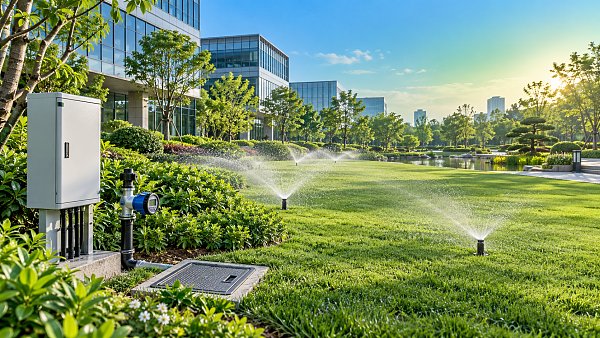
A practical ROI model for smart irrigation for landscaping
Once the baseline is established, model three cases rather than relying on a single forecast:
- Conservative case: modest water reduction, limited labor savings, full software and maintenance costs included.
- Expected case: savings based on local weather variability, audited runtime reductions, and credible repair avoidance.
- Stress case: lower-than-expected savings, a delayed rebate, or added repair work discovered during installation.
This approach is particularly useful for capital committees. It shows that the decision remains sound even if performance is not ideal, and it prevents the proposal from depending on the best possible weather year.
The installed-cost side should include more than controllers. Account for field surveys, design, controller hardware, flow meters or sensors, communications gateways, valve or wiring repairs required for integration, commissioning, staff training, software fees, and contingency. If the system requires cellular connectivity or a cloud platform, include the recurring cost over the evaluation period. A five-year total cost of ownership view is generally more useful than an installation-only price comparison.
For larger portfolios, calculate both site-level and portfolio-level returns. A central platform may have fixed costs that appear uneconomic at one location but become efficient when spread across multiple properties. At the same time, do not assume every site should receive the same specification. A high-visibility, water-intensive campus may warrant flow sensing and granular control; a low-risk secondary site may need only a weather-responsive controller and a zone audit.
Use local climate data, not generic savings claims
Weather intelligence is one reason smart irrigation can outperform conventional scheduling, but it is also an area where vague claims create weak business cases. The relevant inputs are local rainfall patterns, temperature, evapotranspiration, soil type, plant material, slope, shade, and seasonal operating windows. A system that merely pauses after rainfall is not equivalent to one that adjusts irrigation demand by zone and conditions.
For approval purposes, ask suppliers and landscape contractors how their recommendation handles these variables. Can schedules be adjusted by hydrozone? Does the platform use on-site sensors, local weather feeds, or both? How does it respond when connectivity is lost? Is there a manual override? Can the owner export run-time, alert, and water-use data?
These questions are not technical formalities. They determine whether the expected savings can be verified after deployment. If a vendor cannot explain the data path from field event to management report, the finance team will have difficulty proving results—or identifying why results fell short.
Rebates can improve payback, but should not rescue a weak project
Utilities, municipalities, and water districts may offer rebates for qualified controllers, rain sensors, flow monitoring, or irrigation retrofits. These incentives can shorten the payback period substantially, particularly where conservation targets are strict. Still, a rebate should be treated as conditional until eligibility, application timing, equipment requirements, and inspection rules are confirmed in writing.
A prudent approval model shows payback both before and after incentives. If the project only works with a rebate, decision-makers should be comfortable with the possibility of delay or denial. Also check whether the incentive requires baseline records, pre-approval, specified product listings, or post-installation verification. Missing an administrative step can erase a benefit that was assumed in the budget.
The overlooked value: fewer surprises in the landscape budget
The appeal of smart irrigation is not limited to lower consumption. It can make a historically unpredictable expense category more manageable. A flow anomaly alert, for example, may flag a rupture before it becomes a multi-day water loss or a saturated walkway. Remote visibility can reveal that a zone has not operated for weeks, even when the landscape problem is not yet visible from the street.
That said, alerts are only valuable when someone is assigned to receive and act on them. A common procurement mistake is to buy monitoring without defining response ownership. The contract should specify who investigates alarms, expected response times, escalation procedures, and whether the landscape service provider has access to the platform. Otherwise, the organization pays for intelligence but leaves the operational loop open.
For financial approvers, this is an important distinction: risk reduction becomes economically meaningful when it is paired with an accountable process.
Questions to put into the procurement file
Before signing off, request a proposal that can answer the following without broad promises:
- What is the current annual irrigation water use, and how was it measured or estimated?
- Which utility rate and marginal cost assumptions are used in the model?
- What equipment is included, and what existing deficiencies must be corrected separately?
- Which savings come from water, labor, avoided repairs, or landscape preservation?
- Which benefits are measurable within the first year, and which are only risk-based estimates?
- What annual platform, connectivity, calibration, and maintenance costs will remain after installation?
- Who owns the data, who receives alerts, and how will performance be reviewed?
- What happens if a controller, sensor, communications link, or weather feed fails?
It is also sensible to require a post-installation verification period. Compare water use against the established baseline while adjusting for weather and any major change in landscaped area. Review alert history, manual overrides, repairs, and contractor labor. The purpose is not to punish a supplier for every variance; it is to confirm that the operating model is functioning and to tune schedules before waste becomes normalized again.
When should the investment be approved?
Smart irrigation for landscaping is generally ready for approval when the project has a measured baseline, a transparent total-cost estimate, an implementation owner, and a payback that remains acceptable under conservative assumptions. It is especially persuasive when the site faces high water costs, recurring irrigation failures, labor-intensive management, or visible drought and compliance exposure.
If those foundations are missing, the best next step may be a site audit, meter strategy, or pilot at the highest-consumption location rather than a full rollout. A pilot can establish actual usage patterns, test supplier responsiveness, and create a benchmark for a broader capital plan.
For organizations managing complex assets across sectors, the broader lesson is familiar: data creates value only when it supports a decision. Global Industrial Matrix approaches infrastructure benchmarking through that lens—connecting technical performance, operational evidence, and procurement risk rather than treating equipment selection as an isolated purchase. In irrigation, that means approving the level of automation the property can use, maintain, and verify.
The system pays for itself when it turns uncontrolled water use and reactive landscape maintenance into measurable, repeatable savings. The most credible investment case does not promise a perfect lawn or a dramatic percentage reduction. It demonstrates, line by line, why better irrigation control costs less than continuing to manage uncertainty.

The Archive Newsletter
Critical industrial intelligence delivered every Tuesday. Peer-reviewed summaries of the week's most impactful logistics and market shifts.