Monday, May 22, 2024

When does sustainable energy for agriculture pay back on farms?
by
Published
Views:
When Does Sustainable Energy for Agriculture Pay Back on Farms?
When does sustainable energy for agriculture become a measurable business advantage rather than a long-term ambition? For farm operators, investors, and industrial decision-makers, the answer depends on energy costs, equipment utilization, incentives, grid reliability, and operational scale. From solar-powered irrigation to biogas systems and electrified machinery, the practical payback question is less about choosing the greenest technology and more about matching an energy asset to a repeatable farm load.
A farm does not consume energy in the same way as a warehouse or factory. Demand can be seasonal, weather-dependent, highly concentrated around irrigation or harvest, and exposed to volatile fuel prices. That makes simple capital-cost comparisons misleading. A photovoltaic system with strong annual generation may still produce a weak financial outcome if pumping demand occurs outside its production window, export compensation is limited, or the farm cannot maintain the controls and electrical equipment required to use the energy effectively.
The projects that pay back most convincingly tend to solve an operating problem already visible in the farm’s cost base: expensive diesel pumping, recurring grid outages, high demand charges, unmanaged manure, or equipment that must operate at fixed and predictable intervals. Clean energy is then not an isolated sustainability purchase. It becomes part of water management, machinery planning, waste handling, and production continuity.
Payback Starts with the Load Profile, Not the Technology
Procurement teams often begin by requesting prices for solar panels, batteries, biogas digesters, or electric tractors. The more useful first step is to map where, when, and why energy is used. At minimum, that means separating irrigation, refrigeration, ventilation, drying, feeding, processing, workshops, housing, and charging loads. Monthly utility bills provide a starting point, but they rarely show the hourly pattern that determines self-consumption and battery value.
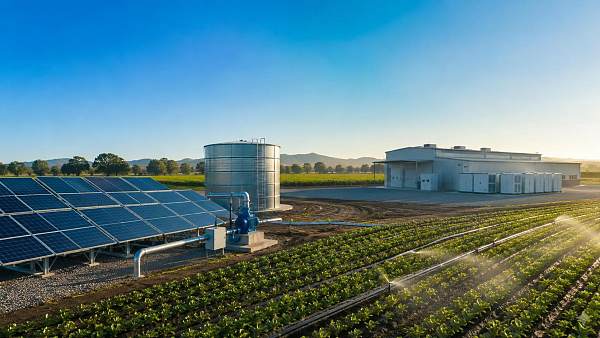
Consider irrigation. A solar-powered pump can be a sensible investment where water demand is high during sunny periods, pumping head is understood, and storage can shift water rather than electricity. In many cases, a reservoir or elevated storage tank is economically simpler than a large battery because it stores the useful output directly: water delivered at the required pressure and volume. Yet this logic changes where irrigation must occur after sunset, water rights constrain pumping hours, or the system needs a dependable response during prolonged cloudy periods.
The same principle applies to cold storage. Solar generation may offset daytime refrigeration load, but cooling systems operate around the clock and cannot be treated as flexible by default. Thermal storage, improved insulation, variable-speed drives, and control upgrades may reduce the size of the energy system required. A buyer evaluating sustainable energy for agriculture should therefore ask whether demand can be shifted, stored, reduced, or scheduled before deciding that electrical storage is necessary.
A good feasibility review identifies the “must-run” load, the “moveable” load, and the load that can be eliminated through efficiency measures. The distinction is operationally important. A system designed around average annual consumption may look attractive in a spreadsheet but fail to protect the farm during the hours when power is genuinely critical.
What Actually Determines the Financial Return
The relevant return is not simply energy generated multiplied by an assumed utility rate. It is the value of avoided costs, additional operating resilience, maintenance obligations, financing expense, replacement cycles, and any revenue or disposal cost associated with by-products. Some of these elements are straightforward; others require conservative assumptions.
Fuel displacement deserves particular care. A diesel-powered irrigation system may appear to offer an immediate opportunity, but the comparison should include the complete operating chain: fuel delivery, engine maintenance, idling, pump efficiency, seasonal access, and the cost of downtime. Conversely, an electrified alternative may introduce new requirements for transformer capacity, power quality, cable routing, switchgear protection, and controls. The energy source is only one component of the cost model.
Financing also changes the answer. A technically viable project may not meet an organization’s return threshold if borrowing costs, currency exposure, or uncertain incentives dominate the model. Incentives can improve a project’s economics, but prudent buyers should test the investment without assuming a grant will arrive on time or remain available. Regulatory eligibility, commissioning dates, local-content rules, and interconnection approvals can all affect whether projected support is realized.
Different Farm Energy Systems Pay Back in Different Ways
Solar is often the first option considered because its operating concept is familiar and modular. It tends to fit farms with a clear daytime electrical load, usable roof or land area, and grid arrangements that reward self-consumption or permit export under known conditions. But solar is not automatically an irrigation solution, a resilience solution, and a decarbonization solution at the same time. Each objective can require a different design.
Battery storage can increase self-use, provide limited backup, smooth generator operation, or support sensitive equipment. Its value is strongest when it solves a defined problem: expensive peak demand, short but costly interruptions, restricted grid capacity, or a need to charge equipment during lower-cost periods. Buying storage merely to maximize renewable-energy percentages can lead to a capital-heavy system with insufficient cycling. Battery procurement should include usable capacity, power rating, thermal management, control strategy, warranty conditions, and end-of-life responsibilities—not only nameplate capacity.
Biogas deserves a more site-specific evaluation. Livestock operations with consistent organic feedstock may be able to integrate manure management, energy production, and nutrient handling. However, digesters are process facilities, not passive power assets. Feedstock consistency, pre-treatment, mixing, temperature control, gas cleaning, digestate storage, emissions management, permitting, and operator discipline shape the result. Where those conditions are not stable, a biogas proposal can be more operationally demanding than the initial business case suggests.
Electrified machinery is another area where the headline technology can distract from the system requirement. A farm considering electric utility vehicles, autonomous equipment, or charging infrastructure needs to assess duty cycle, terrain, towing or hydraulic demands, charging windows, depot design, and local service capability. For some applications, predictable routes and repeated daily use support electrification. For heavy seasonal work with sparse charging access, the operating model may not yet justify a broad fleet transition.
Avoid the “Cheapest Quote” Trap
The lowest equipment price is not necessarily the lowest delivered cost. Agricultural sites are exposed to dust, heat, moisture, corrosive environments, rodents, lightning, inconsistent communications, and operators who cannot wait days for a specialist technician during a narrow harvest window. Design quality and support coverage are therefore commercial issues, not engineering luxuries.
Tender documents should define the site conditions and acceptance criteria clearly. Relevant questions include the expected operating temperature range, enclosure requirements, corrosion exposure, grid characteristics, water quality where pumps are involved, remote-monitoring expectations, alarm ownership, and performance testing methods. Where equipment crosses sectors—such as electric drivetrains, industrial inverters, precision controls, and farm automation—buyers should verify which standards apply to each subsystem rather than accepting broad claims of compliance.
This is where cross-sector benchmarking is useful. Global Industrial Matrix approaches agricultural energy as part of a connected industrial system: power electronics affect charging reliability; mobility engineering affects vehicle duty cycles; water infrastructure affects pumping demand; and environmental controls shape operating risk. Comparing hardware and suppliers against relevant international frameworks, including ISO, IATF, or IPC where applicable to the component and supply chain, helps procurement teams distinguish a documented technical basis from a generic specification sheet.
That does not replace local engineering, utility review, or agricultural expertise. It does make the procurement conversation more disciplined. A photovoltaic supplier may understand generation, while an irrigation contractor understands hydraulics; the project succeeds when both systems are evaluated together. The same is true for automated tractors, cold-chain equipment, filtration modules, and distributed energy controls.
A More Defensible Investment Decision
A farm energy project is usually ready to move forward when the baseline has been measured, the load can be explained, the technical boundary is clear, and the savings case still holds under less favorable assumptions. That means testing lower-than-expected generation, delayed interconnection, higher maintenance, variable crop output, fuel-price changes, and equipment downtime. If the project only works under a perfect scenario, it is not yet a robust procurement decision.
The strongest projects also have an accountable operating model. Someone must own monitoring, maintenance scheduling, fault escalation, utility coordination, and performance review after commissioning. A farm may outsource much of this work, but it should not outsource visibility into it. Metering and control data should be accessible enough to confirm whether the system is producing savings where the business case expected them.
Sustainable energy for agriculture pays back when it is designed around a farm’s actual constraints: water, labor, weather, fuel logistics, grid quality, and production timing. Before approving capital, decision-makers should confirm the load profile, infrastructure interfaces, lifecycle obligations, supplier support model, and the assumptions behind every avoided-cost claim. Those details determine whether an energy asset remains a promising concept or becomes a durable part of farm operations.

The Archive Newsletter
Critical industrial intelligence delivered every Tuesday. Peer-reviewed summaries of the week's most impactful logistics and market shifts.