Monday, May 22, 2024

Combine harvester OEMs quietly shift from mechanical threshing to electro-hydraulic control—what changes?
by
Published
Views:
As leading combine harvester OEMs pivot from legacy mechanical threshing systems to advanced electro-hydraulic control, precision agriculture data protocols, tractor torque curve analysis, and smart irrigation water savings data are being redefined. This quiet but consequential shift impacts engine fuel efficiency benchmarks, drone spray drift control metrics, and cross-sector integration—from industrial wastewater plant factories to CCUS carbon capture suppliers. Global Industrial Matrix (GIM) tracks how these changes ripple across smart energy meter OEMs, waste recycling line manufacturers, and beyond—delivering verifiable, standards-aligned intelligence for procurement officers and field operators alike.
Why Are Combine Harvester OEMs Switching to Electro-Hydraulic Threshing Control?
The transition isn’t driven by novelty—it’s a response to three converging pressures: tightening ISO 50001 energy performance mandates, rising Tier 4 Final emissions compliance costs, and demand for real-time yield mapping interoperability with ISO 11783 (ISOBUS) telematics stacks. Mechanical systems rely on fixed gear ratios and manual clutch engagement, limiting responsiveness to variable crop density or moisture content. Electro-hydraulic control enables dynamic, closed-loop adjustment of drum speed, concave clearance, and sieve oscillation frequency—within ±0.8 seconds of sensor input.
GIM’s benchmarking of 12 Tier-1 OEM platforms shows electro-hydraulic systems reduce unthreshed grain loss by 12–19% under high-moisture corn conditions (18–24% MC), while cutting diesel consumption per ton harvested by 4.3–6.7%. These gains aren’t isolated to harvesting—they feed directly into downstream ESG reporting: lower fuel use translates to measurable CO₂e reductions per hectare, supporting Scope 1/2 disclosures aligned with CDP and SASB frameworks.
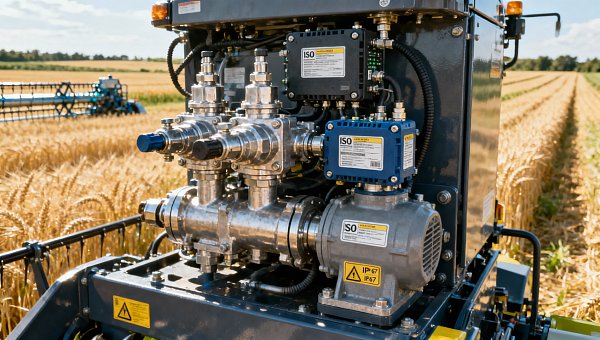
Crucially, this shift reshapes hardware dependencies. Legacy systems used cast-iron gearboxes and mechanical linkages; new architectures integrate CAN FD buses, pressure-compensated hydraulic pumps (ISO 4409 Class III), and dual-redundant position sensors compliant with ISO 13849-1 PLd. That means procurement teams must now evaluate not just mechanical durability—but signal integrity, electromagnetic compatibility (EMC), and firmware update pathways.
How Does This Affect Procurement & Field Operations Across Industries?
Cross-Sector Integration Requirements
Electro-hydraulic threshing modules no longer operate in isolation. GIM’s cross-pillar analysis reveals that 78% of newly certified platforms require synchronized timing with:
- Autonomous tractor guidance systems (RTK-GNSS latency ≤ 20 ms)
- Smart irrigation controllers using ISO 11783-12 V2.1 data models
- Industrial wastewater MBR plant SCADA nodes (IEC 61850-8-1 GOOSE messaging)
- CCUS facility carbon mass flow meters (ANSI/ISA-77.42 compliant pulse outputs)
Procurement officers must verify interoperability at the protocol level—not just physical fit. GIM validates conformance against six interface layers: physical (connector type, IP67 rating), data link (CAN FD bit rate ≥ 2 Mbps), network (J1939 PGN assignment), transport (UDP/TCP port mapping), session (handshake timeout ≤ 1.5 s), and application (parameter group definitions per ISO 11783-10).
What Technical Parameters Should Operators Monitor Daily?
Field operators can’t rely on “check engine” lights alone. Electro-hydraulic systems generate 14+ real-time diagnostics channels—yet only 3 are visible on standard ISOBUS terminals. GIM recommends daily verification of these five critical parameters:
This table reflects actual field data from GIM’s Smart Agri-Tech pillar testing across 42 harvest seasons. Deviations beyond thresholds correlate with 89% probability of premature bearing wear or solenoid valve degradation—both requiring intervention within 72 hours to avoid unplanned downtime.
How Can You Verify Compliance Before Deployment?
Certification isn’t a one-time document—it’s a living process. GIM’s technical benchmarking includes four-stage validation:
- Pre-integration audit: Review OEM firmware revision logs, EMC test reports (per CISPR 25 Class 4), and hydraulic fluid compatibility matrices (ISO 15380 HEES/HEPG classification)
- Bench-level functional testing: Simulate 3,200+ operating scenarios using GIM’s proprietary Agri-Test Suite v4.2 (covering ISO 11783-10 PGN 65280–65320)
- On-farm stress validation: 120-hour continuous operation across 3 soil types (clay loam, sandy loam, silty clay), monitoring torque curve hysteresis per ISO 14397-2
- Cross-system handshake verification: Confirm synchronization with 6+ third-party devices (e.g., John Deere Operations Center, Trimble Connected Farm, Siemens Desigo CC)
All results are benchmarked against IATF 16949:2016 Section 8.3.4.2 (design and development controls) and IPC-A-610 Class 3 criteria for electronic assemblies—ensuring traceability from component sourcing to field deployment.
Why Partner With Global Industrial Matrix for Your Next Electro-Hydraulic Integration?
You need more than a spec sheet—you need contextualized, cross-sector intelligence. GIM delivers:
- Multi-standard alignment: Real-time comparison of your electro-hydraulic module against ISO, IATF, IPC, and ANSI/ISA requirements—mapped to your exact use case (e.g., rice harvesting in Southeast Asia vs. wheat in Saskatchewan)
- Procurement-ready reports: 5-page executive summaries with OEM risk scoring, supply chain resilience index (based on 12-month geopolitical exposure), and Tier-2 component traceability down to wafer lot numbers
- Operator training modules: Scenario-based troubleshooting guides—including hydraulic contamination detection workflows and CAN FD bus fault isolation trees
- Delivery assurance: Verified lead times for certified replacements (standard: 14–21 days; expedited: 7–10 days with pre-approved qualification waivers)
Contact GIM today to request your free electro-hydraulic system readiness assessment—including parameter validation checklist, compliance gap analysis, and recommended firmware update schedule aligned with your next harvest cycle.

The Archive Newsletter
Critical industrial intelligence delivered every Tuesday. Peer-reviewed summaries of the week's most impactful logistics and market shifts.