Monday, May 22, 2024

HDI PCB Factory China Supplier: Key Checks Before RFQ
by
Published
Views:
Choosing an hdi pcb factory china supplier is not just a cost exercise. It directly affects RF integrity, yield stability, compliance readiness, and long-term supply resilience.
Before issuing an RFQ, technical validation should come first. Stack-up capability, material control, drilling accuracy, and communication discipline often decide project success.
In cross-sector manufacturing, advanced boards support telecom devices, automotive modules, medical electronics, industrial control systems, and smart infrastructure. That is why supplier checks must be structured and evidence-based.
What an HDI PCB Factory China Supplier Must Demonstrate
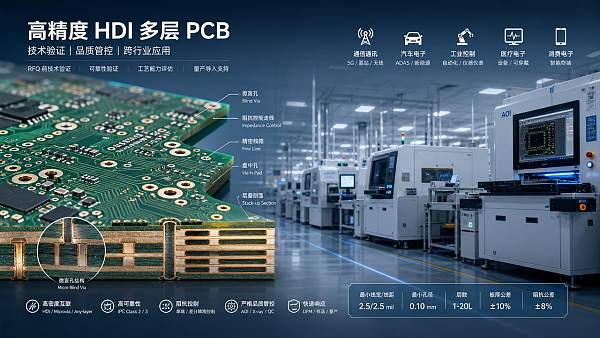
An hdi pcb factory china supplier should prove more than basic multilayer production. HDI boards require fine lines, microvias, sequential lamination, and tight impedance consistency.
For RF-related designs, dielectric stability and copper profile matter as much as nominal dimensions. Small process variation can shift insertion loss or impedance out of target.
Key technical indicators usually include:
- Minimum trace and space capability
- Laser microvia diameter and aspect ratio
- Sequential lamination cycle control
- Impedance modeling and coupon testing
- Material traceability by lot and date code
- AOI, X-ray, microsection, and reliability validation
A qualified hdi pcb factory china supplier should also show familiarity with mixed-demand programs. Many projects combine RF, digital control, thermal management, and mechanical constraints in one board.
Industry Signals Driving Tighter Supplier Qualification
Across the broader industrial landscape, HDI sourcing has become more sensitive. Product miniaturization, higher frequencies, and platform integration have reduced tolerance for process drift.
Global qualification standards are also moving upward. ISO systems are expected, while IPC conformance and sector-specific requirements increasingly shape approval decisions.
These trends make a capable hdi pcb factory china supplier a strategic technical partner, not only a board fabricator.
Core Technical Checks Before Sending an RFQ
The most effective RFQ preparation starts with verifiable checkpoints. This reduces quotation noise and highlights whether the supplier can build the design repeatedly.
1. Stack-up and material compatibility
Ask whether the proposed stack-up has already been manufactured with similar layer counts, resin systems, and copper weights. Proven builds usually reduce NPI risk.
For RF projects, confirm laminate brands, dielectric tolerance, glass style, and expected loss performance. Equivalent substitution policies should be documented in advance.
2. Microvia and sequential lamination control
A reliable hdi pcb factory china supplier should provide limits for stacked or staggered vias, fill quality, registration performance, and laser drilling consistency.
Request cross-sections from similar builds. Microsection evidence often reveals whether the factory controls via wall quality and interconnect reliability.
3. RF and impedance verification
Impedance control should include modeling assumptions, coupon location, test method, and tolerance window. RF boards need more than a simple nominal impedance promise.
If insertion loss is critical, ask for roughness management details, foil type, and process controls affecting conductor profile.
4. Surface finish and assembly interface
Finish selection affects solderability, contact performance, and signal behavior. ENIG, ENEPIG, immersion silver, and OSP should match the assembly and use environment.
Ask how the supplier manages shelf life, oxidation risk, and finish thickness consistency across production lots.
5. DFM response quality
The best sign of competence is a precise pre-quote engineering review. Clear comments on annular ring, solder mask, panelization, and impedance assumptions are highly valuable.
Quality, Compliance, and Traceability Review
Technical capability without quality discipline creates hidden risk. A strong hdi pcb factory china supplier should support audits with records, not only certificates.
Important items to verify include:
- ISO 9001 and, where relevant, IATF 16949 or ISO 13485 alignment
- IPC workmanship criteria used for acceptance
- RoHS, REACH, and conflict minerals declarations
- Lot-level traceability from laminate to final shipment
- CAPA process and 8D response discipline
- Reliability testing such as thermal stress and IST, if applicable
Traceability matters across sectors. Electronics often feed larger assemblies in mobility, automation, environmental systems, and connected infrastructure. One undocumented material change can affect entire platforms.
Application Value Across Industrial Programs
Selecting the right hdi pcb factory china supplier improves more than board yield. It supports schedule accuracy, field reliability, and cross-functional decision confidence.
This broader value aligns with GIM’s cross-sector benchmarking approach. Verified manufacturing data helps compare suppliers against technical, operational, and compliance thresholds in a unified way.
Practical RFQ Preparation Checklist
A well-prepared package improves quotation accuracy and supplier response quality. It also makes capability gaps visible earlier.
- Provide Gerber or ODB++, drill data, stack-up, and impedance targets.
- State laminate preferences, approved alternates, and controlled finish options.
- Define special notes for RF paths, via structures, and copper balancing.
- Request DFM comments, lead time split, and test method disclosure.
- Ask for sample reports: microsection, impedance, and final inspection records.
- Clarify change notification rules for material, process, or subcontracted steps.
When reviewing replies, compare evidence quality, not just quoted price. A lower quote from an unproven hdi pcb factory china supplier can create far higher total cost later.
Next-Step Evaluation Framework
Shortlisting should combine technical fit, compliance maturity, response speed, and supply continuity. Site audit results, sample builds, and engineering dialogue usually provide the clearest ranking signals.
For any hdi pcb factory china supplier, the most useful next step is a structured pre-RFQ review. Validate capability claims against documents, test records, and real build history.
Using a benchmark-driven method helps reduce uncertainty. It also supports better sourcing decisions for RF, automotive, industrial, and infrastructure electronics that depend on HDI performance.
If the goal is reliable qualification, start with measurable checks, align them to application risk, and treat supplier selection as an engineering decision as much as a commercial one.

The Archive Newsletter
Critical industrial intelligence delivered every Tuesday. Peer-reviewed summaries of the week's most impactful logistics and market shifts.