Monday, May 22, 2024

MIIT Approves Export Certification for Domestic AI-Powered CNC Tool Inspection System
by
Published
Views:
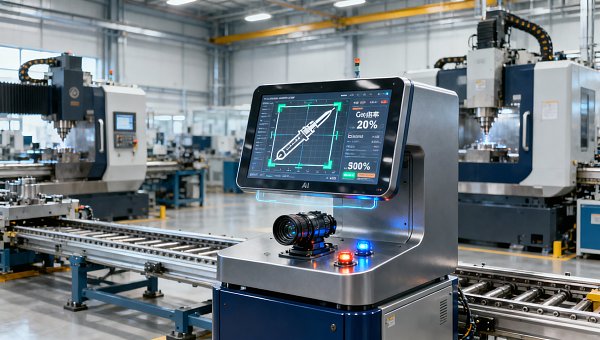
On May 10, 2026, China’s Ministry of Industry and Information Technology (MIIT) issued the third edition of its Recommended Directory for Intelligent Manufacturing Equipment Exports, granting export certification to a domestically developed AI visual inspection system for CNC tools. This marks the first inclusion of an AI-based quality inspection solution compliant with ISO/IEC 23053:2025 — the newly published international standard for functional safety of industrial AI systems. The certification is recognized by TÜV Rheinland (Germany) and UL (USA), and is particularly relevant for enterprises in precision machining, electronics manufacturing, and industrial automation.
Event Overview
On May 10, 2026, MIIT publicly listed the AI visual inspection system based on SMT Precision Metrics — featuring a high-accuracy AOI calibration module and a real-time SPC feedback engine — in its third Recommended Directory for Intelligent Manufacturing Equipment Exports. The system has been confirmed to meet the requirements of ISO/IEC 23053:2025 for functional safety of industrial AI systems. This certification has been mutually acknowledged by TÜV Rheinland and UL.
Impact on Specific Industry Segments
Original Equipment Manufacturers (OEMs) in Precision Machining
OEMs integrating CNC tooling into production lines may face revised qualification expectations when exporting machinery to EU or U.S. markets. Compliance with ISO/IEC 23053:2025 is increasingly referenced in technical tenders and procurement clauses for smart factory equipment — especially where AI-driven quality assurance is embedded.
Electronics Contract Manufacturers (ECMs) and SMT Line Operators
For companies operating surface-mount technology (SMT) production lines, this certification signals growing alignment between domestic AI inspection tools and globally accepted safety benchmarks. It may reduce validation overhead when deploying such systems in multinational facilities — particularly where dual-certification (e.g., TÜV + UL) is contractually required.
Industrial AI Solution Providers and System Integrators
Vendors developing or bundling AI-powered visual inspection modules must now treat ISO/IEC 23053:2025 as a de facto design benchmark for export-ready products. The MIIT listing does not constitute automatic market access, but serves as a formal signal that conformance to this standard is being institutionalized in China’s export support framework.
What Enterprises and Practitioners Should Monitor and Do Now
Track official updates to the Recommended Directory and related MIIT implementation guidance
The current listing is part of a voluntary recommendation mechanism. Analysis shows that future editions may introduce tiered compliance tiers (e.g., ‘basic’, ‘enhanced’) or link eligibility to specific test reports — making it essential to monitor MIIT’s follow-up notices and supporting documents.
Assess applicability to key export markets and product categories
While TÜV Rheinland and UL recognition supports entry into EU and U.S. markets, ISO/IEC 23053:2025 adoption remains nascent outside conformity assessment bodies. Observably, early adopters are concentrated in automotive electronics and medical device manufacturing — sectors where functional safety traceability is already mandated. Companies should prioritize alignment where AI decision logic directly affects process yield or product safety.
Distinguish policy signaling from operational readiness
This certification reflects regulatory endorsement of technical conformance — not automatic regulatory approval for use in all jurisdictions. From industry perspective, it is more accurately interpreted as a harmonization milestone than a market access license. Enterprises should verify whether local import regulations (e.g., EU Machinery Regulation Annex I, U.S. FDA software validation expectations) impose additional requirements beyond ISO/IEC 23053:2025.
Review supplier documentation and integration protocols
Manufacturers sourcing AI inspection modules should request evidence of full clause-by-clause mapping to ISO/IEC 23053:2025 — including documentation of hazard analysis, failure mode mitigation, and human-AI interaction safeguards. Current more appropriate action is to update internal procurement checklists to include these verification points, especially for systems deployed in validated production environments.
Editorial Perspective / Industry Observation
This development is best understood as a coordinated signal — rather than an immediate operational shift. Analysis shows MIIT’s inclusion reflects both technical maturity in domestic AI inspection systems and strategic alignment with emerging global norms for trustworthy industrial AI. However, ISO/IEC 23053:2025 itself entered force only in early 2025; widespread regulatory referencing is still evolving. Therefore, the listing is more indicative of directionality than comprehensive implementation. Industry needs sustained observation — particularly regarding how national accreditation bodies interpret and enforce the standard in real-world audits and type examinations.
It is also notable that this is the first time an AI-based quality inspection system has entered the directory — suggesting a deliberate expansion of the scope beyond hardware-centric智能制造装备. That shift warrants attention from developers previously focused solely on mechanical or mechatronic certifications.
Overall, the event underscores a broader trend: functional safety frameworks for AI are transitioning from theoretical standards to tangible compliance pathways — albeit incrementally and with jurisdiction-specific nuances.
Conclusively, this certification does not alter existing export procedures overnight, nor does it guarantee preferential treatment in foreign markets. Rather, it formalizes a technical baseline that aligns domestic innovation with internationally recognized safety expectations for industrial AI. For stakeholders, the current interpretation should emphasize preparedness — not presumption — and prioritize verifiable conformance over symbolic recognition.
Source: Ministry of Industry and Information Technology (MIIT) of the People’s Republic of China — Third Edition of the Recommended Directory for Intelligent Manufacturing Equipment Exports, published May 10, 2026. Recognition status confirmed via public statements from TÜV Rheinland and UL. Note: Ongoing monitoring is advised for updates to MIIT’s implementation guidelines and national interpretations of ISO/IEC 23053:2025.

The Archive Newsletter
Critical industrial intelligence delivered every Tuesday. Peer-reviewed summaries of the week's most impactful logistics and market shifts.