Monday, May 22, 2024

NVIDIA's China Market Share at Zero: Impact on SMT Equipment & GPU Supply Chain
by
Published
Views:
Industry insiders are observing a pivotal shift in the industrial AI chip landscape following Jensen Huang’s public statement that NVIDIA’s market share in China has dropped to zero — a development with direct implications for SMT (Surface Mount Technology) equipment manufacturers, precision metrology solution providers, and global electronics assembly supply chains. Though no specific date was disclosed, the remark signals accelerated adoption of domestic GPU alternatives in mission-critical industrial vision applications, particularly in high-speed, sub-micron solder-joint inspection.
Event Overview
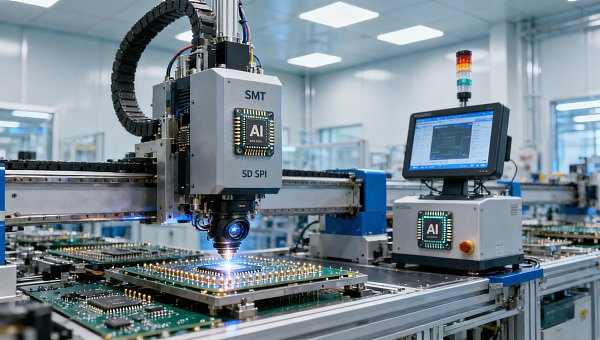
Jensen Huang, CEO of NVIDIA, stated publicly that the company’s market share in China is now ‘zero’. This statement corroborates verified industry reports confirming that leading Chinese AI chips have replaced imported GPUs in industrial vision systems used for SMT precision metrics detection — including real-time image processing for solder paste inspection and fine-pitch component alignment. These domestically developed chips have passed joint IPC/JEDEC qualification testing and support up to 200 MP/s image throughput and sub-micron-level solder-joint recognition accuracy.
Industries Affected
Direct Trade Enterprises (SMT Equipment Exporters)
Export-oriented SMT equipment vendors face reduced technical objections from overseas buyers concerning supply chain continuity. With domestic AI chips now validated under IPC/JEDEC standards, equipment incorporating them no longer carries the same import-chip dependency risk — potentially easing compliance reviews and shortening procurement cycles in regulated markets such as EU and ASEAN.
PCB Assembly & EMS Providers
Contract manufacturers relying on automated optical inspection (AOI) and 3D solder paste inspection (SPI) systems must evaluate compatibility and performance parity between legacy GPU-accelerated platforms and new domestic chip-based solutions. Sub-micron recognition capability and sustained 200 MP/s throughput are critical for high-density packaging lines; migration decisions hinge on firmware integration timelines and calibration reproducibility.
SMT Component & Metrology System Integrators
Suppliers embedding vision algorithms into placement machines, reflow ovens, or inline inspection stations need to assess hardware abstraction layers (HAL) and SDK support from domestic AI chip vendors. Interoperability with existing IPC-compliant communication protocols (e.g., IPC-CFX) and real-time deterministic latency remain key validation criteria — not just raw compute specs.
What Enterprises and Practitioners Should Focus On
Monitor official IPC/JEDEC test documentation updates
While joint certification has been confirmed, the exact test conditions (e.g., temperature range, board types, defect libraries used) are not yet publicly detailed. Enterprises deploying these chips in Class III or automotive-grade production lines should track formal release notes from IPC or JEDEC working groups for traceable compliance evidence.
Evaluate algorithm porting effort across chip architectures
Domestic AI chips supporting SMT vision workloads use varying memory bandwidth models and tensor acceleration units. Teams should benchmark inference latency and thermal throttling behavior using actual SPI/AOI pipelines — not synthetic benchmarks — before committing to full-line upgrades.
Assess supply chain resilience beyond silicon alone
A shift to domestic GPUs reduces exposure to export controls on compute hardware, but does not eliminate dependency on foreign-origin tools (e.g., EDA software, camera sensors, or optical calibration standards). Procurement planning should include dual-sourcing strategies for all Tier-1 components interfacing with the AI accelerator.
Editorial Perspective / Industry Observation
Observably, Huang’s ‘zero share’ comment functions less as a quantitative metric and more as a symbolic inflection point — reflecting the completion of functional substitution in a narrow but high-stakes application segment: real-time, precision metrology for SMT. Analysis shows this is not yet broad-based displacement across AI training or data center use cases, but rather a targeted, standards-validated replacement in embedded industrial vision. From an industry perspective, this milestone matters most because it shifts buyer risk calculus — reducing perceived vulnerability to geopolitical supply shocks in a domain where uptime and measurement traceability are non-negotiable. It is best understood not as an endpoint, but as a threshold enabling further localization in adjacent stack layers (e.g., vision middleware, calibration firmware).
Conclusion
This development signifies a structural adjustment in the industrial AI hardware supply chain — one anchored in verifiable technical qualification rather than policy-driven substitution alone. For stakeholders, it underscores that ‘localization’ is now measurable via standardized benchmarks (IPC/JEDEC), not just national strategy documents. Current understanding should emphasize capability validation over volume metrics: the priority is not how many chips are shipped, but whether they meet the throughput, accuracy, and interoperability thresholds required for certified electronics manufacturing.
Source Attribution
Main source: Public statement by Jensen Huang (NVIDIA CEO); confirmed IPC/JEDEC joint test results for domestic AI chips in SMT precision metrics applications. Note: Exact timing of Huang’s remark and full test report details remain pending official publication and are subject to ongoing verification.

The Archive Newsletter
Critical industrial intelligence delivered every Tuesday. Peer-reviewed summaries of the week's most impactful logistics and market shifts.