Monday, May 22, 2024

Starway EX7 Launches with Falcon-700 ADAS; SMT Precision Metrics Passes Overseas Automotive Validation
by
Published
Views:
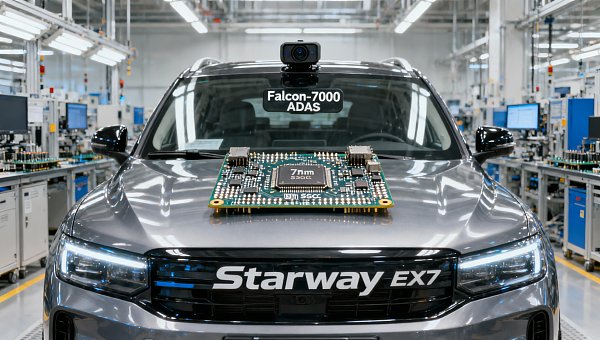
On April 19, 2026, Starway officially launched the EX7 SUV—its first model featuring the domestically developed Falcon-700 intelligent driving assistance system. The vehicle’s domain controller integrates a Chinese-made 7nm automotive-grade SoC, assembled by a leading domestic SMT contract manufacturer that completed full AEC-Q200-compliant surface-mount assembly. This milestone signals growing capability in China’s high-reliability electronics manufacturing infrastructure—and warrants attention from automotive Tier-1 suppliers, EMS providers, and international OEM procurement teams.
Event Overview
On April 19, 2026, Starway launched the EX7 SUV. All trims include the ‘Falcon-700’ intelligent driving assistance system as standard equipment. Its domain controller uses a domestically produced 7nm automotive-grade SoC. The printed circuit board assembly was performed by a domestic SMT contract manufacturer, which completed full AEC-Q200 qualification for the贴装 (placement) process. The production line has achieved stable compliance with both ISO/TS 16949 and IPC-A-610 Class 3 standards. It now offers overseas Tier-1 customers an integrated service covering design support, SMT assembly, and functional testing—reducing new product introduction (NPI) cycles for European and U.S.-based clients by 4–6 weeks.
Industries Affected
Automotive Tier-1 Suppliers (especially non-Chinese)
This case demonstrates that Chinese SMT lines can now deliver validated, end-to-end automotive-grade electronics manufacturing—not just components, but fully tested subassemblies meeting dual international standards. For non-Chinese Tier-1s evaluating nearshoring or regional diversification, this expands qualified sourcing options beyond traditional EMS hubs in Mexico, Eastern Europe, or Southeast Asia.
EMS & Contract Manufacturing Providers (Global)
The validation sets a new benchmark for what constitutes ‘automotive-ready’ SMT capacity outside legacy geographies. Providers with IPC-A-610 Class 3 and ISO/TS 16949 alignment—but lacking AEC-Q200 process-level certification—may face intensified competitive pressure when bidding for ADAS-related modules, especially for cost-sensitive or time-constrained programs.
Automotive Semiconductor Distributors & Logistics Partners
With increased reliance on domestically sourced 7nm automotive SoCs, demand for certified logistics handling—including ESD-safe transport, temperature-controlled warehousing, and traceable lot tracking—will rise among distributors serving Chinese OEMs and Tier-2 suppliers. Visibility into component pedigree (e.g., wafer fab, test house, burn-in records) becomes more operationally relevant.
Functional Safety & Compliance Testing Service Providers
The successful AEC-Q200 validation implies tighter integration between SMT process control and reliability test planning. Testing labs offering AEC-Q200 stress profiling (e.g., temperature cycling, mechanical shock, humidity bias) may see higher inquiry volume from Chinese EMS firms seeking pre-audit readiness support—not just final certification.
What Enterprises and Practitioners Should Monitor and Act On
Track official updates on AEC-Q200 scope coverage
Current information confirms full AEC-Q200 compliance for the placement process. Enterprises should verify whether subsequent certifications cover solder paste qualification, reflow profile validation, AOI/AXI parameter settings, or post-assembly reliability testing—each of which impacts scalability across different BOM complexities.
Assess impact on NPI timelines for ADAS module programs
For Tier-1s managing parallel development lanes in EU/US and China, this case suggests potential acceleration in joint development cycles—if they align early on shared test protocols and data exchange formats (e.g., IPC-2581B for assembly data). Prioritize internal alignment on acceptance criteria before engaging with Chinese SMT partners.
Review supplier evaluation checklists for automotive electronics
Procurement and quality teams should update internal supplier scorecards to explicitly include evidence of AEC-Q200 process-level validation—not just facility-level ISO/TS 16949 certification. Cross-reference against actual production lot reports, not just audit summaries.
Prepare for tighter traceability requirements in SMT handoffs
When initiating collaboration with Chinese SMT providers on automotive projects, expect structured documentation packages: solder paste lot IDs, reflow thermoprofile logs per panel, AOI defect maps with root cause tags, and functional test pass/fail logs tied to individual PCB serial numbers. Internal MES systems should be ready to ingest such granular data.
Editorial Perspective / Industry Observation
From an industry perspective, this is less a one-off project success and more a signal of maturing process discipline within select Chinese SMT lines—particularly those targeting high-value ADAS modules. Analysis shows that achieving dual-standard compliance (ISO/TS 16949 + IPC-A-610 Class 3) alongside AEC-Q200 process validation reflects systemic investment in statistical process control, cross-functional engineering alignment, and failure-mode-aware testing—not just equipment upgrades. Current more suitable interpretation is that it marks the emergence of a small cohort of Chinese EMS providers capable of competing at the ‘system-level assembly’ tier, rather than solely at the ‘board-level build’ level. Ongoing observation will focus on whether this capability scales across multiple SoC platforms, thermal profiles, and substrate types—or remains optimized for this specific 7nm controller architecture.
In summary, the Starway EX7 launch and its associated SMT validation represent a tangible step toward greater functional parity in global automotive electronics manufacturing infrastructure. It does not imply immediate substitution of established EMS regions, but it does recalibrate risk-weighted sourcing decisions—especially where time-to-market compression and localized validation are strategic priorities. For stakeholders, the event is best understood not as a disruption, but as a widening of the viable supplier aperture under increasingly stringent ADAS reliability expectations.
Source: Official announcement by Starway Automobile Co., Ltd., dated April 19, 2026; public technical disclosure from SMT Precision Metrics regarding production line certification status. Note: AEC-Q200 validation scope (process vs. full component qualification), long-term yield stability, and multi-platform scalability remain areas for continued observation.

The Archive Newsletter
Critical industrial intelligence delivered every Tuesday. Peer-reviewed summaries of the week's most impactful logistics and market shifts.