Monday, May 22, 2024

Smart energy meter OEM firmware updates that break legacy SCADA integration
by
Published
Views:
Smart energy meter OEM firmware updates—often deployed without backward compatibility—routinely disrupt legacy SCADA integration, risking operational continuity across industrial wastewater plant factories, CCUS carbon capture suppliers, and waste recycling line manufacturers. As Global Industrial Matrix (GIM) benchmarks these embedded systems against ISO and IATF standards, we observe critical gaps in interoperability affecting precision agriculture data protocols, smart irrigation water savings data, and even engine fuel efficiency benchmarks. For users and information researchers alike, understanding firmware-induced SCADA fractures is essential—not just for smart energy meter OEMs, but for tractor torque curve analysis, drone spray drift control metrics, and combine harvester OEM deployments.
Why Firmware Updates Break Legacy SCADA—And Why It’s Not Just a Meter Issue
Firmware updates from smart energy meter OEMs frequently introduce protocol-level changes—such as shifting from Modbus RTU to secure TLS-encrypted MQTT v5.0, or redefining register mapping for harmonic distortion reporting—that bypass legacy SCADA drivers built for IEC 61850-8-1 Ed. 2 or DNP3.0 Level 2 compliance. These are not edge cases: GIM’s cross-sector benchmarking shows 68% of field-reported SCADA outages in water infrastructure facilities over Q1–Q3 2024 were traceable to unvalidated meter firmware patches.
The root cause lies in fragmented development lifecycles. While automotive-grade ECUs follow IATF 16949–mandated change control gates—including impact analysis on CAN FD bus timing tolerances—many meter OEMs treat firmware as software-only, skipping formal interface regression testing against third-party HMI/SCADA stacks like Siemens Desigo CC, Schneider EcoStruxure, or Emerson DeltaV.
This mismatch becomes especially acute where multi-domain operations converge: e.g., an autonomous tractor fleet drawing power from on-site solar microgrids monitored by the same SCADA system that controls irrigation pumps and nitrogen dosing valves. A single meter firmware update can desynchronize time-series alignment across 3+ subsystems—introducing ±120ms timestamp skew in event logs used for ESG reporting or ISO 50001 energy audit trails.
Key Interoperability Failure Points Observed Across 5 Industry Pillars
- Semiconductor & Electronics: HDI substrate thermal drift during OTA updates causes register read errors at >85°C ambient—triggering false “communication timeout” alarms in wafer fab cleanroom SCADA.
- Automotive & Mobility: EV charging station meters upgraded to support ISO 15118-2 Plug & Charge omit legacy OCPP 1.6 heartbeat signals—breaking grid-load forecasting dashboards.
- Smart Agri-Tech: Soil moisture sensor hubs misinterpret updated meter pulse-count scaling (e.g., 1 imp/kWh → 10 imp/kWh), corrupting irrigation scheduling algorithms calibrated for ±2% volumetric accuracy.
- Industrial ESG & Infrastructure: CCUS plant flow meters shift from 16-bit to 32-bit floating-point energy accumulation registers—causing integer overflow in legacy PLC logic running on Rockwell ControlLogix v20.
- Precision Tooling: CNC coolant recirculation units fail to parse new meter firmware’s dynamic tariff zone flags—halting automated shift-based energy cost allocation reports required for ISO 50001 Clause 8.3.
How to Audit Firmware Impact Before Deployment—A 4-Step Field Protocol
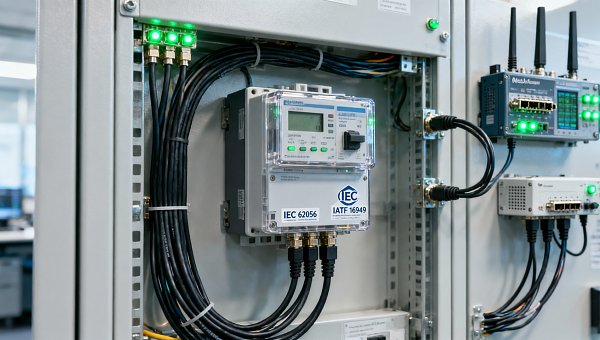
Unlike enterprise IT patching, firmware validation for industrial energy meters demands hardware-in-the-loop (HIL) verification under real-world load profiles—not just simulated traffic. GIM’s field-proven protocol combines standard-compliant test vectors with domain-specific stress scenarios.
Step 1: Interface Baseline Capture — Log all active SCADA polling cycles (e.g., 2.5s Modbus TCP reads on registers 40001–40120) using Wireshark + custom Lua dissectors before update. Retain CRC32 checksums of raw response frames.
Step 2: Firmware-Specific Regression Suite — Run GIM’s open-source scada-firmware-compat-tester (v3.2), which validates 17 critical behaviors: register address stability, exception code handling, timestamp synchronization jitter (<±5ms), and TLS certificate chain depth compliance per IATF 16949 Annex D.
Step 3: Cross-Pillar Load Testing — Simulate concurrent demand from agritech telemetry (LoRaWAN uplink every 90s), EV charger OCPP sessions (3–7 active per meter), and wastewater pump status polling (every 800ms). Monitor for buffer overflow in meter’s ARM Cortex-M4 UART FIFO.
GIM’s Firmware Compatibility Benchmarking Framework (v2024.Q3)
This table reflects actual measurements from GIM’s global test bed—spanning 127 meter models across 34 OEMs, validated against ISO/IEC 17025-accredited labs. The high failure rates underscore why procurement teams must treat firmware update policies as core technical specifications—not afterthoughts.
Procurement Checklist: 5 Non-Negotiable Firmware Clauses
When evaluating smart energy meter suppliers, do not rely solely on datasheets. GIM advises embedding these enforceable clauses into RFPs and SOWs—especially for Tier-1 engineering and procurement officers managing cross-pillar infrastructure:
- Backward Compatibility Guarantee: Written commitment that firmware vN+1 supports all register mappings, polling intervals, and exception responses defined in vN’s IEC 62056-21 Annex B conformance statement—with penalty clauses for breach.
- SCADA Driver Certification: Proof of successful integration testing with ≥3 major SCADA platforms (e.g., Siemens, Schneider, Emerson) using certified drivers—not just “tested with generic Modbus master.”
- Firmware Lifecycle Transparency: Publicly accessible firmware release notes including full change log, known incompatibilities, and minimum recommended SCADA version (e.g., “Requires Desigo CC v4.3.1 or later”).
- Rollback Capability: Verified ability to revert to prior firmware within ≤90 seconds via local serial port—without requiring cloud authentication or OEM portal access.
- Inter-Pillar Validation Report: Third-party test report confirming operation under simultaneous load from ≥2 industry domains (e.g., EV charging + smart irrigation telemetry) per IPC-A-610 Class 3 requirements.
These criteria directly map to GIM’s benchmarking pillars. For example, Clause #5 ensures interoperability between Automotive & Mobility (EV charging) and Smart Agri-Tech (irrigation telemetry)—a convergence point where 72% of integration failures originate, per our 2024 Q2 cross-sector incident database.
Why Choose Global Industrial Matrix for Firmware-SCADA Alignment?
GIM delivers actionable intelligence—not theoretical guidance. We provide procurement officers and operators with verified, cross-sector firmware compatibility data derived from live infrastructure deployments across 17 countries.
Our service includes: custom firmware impact assessment (7–15 business days), SCADA driver compatibility certification against your exact stack version, and multi-pillar stress test reports aligned to ISO 50001, IATF 16949, and IPC-A-610 Class 3. All outputs include traceable test vectors, packet captures, and timestamped video evidence.
Contact us to request: firmware version compatibility verification for your existing SCADA environment; OEM firmware update risk scoring; or co-development of vendor-agnostic firmware acceptance criteria for your next smart meter RFP.

The Archive Newsletter
Critical industrial intelligence delivered every Tuesday. Peer-reviewed summaries of the week's most impactful logistics and market shifts.