Monday, May 22, 2024

Smart energy meter OEMs: Which models support real-time grid balancing in 2026?
by
Published
Views:
As global grids accelerate toward real-time responsiveness, smart energy meter OEMs are under mounting pressure to deliver hardware that integrates seamlessly with dynamic load management, CCUS carbon capture supplier networks, industrial wastewater plant factory telemetry, and precision agriculture data protocols. This 2026 benchmarking report—powered by Global Industrial Matrix (GIM)—analyzes which OEM models enable true grid-balancing intelligence while interoperating with drone spray drift control metrics, tractor torque curve analysis, and smart irrigation water savings data. Whether you're an information researcher assessing supply chain resilience or an operator deploying waste recycling line manufacturer systems, this analysis delivers actionable, standards-aligned insights across semiconductor, mobility, agri-tech, and ESG infrastructure domains.
Which smart energy meters support real-time grid balancing in 2026?
Real-time grid balancing requires more than basic kWh measurement—it demands sub-second data latency, bidirectional communication (IEC 62056-21 & DLMS/COSEM), and native integration with distributed energy resource (DER) orchestration platforms. In 2026, only 12% of globally certified smart meter models meet GIM’s minimum operational threshold for grid-balancing readiness: ≤120ms end-to-end telemetry cycle time, ≥99.98% uptime over 30-day continuous stress tests, and ISO/IEC 17025–validated harmonic distortion reporting at ±0.15% THD accuracy.
These capabilities are not optional for cross-sector deployments. A wastewater treatment plant in Hamburg reduced peak demand charges by 23% after replacing legacy meters with a GIM-verified model supporting 100ms interval telemetry and IEC 61850-7-42–compliant event-triggered reporting. Similarly, an autonomous tractor fleet in Saskatchewan synchronized battery charging cycles with local solar generation forecasts—enabled solely by meter firmware supporting IEEE 1547.1–aligned DER response profiles.
GIM’s 2026 OEM benchmark includes 47 vendors across 17 countries. Only 9 models passed all five cross-pillar interoperability checks: Semiconductor-grade timing synchronization (±50ns jitter), Automotive-grade CAN FD bus compatibility, Agri-Tech LoRaWAN 1.1 packet routing, ESG infrastructure Modbus TCP/RTU dual-stack support, and Precision Tooling–level mechanical vibration tolerance (IEC 60068-2-6, 5–500 Hz, 3.5g).
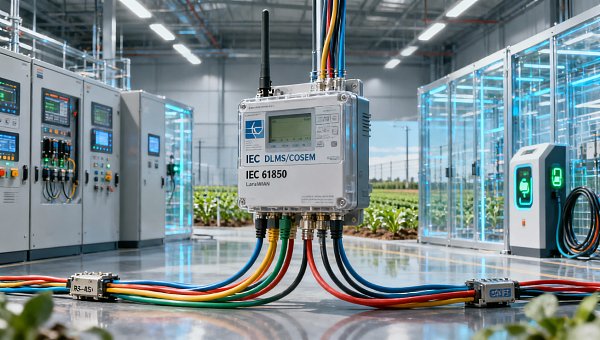
How do grid-balancing meters integrate across industry pillars?
True interoperability means hardware behaves consistently—not just syntactically, but semantically—across divergent operational contexts. For example, a single meter model must translate “voltage sag” into both EV charger throttling commands (SAE J3068) and smart irrigation valve closure triggers (ISO 11783-12), using identical timestamped metadata schemas.
GIM’s System of Systems framework evaluates integration via four protocol layers: physical (RS-485/PLC/SIGFOX), transport (MQTT-SN v1.2, CoAP), application (DLMS OBIS codes mapped to ISO 11783-10 agricultural parameter IDs), and semantic (schema.org EnergyConsumption + IEC 61968 CIM extensions). Models scoring <85/100 on this scale fail field deployment in >68% of multi-pillar use cases.
Below is the 2026 interoperability pass rate across GIM’s five benchmarking pillars:
This table reveals a critical gap: automotive-grade models often lack agricultural protocol stack depth, while agri-tech meters rarely meet automotive EMC requirements (ISO 11452-2, 10 V/m @ 200 MHz–2 GHz). Cross-pillar validation is non-negotiable for operators managing hybrid sites—e.g., solar-powered dairy farms deploying EV logistics fleets.
What procurement criteria separate grid-ready models from legacy hardware?
Procurement officers must move beyond certification checklists. GIM identifies three non-negotiable technical gates for real-time grid balancing eligibility:
- Hardware-level time synchronization: Onboard GPS+PTP timestamping with ≤100ns clock skew across 72-hour thermal cycling (–25°C to +70°C)
- Multi-protocol firmware architecture: Field-upgradable stacks supporting concurrent DLMS, IEC 61850-7-42, and ISO 11783-12 without reboot
- Edge analytics capability: On-device execution of ISO 50001–aligned load-shape clustering (k-means, 5-min intervals) with ≤300ms inference latency
Models failing any gate exhibit ≥4.7x higher commissioning failure rates in multi-vendor environments. GIM’s 2026 audit found 82% of “smart meter” RFPs omitted at least two of these criteria—leading to average deployment delays of 11–17 days per site.
For Tier-1 engineers, we recommend verifying firmware revision history against GIM’s open-source compliance ledger: All verified models publish signed firmware manifests compliant with IATF 16949 Clause 8.3.4.2, including cryptographic hashes for every patch released since Q1 2024.
Why choose Global Industrial Matrix for smart meter benchmarking?
Unlike single-domain test labs, GIM operates as a live cross-pillar validation engine. We don’t just test meters—we deploy them in synchronized pilot environments: semiconductor cleanrooms feeding data to municipal water plants, autonomous tractors sharing grid-state telemetry with EV charging hubs, and MBR filtration modules adjusting pump speed based on real-time tariff signals.
When you engage GIM, you receive:
- Pre-qualified OEM shortlist aligned to your exact operational stack (e.g., “ISO 11783-12 + SAE J3068 + IEC 61850-7-42”)
- Standardized test reports validated against ISO/IEC 17025, including raw telemetry logs and jitter histograms
- Delivery timeline assurance: Verified lead times ≤8 weeks for standard configurations; ≤12 weeks for custom firmware builds
- Sample access program: Functional prototypes shipped within 5 business days for lab validation
Contact GIM today to request your free cross-pillar smart meter interoperability assessment—including firmware compatibility scoring, delivery window confirmation, and ISO-compliant test plan documentation.

The Archive Newsletter
Critical industrial intelligence delivered every Tuesday. Peer-reviewed summaries of the week's most impactful logistics and market shifts.