Monday, May 22, 2024

RO Membrane Wholesale: Cost, Lifespan, and Supply Risks in 2026
by
Published
Views:
In 2026, ro membrane wholesale decisions are no longer driven by unit price alone. For business evaluators balancing procurement cost, membrane lifespan, and global supply volatility, a data-based view is essential.
This article examines how buyers can compare suppliers, forecast replacement cycles, and reduce sourcing risks while protecting long-term operating efficiency and compliance.
What business evaluators actually need to know before buying RO membranes in bulk
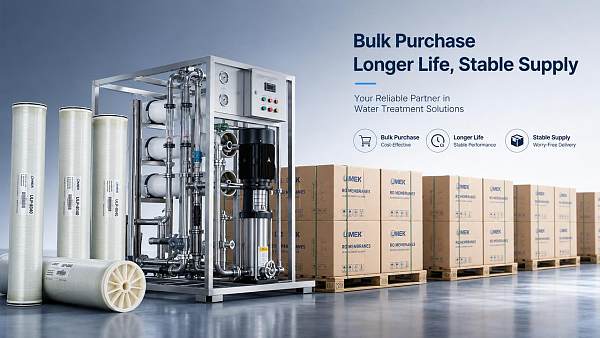
The core search intent behind ro membrane wholesale is commercial evaluation, not basic product education. Buyers want to know whether lower quoted prices will create higher lifecycle cost or supply disruption later.
For procurement teams, the real question is simple: which supplier can deliver acceptable membrane performance, predictable replacement intervals, and reliable availability at the lowest total business risk.
That means wholesale decisions should be based on three linked factors. First is landed cost. Second is usable lifespan under real feedwater conditions. Third is the supplier’s ability to maintain stable deliveries.
In 2026, these factors are more connected than many buyers assume. A membrane with a lower upfront price can lose its cost advantage quickly if fouling rates are higher, cleaning tolerance is lower, or lead times become unstable.
Business evaluators also need to look beyond brochures. Rated flux, nominal rejection, and price per element are starting points, but not decision-grade evidence for long-term sourcing programs.
Why unit price is a weak standalone metric in ro membrane wholesale
In wholesale buying, unit price is visible and easy to compare, so it often dominates first-round screening. However, it rarely reflects the full economics of membrane ownership in industrial or municipal systems.
A cheaper membrane may require more frequent replacement, higher cleaning frequency, or tighter pretreatment control. Each of these raises operating expense and may reduce system uptime, especially in high-volume treatment environments.
For business evaluators, a better metric is annualized treatment cost. This includes procurement, shipping, customs, installation labor, cleaning chemicals, energy effects, downtime, and expected replacement timing.
If a supplier offers a membrane priced 12 percent lower, but average service life falls by 20 percent, the apparent savings can disappear. In many systems, replacement frequency matters more than purchase price.
This is especially true when labor access is difficult or shutdown windows are expensive. In those cases, membrane longevity carries significant financial weight even when per-element price looks competitive.
How to evaluate membrane lifespan in commercial procurement decisions
Lifespan is one of the most misunderstood variables in ro membrane wholesale. Suppliers often cite ideal operating conditions, but actual membrane life depends heavily on feedwater quality, pretreatment discipline, and cleaning practices.
Business evaluators should ask for data tied to comparable applications. Brackish water, seawater, food processing reuse, pharmaceutical pretreatment, and industrial wastewater polishing all create different stress profiles for membranes.
A realistic review should include average normalized permeate flow decline, salt rejection stability, differential pressure growth, and cleaning recovery rates over time. These indicators reveal whether lifespan claims are operationally credible.
Another important question is tolerance to upset conditions. Some membranes perform well under steady-state operation but degrade faster when exposed to oxidants, organic fouling, biological loading, or inconsistent pretreatment.
When possible, request field references with runtime history rather than relying only on laboratory certification. Commercial buyers need service-life evidence under conditions that resemble their own water chemistry and maintenance realities.
For framework contracts, it is useful to model three lifespan cases: optimistic, expected, and stressed. This approach gives finance and procurement teams a better basis for scenario planning.
What supply risks are shaping the RO membrane market in 2026
Supply risk in 2026 is no longer limited to factory shutdowns. Buyers face a wider set of variables, including resin availability, freight volatility, regional compliance issues, energy costs, and geopolitical trade restrictions.
RO membrane production depends on a chain of upstream materials and process consistency. Disruptions in specialty polymers, backing materials, housings, packaging, or quality inspection can all affect delivery reliability.
Another risk is concentration. Some wholesale buyers rely too heavily on one region, one private-label manufacturer, or one distributor with limited technical transparency. This creates hidden vulnerability when demand spikes or logistics tighten.
Lead time inflation is also a practical concern. A supplier may maintain list pricing yet extend delivery windows from six weeks to fourteen weeks, which can be more damaging than a moderate price increase.
There is also the issue of batch consistency. In constrained markets, some suppliers may substitute production sources or modify specifications quietly. Without incoming verification protocols, buyers may discover variation only after installation.
For business evaluators, supply risk should be scored as seriously as price. A membrane that is technically acceptable but intermittently unavailable can undermine treatment continuity, contractual obligations, and compliance performance.
How to compare RO membrane wholesale suppliers beyond marketing claims
Supplier comparison should begin with a structured commercial-technical scorecard. This prevents procurement decisions from being driven by headline discounts or brand familiarity alone.
Start with product fit. Confirm membrane type, pressure class, element dimensions, rejection range, flux profile, and compatibility with existing housings and cleaning protocols. Small mismatches can create major integration costs.
Next, review quality assurance. Ask whether the supplier provides batch traceability, factory test records, wet testing standards, packaging controls, and change-notification policies. These elements matter when scaling multi-site purchases.
Then assess fulfillment strength. Key indicators include safety stock strategy, regional warehousing, historical on-time delivery rate, customs handling capability, and the ability to support urgent replacement demand.
Commercial governance is equally important. Evaluate payment terms, warranty structure, claims response time, after-sales technical support, and willingness to support trial orders before long-term commitment.
Finally, test transparency. The most dependable suppliers can explain not only product strengths but also operating limits, pretreatment dependencies, and likely failure modes. That level of honesty usually signals lower execution risk.
Questions procurement teams should ask before signing a wholesale agreement
Strong sourcing outcomes often depend on asking better questions early. Many avoidable problems arise because buyers focus on quotation speed and overlook operating assumptions embedded in the offer.
Ask suppliers what feedwater envelope their lifespan estimate assumes. Request limits for silt density, hardness, chlorine exposure, temperature, and organic loading. Without these details, lifespan claims are difficult to trust.
Ask whether the quoted membrane has changed construction in the last twenty-four months. If so, request documentation on performance equivalence and any known changes in cleaning tolerance or pressure-drop behavior.
Ask about allocation risk. During shortages, will your account receive committed production capacity, or will shipments depend on spot availability? Contract language should clarify this point.
Ask how warranty claims are investigated. If failure occurs, what evidence is required, how quickly is support mobilized, and does the supplier provide replacement stock while the case is being reviewed?
Also ask for a realistic lead-time range, not only the best-case estimate. Procurement planning is stronger when teams understand average, peak-season, and disruption-case delivery timing.
Building a total cost model that reflects real membrane economics
For business evaluators, the most useful decision tool is a total cost of ownership model. This converts technical uncertainty into comparable financial scenarios across suppliers.
The model should begin with landed purchase cost per element, including freight, duties, taxes, and local handling. Many organizations underestimate the impact of logistics on wholesale membrane economics.
Then add operating variables: energy consumption impact, cleaning frequency, chemical use, labor time, and expected output loss during maintenance. These items often determine whether a lower-price quote is truly competitive.
Replacement timing should be modeled in months, not vague service-life labels. A difference between thirty and forty-two months may materially change annual cost and spare inventory planning.
It is also wise to estimate the cost of one emergency supply event. Air freight, rush customs clearance, and unplanned downtime can erase a year of negotiated savings from a lower contract price.
When finance teams review membrane sourcing through this lens, they usually make more stable decisions. The focus shifts from cheapest available stock to lowest controllable long-term cost.
How to reduce sourcing risk without overpaying
Reducing risk does not always mean choosing the most expensive global brand. In many cases, buyers can achieve a strong balance of cost and resilience through better sourcing design.
One approach is dual qualification. Approving a primary and secondary supplier reduces dependence on a single source while maintaining leverage in annual pricing discussions.
Another strategy is segmented purchasing. Critical sites with strict uptime requirements may use premium membranes, while less sensitive applications can adopt value-focused alternatives after controlled testing.
Framework agreements should also include practical protections such as forecast sharing, buffer stock commitments, specification freeze rules, and penalties or remedies for severe delivery failure.
Technical validation is equally important. Before large-scale conversion, run pilot or phased field trials to compare fouling behavior, rejection stability, and cleaning recovery under actual site conditions.
For multinational buyers, regional diversification can reduce logistics risk. However, diversification only works if product quality and documentation standards are aligned across all approved supply channels.
Where compliance and operational continuity fit into the buying decision
For many organizations, membrane procurement is linked directly to compliance exposure. If water quality drifts due to inconsistent membrane performance, the commercial impact may go far beyond replacement cost.
Industries with strict discharge, reuse, or process-water requirements need membranes that perform consistently over time, not just pass initial acceptance testing. That makes quality stability a board-level concern in some sectors.
Documentation also matters. Buyers may need material declarations, quality certificates, validation records, or traceability support for audits and customer assurance programs.
From a continuity perspective, a missed delivery can disrupt production, delay maintenance windows, or force operation outside preferred efficiency ranges. These outcomes should be included in supplier-risk evaluation.
In short, ro membrane wholesale is not only a procurement line item. It is part of a broader operational reliability and compliance strategy, especially in infrastructure and process-intensive industries.
Conclusion: what a smart ro membrane wholesale decision looks like in 2026
In 2026, the best ro membrane wholesale decision is rarely the one with the lowest quoted price. It is the one that balances cost, service life, supply continuity, and technical fit with the least overall business risk.
Business evaluators should prioritize lifecycle economics, comparable field data, supplier transparency, and contract safeguards. These factors provide a more reliable basis for decision-making than catalog specifications alone.
If two suppliers appear similar on price, the better choice is usually the one with clearer lifespan evidence, stronger batch consistency, and more dependable delivery capability.
For organizations seeking resilient procurement, the key takeaway is clear: buy membranes as a performance-and-supply program, not as a commodity purchase. That mindset protects efficiency, compliance, and long-term value.

The Archive Newsletter
Critical industrial intelligence delivered every Tuesday. Peer-reviewed summaries of the week's most impactful logistics and market shifts.