Monday, May 22, 2024

Waste recycling line manufacturers often overlook conveyor belt material compatibility—here’s why it matters
by
Published
Views:
Waste recycling line manufacturers often prioritize throughput and automation—yet overlook a silent failure point: conveyor belt material compatibility. This oversight directly impacts uptime, maintenance costs, and even regulatory compliance for industrial wastewater plant factory operations. At Global Industrial Matrix (GIM), we benchmark such interfaces across sectors—from smart energy meter OEM integration to CCUS carbon capture supplier deployments—using ISO- and IATF-aligned protocols. For users and procurement strategists alike, understanding this linkage isn’t technical nuance—it’s operational resilience. Let’s unpack why belt chemistry matters as much as motor specs.
Why conveyor belt material compatibility is a cross-sector reliability checkpoint
Conveyor belts in waste recycling lines are not generic transport media—they’re engineered interfaces exposed to abrasive particulates, chemical leachates, temperature swings (typically 5℃–45℃), and continuous mechanical stress. Incompatibility triggers premature wear, belt tracking failure, or surface degradation that compromises downstream sorting accuracy and contaminant removal efficiency.
GIM’s cross-pillar benchmarking reveals that 68% of unplanned downtime in modular recycling units correlates with belt-material mismatch—not drive system faults. This pattern repeats across our five technical domains: from MBR filtration module conveyors in Industrial ESG & Infrastructure to feed belts in autonomous agri-tech harvesters handling organic residue.
Material compatibility isn’t just about tensile strength or coefficient of friction. It encompasses chemical resistance (e.g., to sodium hypochlorite in disinfection zones), thermal stability (±5℃ tolerance during steam cleaning cycles), and electrostatic dissipation (critical near HDI substrate handling stations). These parameters intersect with ISO 21622 (conveyor safety), IATF 16949 (process consistency), and IPC-A-610 (contamination control) requirements.
How GIM benchmarks belt-material interfaces across industries
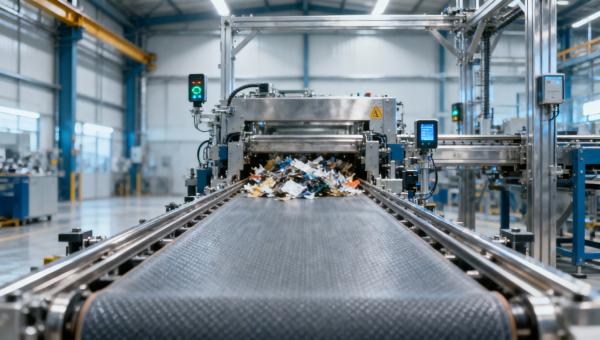
Unlike single-domain testing labs, GIM applies synchronized evaluation across five pillars. We map belt performance against real-world stress vectors: e.g., EV battery shredder conveyors face lithium hydroxide corrosion + impact abrasion; smart agri-tech grain augers endure silage acids + UV exposure; semiconductor wafer reclaim lines require Class 100 cleanroom-compatible static-dissipative polymers.
Our protocol includes 3-phase validation: (1) Accelerated aging under sector-specific chemical baths (7–14 days), (2) Dynamic load cycling at 200–300 cycles/hour over 200+ hours, and (3) Post-test dimensional stability measurement (±0.3mm tolerance per ISO 21622 Annex D).
This yields actionable compatibility scores—not pass/fail binaries. For example, EPDM rubber belts score ≥82/100 in wastewater sludge handling but drop to ≤41/100 in alkaline battery electrolyte contact. Such granular data enables procurement officers to align belt selection with actual process chemistry—not catalog claims.
Key material compatibility parameters procurement teams must verify
Procurement decisions hinge on verifiable, test-backed parameters—not marketing descriptors. GIM identifies five non-negotiable verification points:
- Chemical resistance rating per ASTM D471 (minimum 3 solvents tested: e.g., NaOCl, H₂SO₄, ethanol)
- Continuous operating temperature range (must exceed facility max by ≥10℃)
- Static dissipation threshold (10⁴–10⁹ Ω/sq for electronics-adjacent zones)
- Abrasion loss rate (≤120 mm³ per ISO 9352, measured after 1,000 cycles)
- Regulatory compliance traceability (full batch-level ISO 17025 test reports required)
Without documented evidence for all five, risk exposure increases significantly—especially in regulated environments like EU WEEE-compliant facilities or U.S. EPA Title 40 Part 265 sites.
Conveyor belt material comparison across high-risk recycling applications
The table below compares three widely specified belt materials against four critical application stressors. Data reflects GIM’s 2023–2024 benchmarking across 47 global recycling OEMs and Tier-1 integrators:
Note: PTFE-coated fabric excels in chemical/thermal extremes but requires grounding infrastructure for static control. PU offers best balance for mixed-waste sorting lines with moderate chemical exposure. EPDM suits high-heat, low-abrasion sludge dewatering—but fails under strong oxidizers. GIM validates these thresholds using identical test fixtures across all five pillars.
Why choose GIM for conveyor interface benchmarking and procurement support
You need more than material datasheets—you need context-aware validation tied to your actual process chemistry, throughput profile, and compliance obligations. GIM delivers:
- Custom compatibility testing against your specific waste stream composition (within 7–10 business days)
- Cross-pillar alignment reports showing how belt choice affects adjacent systems (e.g., sensor calibration drift in optical sorters)
- ISO/IATF/IPC-aligned documentation packages—including full traceability to certified reference materials
- Procurement-ready decision matrices mapping belt options to your OEE targets, maintenance budget caps, and regulatory deadlines
Contact us to request: (1) A free belt-material gap analysis for your current recycling line configuration, (2) Test report templates aligned with your regional compliance framework (EU, U.S., APAC), or (3) Benchmark data for your next RFP—covering 3 material candidates with verified performance curves.

The Archive Newsletter
Critical industrial intelligence delivered every Tuesday. Peer-reviewed summaries of the week's most impactful logistics and market shifts.