Monday, May 22, 2024

ESG Audit Checklist for Factories: Key Gaps That Trigger Non-Compliance
by
Published
Views:
An effective esg audit checklist for factories helps quality control and safety managers identify the hidden compliance gaps that lead to failed audits, supplier risk, and operational disruption. From labor practices and emissions tracking to waste handling and documentation control, this guide highlights the most common weak points and shows where factories often fall short before regulators, customers, or third-party assessors do.
For most factories, non-compliance does not start with a major violation. It usually begins with small control failures, inconsistent records, unclear ownership, and weak follow-through across departments.
That is why quality and safety teams need more than a generic checklist. They need a practical audit framework that reveals where operational reality no longer matches policy, permits, customer codes, or ESG claims.
What factory teams are really trying to prevent with an ESG audit checklist
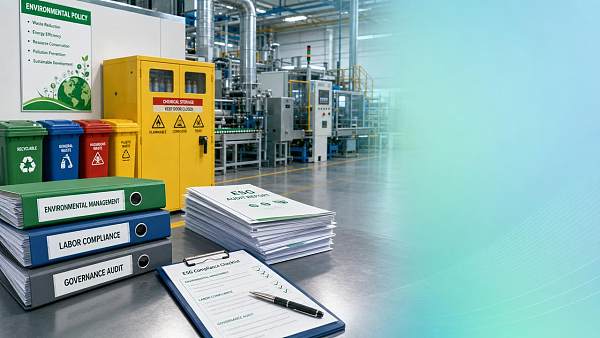
When people search for an esg audit checklist for factories, they are usually not looking for theory. They want to prevent failed customer audits, corrective action overload, shipment delays, and reputational risk.
Quality control personnel often focus on traceability, document accuracy, process consistency, and supplier expectations. Safety managers are more concerned with legal exposure, incident prevention, hazardous materials, emergency readiness, and workforce protection.
Both groups share the same concern: hidden gaps can stay invisible until an external assessor, buyer, regulator, or investor asks for evidence. At that point, weak controls become formal non-conformities.
The most useful checklist is therefore not a long list of ESG buzzwords. It is a structured way to test whether the factory can prove compliance, not merely describe intentions.
The core areas where factories most often trigger ESG non-compliance
In practice, factory ESG audits usually concentrate on three broad pillars: environmental controls, social and labor management, and governance systems. Failures tend to happen where these pillars overlap operational processes.
Environmental gaps often involve incomplete emissions data, poor waste segregation, missing disposal manifests, outdated permits, and weak monitoring of water, air, noise, or chemical storage conditions.
Social non-compliance often stems from inconsistent working hour records, insufficient contractor oversight, poor grievance processes, weak training evidence, and gaps between written labor policies and shop-floor practices.
Governance failures usually appear in document control, unclear accountability, missing management review, weak internal escalation, and the absence of timely corrective action verification after prior findings.
Factories that perform well during ESG audits generally do one thing better than others: they connect frontline operations, EHS controls, HR records, and quality documentation into one auditable system.
Environmental checklist items that frequently expose weak controls
Environmental compliance is one of the fastest ways for assessors to detect whether a site manages ESG seriously. Numbers, logs, and permits are easier to verify than broad policy statements.
Start with legal applicability. Confirm the site maintains a current register of environmental obligations covering emissions, wastewater, stormwater, hazardous waste, chemical handling, energy use, and local reporting requirements.
Next, verify permit control. Many factories fail because permits have expired, conditions are misunderstood, monitoring frequencies are missed, or actual production volumes exceed approved thresholds.
Waste management is another high-risk area. Check whether waste streams are clearly classified, labeled, segregated, stored safely, and transferred through approved vendors with complete documentation.
Review hazardous materials handling carefully. Auditors often find missing secondary containment, unlabeled containers, outdated safety data sheets, poor incompatibility separation, or insufficient spill response readiness.
Energy and carbon reporting can also trigger findings. If a factory makes sustainability claims, it must be able to explain the calculation methods, data sources, scopes included, and review controls.
Water use and discharge controls matter especially in water-stressed regions or high-process industries. Metering gaps, missing sampling records, and poor effluent trend analysis often lead to non-compliance concerns.
Good environmental performance is not only about having equipment installed. It depends on calibration records, preventive maintenance, alarm response, operator competence, and evidence that abnormal conditions are investigated.
Social and labor gaps that often fail third-party assessments
Many factories underestimate how quickly labor issues can escalate during an ESG review. Auditors frequently compare policy statements with payroll records, time logs, interviews, dormitory conditions, and contractor practices.
Working hours and wage compliance are common problem areas. Even where pay rates appear correct, poor overtime control, missing approval records, or inconsistent attendance systems can create serious red flags.
Age verification and prevention of underage labor must be airtight. Factories should maintain documented hiring checks, remediation procedures, and controls for labor agencies, subcontractors, and temporary workers.
Forced labor indicators are also under growing scrutiny. This includes retention of identity documents, restricted movement, recruitment fee burdens, coercive disciplinary practices, or unclear resignation procedures.
Training is another weak point. Many sites deliver safety and conduct training, but cannot prove who attended, what was covered, whether comprehension was verified, or whether contractors received equivalent instruction.
Worker voice mechanisms matter more than many factories expect. If grievance channels exist only on paper, or workers fear retaliation, auditors may conclude that management visibility into real conditions is limited.
Health and safety links directly to ESG performance. Incomplete risk assessments, weak lockout controls, poor PPE enforcement, and low-quality incident investigations often influence broader judgments about management credibility.
Governance failures that make even compliant factories look risky
A factory may have decent practices on the floor and still perform poorly in an ESG audit because governance systems fail to demonstrate control. Auditors look for evidence of repeatable management, not isolated good behavior.
Document control is one of the most frequent governance issues. Teams often use outdated procedures, conflicting forms, or uncontrolled spreadsheets, making it difficult to prove that the current process is understood and followed.
Role clarity is equally important. If quality, EHS, HR, operations, and maintenance teams all assume someone else owns a compliance topic, gaps remain open until an audit exposes them.
Management review is another critical checkpoint. Senior leaders should regularly review ESG objectives, incidents, legal changes, performance trends, audit results, and corrective action closure status.
Supplier and contractor governance also deserves attention. A site may control internal processes well but still face non-compliance through waste vendors, labor agencies, transport partners, or outsourced processing activities.
Corrective action systems must go beyond closing paperwork. Strong factories identify root cause, assign accountable owners, verify effectiveness, and monitor recurrence trends across similar processes or locations.
How to build a practical ESG audit checklist for factories
The best checklist is evidence-based and site-specific. It should reflect the factory’s processes, risk profile, customer requirements, permits, workforce model, and applicable standards rather than generic ESG categories alone.
Organize the checklist into verifiable sections: legal compliance, environmental controls, labor and human rights, occupational health and safety, governance, supplier oversight, and records management.
For each item, ask three questions. What is the requirement? What evidence proves compliance? Who owns the control? This format helps teams move from awareness to auditable accountability.
Add a fourth test where possible: what would failure look like in practice? This helps auditors and internal reviewers identify real warning signs instead of checking boxes too quickly.
Use multiple evidence sources. Do not rely only on documents. Combine interviews, site walks, observations, sampling, trend data, permits, training logs, contractor files, and maintenance records.
Scoring can also improve prioritization. Classify findings by severity, legal exposure, customer impact, recurrence risk, and ease of remediation. This prevents minor housekeeping issues from distracting teams from systemic failures.
Questions quality and safety managers should ask before the external audit
Before any customer, certification, or investor-facing assessment, teams should pressure-test the site with hard questions. Can every ESG claim be supported with current, traceable evidence?
If a worker, supervisor, and department manager are interviewed separately, will their answers align on actual practice? If not, the issue is usually weak implementation rather than poor communication alone.
Can the site show trends, not just snapshots? Auditors increasingly want to see whether incidents, waste volumes, overtime, energy use, or corrective actions are monitored over time and acted upon.
Are contractors and temporary labor included in the same control environment as direct employees? Exclusion here is a frequent cause of hidden risk and inconsistent audit outcomes.
If a finding was raised last year, what changed structurally? Repeated issues are especially damaging because they suggest management either misunderstood the cause or failed to enforce closure.
Turning audit findings into operational improvement instead of recurring fire drills
An ESG audit should not end with a punch list that gets forgotten once the assessor leaves. The real value comes from turning findings into stronger routines, clearer ownership, and better operational discipline.
Start by separating symptoms from root causes. Missing records may indicate poor filing, but they may also reveal weak training, excessive manual data entry, or unclear departmental responsibility.
Create corrective actions that change the process, not only the file. Examples include revising approval flows, automating data capture, retraining supervisors, updating contractor onboarding, or redesigning escalation triggers.
Track closure with evidence and effectiveness checks. A completed action should reduce the chance of recurrence, not simply satisfy a deadline. This distinction matters in every mature ESG management system.
Finally, use ESG audit results as a cross-functional management tool. When quality, safety, HR, maintenance, and operations review findings together, factories become better at preventing hidden non-compliance before it spreads.
Conclusion: the best ESG checklist is the one that reveals what your factory cannot yet prove
A strong esg audit checklist for factories does more than prepare for inspections. It exposes the control weaknesses that create compliance risk, customer concern, and avoidable operational disruption.
For quality control and safety managers, the priority is clear: focus on evidence, ownership, and recurring failure points across environmental, labor, and governance systems. That is where the most costly gaps usually hide.
Factories that treat ESG as an auditable operating discipline, rather than a reporting exercise, are better positioned to pass assessments, protect supplier status, and build long-term resilience.

The Archive Newsletter
Critical industrial intelligence delivered every Tuesday. Peer-reviewed summaries of the week's most impactful logistics and market shifts.