Monday, May 22, 2024

What should an ESG monitor in Southeast Asia track first?
by
Published
Views:
What Should an ESG Monitor in Southeast Asia Track First?
For enterprise decision-makers, an ESG Monitor Southeast Asia should not start with the prettiest sustainability dashboard or the longest questionnaire. It should start with the indicators that reveal real exposure: supply chain risk, regulatory pressure, and operational resilience. In Southeast Asia, those signals often show up earlier in energy use, labor practices, waste handling, and governance transparency than they do in annual reports. If you miss the early signs, the first problem is usually not reputation. It is disruption.
That matters because the region is not uniform. A factory in Malaysia, a supplier cluster in Vietnam, an agro-processing site in Thailand, and a logistics node in Indonesia may all sit under the same ESG policy umbrella, yet the actual risk profile can be very different. The practical question is less “What should we report?” and more “What do we need to know first so we do not make a bad procurement, investment, or expansion decision?”
Start with what can break operations
The first layer to track is usually environmental performance that affects continuity: electricity mix, fuel intensity, water stress, wastewater treatment, and waste disposal discipline. These are not abstract sustainability themes. They determine whether a site can keep running during power price spikes, drought conditions, stricter discharge checks, or customer audits.
In Southeast Asia, that often means paying attention to location-specific pressure rather than global averages. A site with stable grid access may still face high Scope 2 exposure if the local power mix is carbon-heavy. A food or smart agri-tech supplier may look efficient on paper but be vulnerable if its water source is seasonal or its effluent treatment is inconsistent. For industrial buyers, that kind of weakness tends to surface late, when the shipment is already delayed or the customer has escalated a compliance concern.
A useful rule: track the metrics that can change unit cost, permit status, or production uptime in the next 12 to 24 months. If a metric does not affect those three things, it can wait a bit. If it does, it belongs near the top of the dashboard.
Labor is not a side note in this region
For Southeast Asia, social indicators deserve more attention than many teams initially give them. That is partly because labor conditions vary widely across industries and sourcing tiers, and partly because the weak point is often not the Tier-1 supplier everyone knows. It is the subcontractor, labor agency, or processing facility one layer down.
An ESG monitor should track working hours, wage compliance, freedom to raise concerns, turnover, incident reporting, and worker accommodation where relevant. In some sectors, especially electronics assembly, precision tooling, construction, plantation-linked processing, or logistics, these indicators can be the first warning that a site is under pressure. High turnover may sound like an HR issue until it starts affecting defect rates, training loss, and delivery stability.
This is where enterprise teams often get caught out. They ask for policy documents, but policy is not proof of practice. A supplier can have a clean code of conduct and still fail on time records or grievance handling. So the question should be: can the data be checked, and does it describe day-to-day conditions rather than a one-time declaration?
Governance is the part that makes the rest believable
Governance is sometimes treated as the least visible part of ESG, but for procurement and investment teams it is often the filter that tells you whether anything else is trustworthy. If ownership is opaque, recordkeeping is weak, or audit responses shift depending on the audience, the environmental and social data need extra scrutiny.
For an ESG Monitor Southeast Asia, the governance layer should include board oversight, anti-corruption controls, supplier disclosure quality, audit trail consistency, and the existence of escalation channels. In markets where corporate structures can be layered across multiple entities, transparency around beneficial ownership and related-party relationships may matter just as much as emissions data. That is especially true when the buyer needs to assess concentration risk or verify whether a supplier is really independent.
This is also where industrial benchmarking helps. GIM’s cross-sector approach is useful because the governance questions around a semiconductor substrate supplier, an EV component maker, and an environmental infrastructure operator are not identical, but they rhyme. If the reporting logic is thin in one pillar, the same weakness often shows up elsewhere.
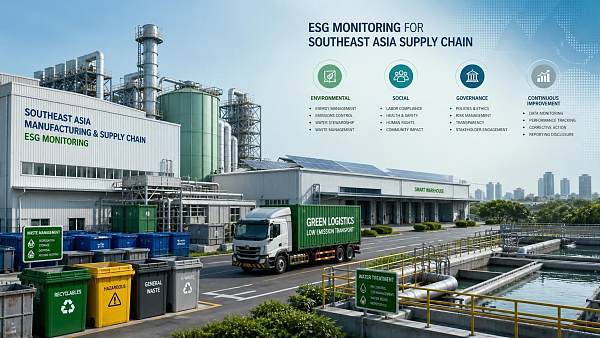
The first dashboard should be narrow, not impressive
A lot of ESG monitoring fails because it tries to be complete on day one. That sounds disciplined, but in practice it creates noise. Decision-makers do not need fifty indicators at the start. They need a small set that can be compared across countries, plants, and suppliers without constant interpretation disputes.
A workable first pass usually covers four questions:
- Is the site exposed to energy, water, or waste risks that can interrupt operations?
- Are labor practices stable enough to support production quality and delivery reliability?
- Can governance data be verified, or is it mostly self-declared?
- Are there market-specific or customer-specific rules that make this site a higher-risk node?
That does not mean every company should track the same thresholds. A multinational electronics buyer and a regional agri-processing group will prioritize different things. But both need a baseline that lets them compare sites on the same logic. Without that, ESG becomes a reporting exercise with no operational value.
Why Southeast Asia needs local context, not imported assumptions
One common mistake is to apply a global ESG template and assume it will work everywhere. In Southeast Asia, that usually misses the point. Local grid structures, permitting practices, industrial zoning, workforce mobility, and supplier maturity vary too much for a copied framework to hold up on its own.
For example, a water metric that looks routine in one country may be material in another because of seasonal stress or competition from other industrial users. A labor indicator may matter more in a labor-intensive plant than in a highly automated one. Governance disclosure may be easy for listed firms and much harder for privately held suppliers. These are not minor adjustments; they change what should be tracked first.
That is why an effective ESG monitor should be built like an industrial benchmark, not a branding tool. The point is to identify where the system is fragile, where assumptions are untested, and where a supplier or asset may look compliant until a customer audit or regulatory review puts pressure on the details.
A practical sequence for the first 90 days
If the goal is to get started without drowning in data, the sequence is usually straightforward. Begin with a baseline of site-level energy, water, waste, and labor data. Then check whether those figures can be verified through utility records, permits, payroll evidence, audit logs, or third-party documentation where available. After that, map ownership and governance disclosures against the actual supplier network.
The biggest mistake is to treat all gaps the same. Missing carbon data is a problem. Missing labor-hour records can be a bigger one. Missing governance clarity may be the reason the other two are missing. In other words, the order matters.
For enterprise teams, the first win is not a perfect scorecard. It is a cleaner risk picture. Once that picture is in place, ESG stops being a year-end reporting burden and becomes a way to compare markets, choose suppliers more intelligently, and avoid unpleasant surprises that would have been obvious earlier with the right monitor in place.

The Archive Newsletter
Critical industrial intelligence delivered every Tuesday. Peer-reviewed summaries of the week's most impactful logistics and market shifts.