Monday, May 22, 2024

Anthropic Valued at $1.2T, Surpassing OpenAI; Chinese AI Chips Accelerate ADAS & Farm Vision Deployment
by
Published
Views:
On May 7, 2026, Anthropic’s valuation reached $1.2 trillion—exceeding OpenAI’s—marking a pivotal shift in global AI leadership and intensifying demand for edge-optimized AI chips. This development directly impacts automotive electronics suppliers, intelligent agricultural equipment manufacturers, and AI chip vendors focused on real-time vision inference at the edge.
Event Overview
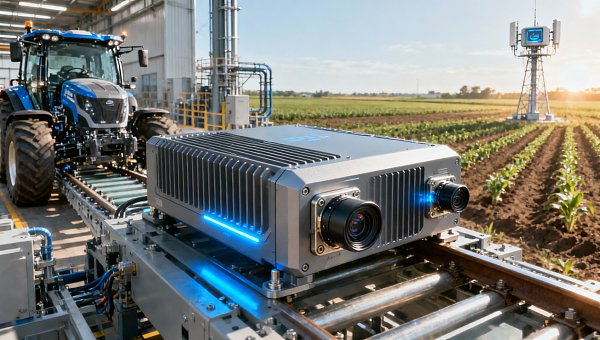
On May 7, 2026, Anthropic’s valuation was reported to have reached $1.2 trillion, surpassing OpenAI’s. Concurrently, domestic Chinese semiconductor vendors are accelerating the lightweight deployment of Claude-family models onto automotive ADAS domain controllers and autonomous tractor vision processing units. This enables Chinese smart farming and automotive electronics suppliers to offer overseas customers ‘out-of-the-box’ AI vision solutions—reducing local algorithm fine-tuning and certification overhead.
Which Sub-Sectors Are Affected
Automotive Electronics Suppliers
These companies integrate AI accelerators into ADAS domain controllers. The adoption of lightweight Claude variants implies tighter integration requirements between model architecture, chip instruction sets, and ISO 26262-compliant runtime frameworks—potentially reshaping firmware update cycles and validation scope.
Intelligent Agricultural Equipment Manufacturers
Producers of autonomous tractors and harvesters rely on robust, low-latency vision systems for field navigation and crop analysis. Pre-integrated Claude-based vision stacks lower their software development burden but increase dependency on compatible chip toolchains and vendor-specific SDKs.
AI Chip Vendors (China-based, Edge-Focused)
Vendors supplying NPUs or vision-specific SoCs for automotive and agri-tech applications face intensified demand for model-aware hardware optimization—particularly for quantization-aware training support, memory bandwidth efficiency, and deterministic latency under variable lighting/soil conditions.
Global Tier-1 Automotive Suppliers (Serving Overseas OEMs)
These firms procure AI vision modules from Chinese suppliers for integration into regional vehicle platforms. The ‘out-of-the-box’ positioning reduces their in-house AI tuning effort but raises scrutiny around model behavior consistency across geographies—especially under regulatory regimes requiring explainability or audit trails.
What Relevant Enterprises or Practitioners Should Focus On Now
Monitor official model licensing terms for Claude derivatives in embedded contexts
Anthropic has not publicly disclosed licensing conditions for commercial deployment of Claude in safety-critical edge devices. Enterprises evaluating integration should track updates to Anthropic’s API terms, model redistribution policies, and any hardware co-certification programs.
Validate chip-model compatibility with real-world ADAS and farm vision workloads—not just benchmark suites
Performance metrics from synthetic benchmarks (e.g., TOPS/Watt) may not reflect inference stability under dust, vibration, or low-SNR camera input. Prioritize testing with actual sensor data pipelines used in production-grade ADAS or tractor vision stacks.
Distinguish between pre-integration claims and certified functional safety readiness
‘Out-of-the-box’ deployment refers to software stack readiness—not necessarily ASIL-B/D or ISO 25119 compliance. Suppliers must separately verify safety mechanisms (e.g., error detection, fail-safe outputs) and maintain traceable documentation for regional type approvals.
Assess supply chain exposure to specific NPU IP blocks or compiler toolchains
Lightweight Claude deployment relies on vendor-specific quantization tools and kernel libraries. Diversifying across multiple chip architectures may mitigate long-term lock-in risk, especially where compiler updates or SDK deprecations affect model portability.
Editorial Perspective / Industry Observation
Observably, this valuation milestone reflects investor confidence in Anthropic’s alignment with enterprise and embedded AI use cases—not just frontier LLM capabilities. It is less a signal of immediate market share gain and more an indicator of shifting capital priorities toward deployable, verifiable AI at the edge. From an industry perspective, the accelerated adaptation of Claude to ADAS and farm vision systems suggests growing convergence between foundation model innovation and domain-specific hardware constraints. Analysis shows that the emphasis is now shifting from model scale to model fit: how well a model’s architecture, quantization profile, and inference footprint align with real-time, resource-constrained environments. Current attention should focus less on headline valuation comparisons and more on whether such deployments yield measurable reductions in time-to-certification and field deployment cost—metrics that remain unreported in public disclosures.
Conclusion: This event signifies a structural inflection—not merely a funding milestone. It underscores that competitive advantage in AI-enabled hardware is increasingly determined by co-optimization between model design, chip architecture, and domain-specific validation pathways. For stakeholders, it is better understood as an early-stage catalyst for supply chain repositioning, rather than a fully realized market transition.
Information Source: Public valuation report dated May 7, 2026; confirmed deployment timeline and technical scope from vendor statements regarding Claude lightweight adaptation for ADAS and autonomous tractor vision systems. Ongoing observation is warranted regarding Anthropic’s formal licensing framework for embedded inference and third-party certification status of integrated solutions.

The Archive Newsletter
Critical industrial intelligence delivered every Tuesday. Peer-reviewed summaries of the week's most impactful logistics and market shifts.