Monday, May 22, 2024

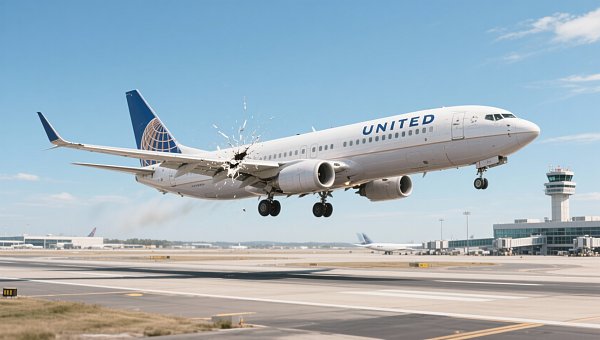
United Airlines Jet Collision with Drone Triggers FAA Avionics Review
by
Published
Views:
On April 29, 2026, a United Airlines commercial aircraft collided with a suspected drone during landing — an incident that has triggered urgent U.S. Federal Aviation Administration (FAA) reassessment of unmanned aerial system (UAS) proximity airspace controls. This event is highly relevant to manufacturers and exporters of aviation-grade electronic modules — particularly those supplying ADAS & Sensors and Mobility Vision systems to the North American market — as it signals imminent changes to avionics certification requirements under DO-160G.
Event Overview
On April 29, 2026, a United Airlines passenger aircraft experienced a collision with a suspected drone during its landing phase. No injuries were reported. The FAA has initiated an emergency evaluation of vulnerabilities in current drone airspace management protocols. As of the available public information, no further operational details (e.g., flight number, airport, altitude, or drone identification) have been officially confirmed.
Industries Affected
Direct Exporters to the U.S. Aviation Market
Companies holding or pursuing Type Certificate (TC) applications for aviation-grade electronic modules destined for FAA certification will face revised testing mandates. Analysis shows the upcoming DO-160G amendment — expected within 90 days — will introduce mandatory combined testing for external impact and electromagnetic interference (EMI) co-mode resilience. This directly affects time-to-certification and test cost for ADAS & Sensors and Mobility Vision modules exported from China to North America.
Avionics Module Manufacturers (OEM/ODM)
Manufacturers integrating sensors, vision processors, or embedded control units into FAA-submittable systems may encounter requalification requirements. From industry perspective, legacy designs lacking documented impact-resistant redundancy — especially for external housing, lens mounts, or signal interface shielding — may no longer satisfy updated DO-160G clauses. Testing scope expansion implies higher non-recurring engineering (NRE) costs and potential redesign cycles.
Supply Chain Service Providers (Certification Consultants, Test Labs)
Third-party certification support firms and accredited test laboratories serving Chinese avionics exporters are likely to see increased demand for combined mechanical-EMI test capability. Observably, labs without DO-160G Section 22 (Mechanical Stress) and Section 20 (Radiated Susceptibility) co-test accreditation may face capacity constraints or require capability upgrades ahead of the regulatory deadline.
What Enterprises and Practitioners Should Monitor and Do Now
Track Official FAA Guidance and DO-160G Revision Timeline
Monitor FAA’s official notices and RTCA’s public updates on DO-160G Amendment 4 (or successor). Current more actionable than broad policy analysis is tracking the exact publication date, effective date, and transition provisions — especially whether grandfathering applies to TC applications submitted before the revision takes effect.
Review Active TC Submissions for Impact Resilience Documentation
For companies with pending TC applications, assess whether existing test reports include evidence of structural redundancy against localized mechanical impact — e.g., drop-test compliance for external sensor housings, lens retention under shock, or EMI filter integrity post-impact. If not, proactively initiate supplemental testing now rather than wait for formal FAA request.
Distinguish Between Regulatory Signal and Enforceable Requirement
The FAA’s emergency evaluation is a clear signal — not yet a binding rule change. Current more appropriate understanding is that this is a pre-rulemaking risk assessment phase. Businesses should treat upcoming DO-160G revisions as probable but not yet finalized; avoid premature full-scale redesigns until the amendment text is published and peer-reviewed by RTCA Working Group 78.
Prepare Internal Alignment Across Engineering, Certification, and Procurement Teams
Initiate cross-functional alignment sessions covering mechanical design, EMC engineering, certification planning, and supplier quality. Specifically: update internal design checklists to flag ‘external impact + EMI co-mode’ test readiness; review contracts with Tier-2 sensor suppliers for compliance traceability; and pre-qualify test labs capable of performing simultaneous mechanical stress and radiated susceptibility tests per DO-160G Annexes.
Editorial Perspective / Industry Observation
This incident is better understood as a regulatory inflection point — not an isolated safety failure. Observably, it reflects growing institutional focus on integrated threat modeling (i.e., coupling physical intrusion risks with electromagnetic vulnerability), rather than treating them as separate compliance domains. Analysis shows the FAA’s move toward mandating combined impact-EMI testing aligns with broader global trends in functional safety standards (e.g., ISO 21448 SOTIF), though implementation pace remains U.S.-specific. Industry needs sustained attention not because the rule is final, but because the underlying risk model is shifting — and certification pathways are becoming more interdependent across mechanical, electrical, and software domains.
Conclusion
This event underscores how localized airspace incidents can catalyze technical standard revisions with transnational supply chain implications. It does not represent an immediate certification barrier, but rather a material acceleration in the convergence of mechanical robustness and electromagnetic resilience requirements for aviation electronics. Currently, it is more accurate to interpret this development as an early-stage regulatory signal requiring proactive technical and procedural preparation — not a finalized compliance mandate.
Information Sources
Primary source: U.S. Federal Aviation Administration (FAA) press statement dated April 29, 2026; RTCA DO-160G standard documentation (current edition); United Airlines operational bulletin (publicly released summary only).
Note: DO-160G Amendment 4 text and final FAA implementation timeline remain pending publication and are subject to ongoing observation.

The Archive Newsletter
Critical industrial intelligence delivered every Tuesday. Peer-reviewed summaries of the week's most impactful logistics and market shifts.