Monday, May 22, 2024

Zhongqing Robotics Secures $200M Series B, AMR Chassis Export Upgrade
by
Published
Views:
On April 30, Zhongqing Robotics announced completion of a $200 million Series B financing round, achieving a valuation exceeding RMB 10 billion. The news signals meaningful momentum for global industrial automation supply chains—particularly for overseas system integrators relying on China-developed autonomous mobile robot (AMR) chassis, and for manufacturers in automotive assembly and smart warehousing sectors where ISO 3691-4:2023–certified mobility platforms are increasingly required.
Event Overview
Zhongqing Robotics announced on April 30 the successful closing of its $200 million Series B funding round, with a post-money valuation surpassing RMB 10 billion. The company’s core product is an AMR chassis powered by proprietary motion control algorithms. This chassis has obtained ISO 3691-4:2023 certification and is deployed internationally—primarily in automotive factory AGV integration and intelligent warehouse systems. Proceeds will fund enhancements to the Chassis Dynamics module, including multi-voltage platform compatibility and electromagnetic compatibility (EMC) interference resistance upgrades.
Impact on Specific Industry Segments
Overseas System Integrators (AGV/AMR)
These firms integrate mobile robotic platforms into end-user applications such as automotive production lines or logistics hubs. Zhongqing’s ISO 3691-4:2023 certification and EMC upgrades directly reduce their need for local re-certification and custom hardware adaptation. Impact manifests in shorter project lead times and lower compliance-related engineering overhead—especially in EU and North American markets with stringent safety and EMC requirements.
Automotive OEMs & Tier-1 Suppliers (Factory Automation)
As Zhongqing’s chassis sees broader adoption in overseas auto plants, original equipment manufacturers and suppliers benefit from more standardized, pre-validated mobility layers. This may accelerate deployment of flexible intra-factory transport solutions. Impact centers on reduced integration risk and faster scalability of AMR-based material handling—provided the chassis maintains consistent performance across voltage variants (e.g., 24V/48V) used in different regional plant infrastructures.
Smart Warehouse Solution Providers (Logistics Automation)
Providers deploying high-density, multi-robot fulfillment systems rely on stable, interoperable chassis platforms. Zhongqing’s focus on EMC robustness and multi-voltage support helps mitigate signal interference in electrically noisy warehouse environments and supports mixed-fleet deployments across diverse power infrastructures. Impact is most visible in improved system uptime and simplified fleet management across geographically distributed sites.
What Relevant Enterprises or Practitioners Should Monitor and Act On
Track official technical documentation updates for Chassis Dynamics module
Zhongqing has stated that B-round funds will be used for multi-voltage platform adaptation and EMC upgrades. Overseas integrators should monitor release notes or datasheet revisions—particularly for voltage range specifications (e.g., nominal input tolerances), EMC test reports (IEC 61000-4 series), and firmware update protocols. These details determine whether existing integration architectures require revision before deployment.
Assess alignment with target market certification pathways
ISO 3691-4:2023 is widely recognized but not universally sufficient: EU CE marking requires additional directives (e.g., Machinery Directive 2006/42/EC, EMC Directive 2014/30/EU); UL certification remains essential for U.S. industrial deployments. Firms should verify whether Zhongqing’s current certification scope covers full conformity—or if supplementary testing or notified body involvement remains pending for specific configurations.
Prepare for potential supply chain adjustments in chassis-dependent projects
If Zhongqing scales production rapidly post-funding, lead times for chassis units or evaluation kits may shift. Integrators with active bids or pilot deployments should confirm current availability windows and clarify escalation paths for urgent orders—especially given the emphasis on export readiness in the announcement.
Editorial Perspective / Industry Observation
Observably, this funding event is less about immediate market share gain and more about infrastructure validation: it confirms growing international acceptance of China-developed AMR mobility layers—not just as cost alternatives, but as technically compliant components within complex automation ecosystems. Analysis shows the emphasis on ISO 3691-4:2023 and EMC upgrades reflects responsiveness to real-world integration pain points reported by overseas partners, rather than purely internal R&D milestones. From an industry perspective, this round functions primarily as a signal—indicating maturation in both product robustness and commercial readiness for cross-border B2B deployment. It does not yet represent broad ecosystem dominance, but it does narrow the technical gap between Chinese chassis suppliers and established Western counterparts in certified mobility performance.
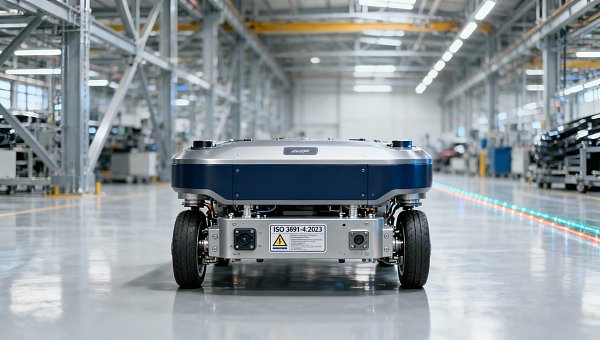
Conclusion: This financing milestone underscores a structural shift—not toward commoditization, but toward specification-driven interoperability in the global AMR supply chain. For stakeholders, it is best understood not as a discrete corporate achievement, but as an inflection point in how Chinese robotics hardware gains functional equivalence in regulated industrial environments. Continued attention should focus on verifiable delivery of the stated technical upgrades—and their tangible impact on certification timelines and integration effort for end users.
Source: Official announcement by Zhongqing Robotics (April 30). No third-party financial or technical verification cited. Ongoing observation recommended regarding actual rollout timelines and certification scope coverage for Chassis Dynamics module enhancements.

The Archive Newsletter
Critical industrial intelligence delivered every Tuesday. Peer-reviewed summaries of the week's most impactful logistics and market shifts.