Monday, May 22, 2024

OBD2 Diagnostic Tool OEM Options: Key Features That Reduce After-Sales Headaches
by
Published
Views:
Choosing the right obd2 diagnostic tool oem partner can significantly reduce warranty claims, training costs, and daily troubleshooting pressure for after-sales teams. For maintenance professionals, the real value lies not only in fault reading accuracy, but also in software stability, vehicle coverage, update support, and integration reliability. This article explores the key OEM features that help service operations stay efficient, consistent, and far less reactive.
For after-sales maintenance teams, the core search intent behind this topic is practical and immediate: how to choose an OEM diagnostic platform that reduces repeat repairs, avoids software-related disruption, shortens diagnosis time, and lowers the burden on technicians in the field. The decision is not only about buying a scan tool. It is about preventing service bottlenecks that appear months later through poor compatibility, unstable updates, weak support, or inconsistent fault interpretation.
The most important takeaway is clear. A good OEM partner is not defined by the longest feature list or the lowest hardware cost. It is defined by whether the tool performs reliably across real service conditions, supports the vehicle mix you actually handle, and helps your team resolve issues faster with fewer callbacks. For after-sales personnel, the right selection criteria are stability, coverage depth, update discipline, workflow usability, data accuracy, and support responsiveness.
What After-Sales Teams Really Need from an OBD2 Diagnostic Tool OEM
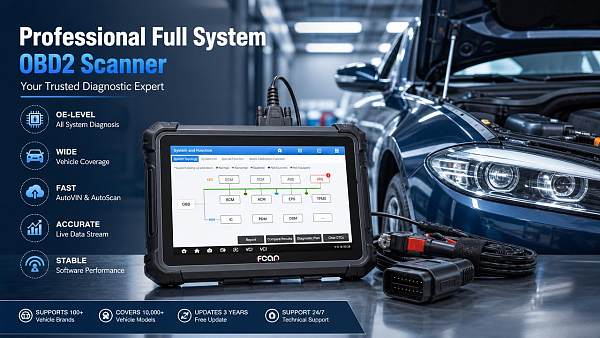
When maintenance staff evaluate an OBD2 platform, they are usually not looking for abstract innovation. They want fewer service interruptions, clearer fault paths, and less wasted time on tools that appear capable during demos but fail in workshop reality. That means the OEM must support efficient work under pressure, not just advertise advanced functions.
In daily after-sales operations, the biggest pain points are often predictable. A tool may connect slowly, freeze during guided diagnostics, misread manufacturer-specific fault codes, or require too many steps for common tasks. In other cases, update packages create compatibility issues, or support teams respond too slowly when vehicles cannot be released on time. These failures turn a diagnostic purchase into an operational headache.
That is why maintenance professionals care less about marketing language and more about consistency. They need to know whether the tool behaves the same way across technicians, service locations, and software versions. They want to avoid situations where one experienced staff member can make the platform work, but the broader team cannot use it efficiently or safely.
From an SEO and buying perspective, anyone searching for obd2 diagnostic tool oem is typically trying to compare OEM options beyond price. They want to identify the features that directly affect after-sales performance: code accuracy, ECU communication stability, service procedure guidance, user interface clarity, and long-term support capability.
Why Software Stability Matters More Than a Long Function List
One of the most overlooked factors in OEM selection is software stability. Many diagnostic tools look competitive on paper because they support a wide range of functions such as code reading, live data, actuator tests, reset services, and module coding. But if the software is unstable, those functions add little value. In after-sales environments, a tool that crashes during a relearn process can cause far more damage than a tool with fewer but dependable capabilities.
Stable software reduces several hidden costs at once. It lowers technician frustration, shortens training time, and reduces the number of workarounds required on the shop floor. It also creates more predictable repair workflows. When the software behavior remains consistent after updates, technicians build trust in the system and use it more effectively.
Maintenance teams should ask OEMs specific questions. How often are bugs patched? Is there a rollback option if an update causes field issues? Are updates validated across the supported vehicle base before release? Does the tool maintain stable Bluetooth or wired communication during long sessions? These are more meaningful questions than simply asking how many vehicle brands are listed in the catalog.
A useful rule is this: broad features sell the tool, but stable software protects after-sales performance. If the OEM cannot demonstrate a disciplined release process, documented issue resolution, and a history of dependable updates, future service headaches are very likely.
Vehicle Coverage Should Be Measured by Depth, Not Just Brand Count
Another common mistake is evaluating vehicle coverage in overly broad terms. Many suppliers claim wide compatibility because they support numerous brands or model lines. However, after-sales teams need to examine coverage depth. A tool may communicate with a vehicle, read generic OBD2 codes, and still fail to access the specific systems needed for efficient repairs.
Depth of coverage includes support for OEM-specific fault codes, subsystem access, bidirectional control, service functions, calibration routines, and model-year continuity. For example, if your workshop regularly handles mixed fleets, imported vehicles, or several trim variations within the same model family, basic support is not enough. You need a platform that can reliably work across those real variations.
Coverage depth also matters when dealing with recurring post-warranty failures. Generic code readers may identify an emissions-related issue, but they often fall short when technicians need to trace root causes through sensor behavior, module communication, or manufacturer-specific logic. This creates unnecessary parts replacement, repeated visits, and frustrated customers.
The best obd2 diagnostic tool oem partners are transparent about what is supported at the system level. They can explain which functions are available by make, model, year, and control module. They do not hide behind broad compatibility claims. For after-sales teams, this level of visibility makes tool selection far less risky.
Fast and Reliable Updates Reduce Warranty Pressure
In modern service environments, a diagnostic platform becomes outdated quickly if its update mechanism is weak. New model years, software revisions, ECU replacements, and evolving fault strategies all require continuous support. If updates arrive late, contain errors, or are difficult to deploy, after-sales teams lose time and confidence.
Update quality affects warranty performance directly. A delayed or incorrect diagnostic interpretation can lead to wrong component replacement, unnecessary escalation, or missed root causes. Over time, these errors increase warranty cost, labor inefficiency, and customer dissatisfaction. In contrast, well-managed updates keep the tool aligned with vehicle changes and reduce guesswork.
Maintenance personnel should evaluate not only update frequency but update governance. Does the OEM provide release notes that are actually useful? Are changes grouped by vehicle family, function, and known issue? Can workshops schedule updates to avoid disrupting active service hours? Is remote deployment possible for multi-site operations?
It is also worth checking whether the OEM uses feedback from field technicians to refine updates. A mature supplier will have a clear process for collecting service data, reproducing problems, and issuing corrective releases. That responsiveness often matters more than raw release volume.
Ease of Use Is Not a Cosmetic Issue
In many workshops, tools are shared across technicians with different experience levels. This makes interface design and workflow logic critical. A confusing menu structure, unclear language, or inconsistent button behavior slows down diagnosis and increases the chance of procedural mistakes. Usability is not just about convenience. It directly affects labor efficiency and repair consistency.
An effective OEM design helps technicians move from symptom to action with minimal friction. Functions should be logically grouped. Fault descriptions should be understandable. Live data views should be easy to compare and filter. Service procedures should follow a sequence that matches actual workshop thinking, not software engineering logic.
For after-sales operations, guided workflows can be especially valuable when staff turnover is high or training resources are limited. They help less experienced technicians avoid skipping important checks. However, guided paths should not trap experienced users in unnecessary steps. The best tools balance speed for experts with support for general users.
This is why product trials should include real workshop tasks, not only demonstration scenarios. Ask technicians to perform common jobs such as reading manufacturer-specific codes, checking freeze-frame data, performing a reset, and confirming a repair. Their feedback will reveal whether the tool truly fits the service environment.
Integration Reliability Prevents Data Silos and Manual Rework
For many service organizations, the diagnostic tool is no longer a standalone device. It is part of a broader after-sales ecosystem that may include repair order systems, fleet maintenance platforms, parts lookup tools, warranty reporting modules, and technical databases. If the OEM solution cannot integrate smoothly, technicians and administrators end up copying data manually, which creates delay and error.
Integration reliability matters in several ways. First, it improves traceability. Fault codes, vehicle identification data, and repair actions can be stored consistently across systems. Second, it helps standardize service records, which supports warranty analysis and recurring fault tracking. Third, it reduces duplicate effort, allowing technicians to focus on diagnosis rather than documentation.
When evaluating OEM options, ask whether the platform supports API access, standardized export formats, cloud synchronization, user management, and audit trails. Even if your current process is relatively simple, future service expansion may require stronger digital connectivity. Choosing a closed system with weak integration can create long-term operational friction.
For organizations handling multiple regions or workshop sites, integration also supports benchmarking. Supervisors can compare diagnostic patterns, identify repeat failure trends, and see whether certain issues are caused by parts quality, software mismatch, or technician process gaps. This kind of visibility turns diagnostics into a management asset rather than just a repair tool.
Technical Support Quality Is a Major Part of the Product
Many buyers focus on hardware and software but underestimate support. In practice, support quality often determines whether an after-sales team can maintain service continuity when a difficult case appears. If the OEM cannot respond quickly with useful guidance, even a good platform becomes risky.
Strong support includes more than a hotline. It should cover onboarding, technical documentation, fault escalation, update clarification, and regional service understanding. Workshops need access to support teams that can interpret logs, explain anomalies, and provide timely answers when the issue affects vehicle release schedules.
Response time is only one metric. Accuracy matters just as much. Support staff should understand both the product and the maintenance context. Generic replies or script-based answers waste valuable time. The best OEM partners provide layered support, where basic issues are resolved fast and complex cases are escalated to engineers who can address protocol, ECU, or software-level questions.
It is also useful to review how the OEM handles known issues. Do they publish technical bulletins? Are customers proactively informed when a software conflict is discovered? Is there a service portal where cases can be tracked clearly? These support mechanisms reduce uncertainty and make after-sales teams less reactive.
Training Burden and Technician Adoption Affect Total Cost More Than Buyers Expect
A low purchase price can be misleading if the tool requires extensive training, repeated retraining after updates, or constant dependence on a few senior technicians. For after-sales teams, the real cost includes learning time, onboarding effort, misuse risk, and recovery from diagnostic mistakes.
An OEM that reduces training burden creates immediate value. Clear workflows, accessible documentation, stable interfaces, and role-based access all help technicians become productive faster. This is especially important in service environments with workforce turnover, multi-brand operations, or expanding service networks.
Ask whether training materials are available in formats technicians will actually use. Short video guides, service-based walkthroughs, troubleshooting trees, and searchable knowledge bases are often more practical than long manuals. Also check whether the OEM offers training aligned with specific job roles such as general technician, diagnostic specialist, or service supervisor.
Adoption should be measured during pilot use. If technicians avoid the tool unless forced, that is a warning sign. Good adoption usually means the tool saves time in ordinary jobs, not just in complex cases. The right OEM solution should become a trusted part of daily maintenance, not a shelf product used only when other options fail.
How to Evaluate an OBD2 Diagnostic Tool OEM Before It Creates Problems
The safest way to select an OEM partner is to test against your actual after-sales conditions. Start with your most common vehicle categories, frequent fault types, and high-pressure service tasks. Then compare suppliers based on outcomes, not presentations. Can the tool complete the tasks reliably, repeatedly, and across different users?
A practical evaluation checklist should include communication speed, software stability, VIN recognition, fault-code depth, live-data usability, bidirectional controls, update process, integration options, and support responsiveness. It should also include less obvious factors such as battery drain behavior, connection recovery after interruption, and clarity of error messages.
Field validation is essential. A workshop pilot over several weeks provides better evidence than a short demonstration. During the pilot, track metrics such as average diagnosis time, repeat scans, failed procedures, technician feedback, and cases requiring supplier assistance. These data points reveal whether the OEM truly reduces after-sales pressure.
It is also wise to assess supplier maturity. Look for evidence of engineering discipline, industry standard awareness, product roadmap clarity, and quality management processes. In a market where electronics, automotive systems, and digital service infrastructure increasingly overlap, buyers benefit from partners that understand cross-functional reliability rather than just standalone device sales.
Final Decision: Choose the OEM That Reduces Rework, Not Just the One That Looks Advanced
For maintenance professionals, the best obd2 diagnostic tool oem option is the one that quietly removes friction from daily work. It helps technicians find faults accurately, complete procedures reliably, stay current with vehicle changes, and keep service records consistent. Most importantly, it reduces repeat repairs, avoids unnecessary escalation, and supports predictable service delivery.
If you are comparing OEM options, prioritize what affects after-sales outcomes the most: software stability, deep vehicle coverage, disciplined updates, practical usability, integration reliability, strong technical support, and manageable training requirements. These are the features that reduce headaches long after the purchase order is approved.
In short, the right OEM partner is not simply a tool manufacturer. It is an operational reliability partner for your service team. When chosen carefully, the platform becomes a force multiplier for technicians and a safeguard against the hidden costs of poor diagnostics.

The Archive Newsletter
Critical industrial intelligence delivered every Tuesday. Peer-reviewed summaries of the week's most impactful logistics and market shifts.