Monday, May 22, 2024

Computer Parts Exporter Checklist for Fewer Quality Claims and Returns
by
Published
Views:
For every computer parts exporter serving distributors, wholesalers, and agents, fewer quality claims and returns start with stronger control before shipment. From component verification and packaging standards to documentation accuracy and traceability, this checklist highlights the practical steps that protect margins, build buyer confidence, and support more reliable cross-border supply performance.
Why does a computer parts exporter need a formal pre-shipment checklist?
Many distributors assume quality issues begin on the production line, but a large share of claims actually emerge from weak shipment discipline. A computer parts exporter may source compliant motherboards, SSDs, cooling fans, power supplies, connectors, or graphics-related subassemblies, yet still face returns because of mixed lots, mismatched labels, insufficient cushioning, or incomplete documentation. In cross-border trade, even a small identification error can trigger channel disputes, warehouse confusion, installation mistakes, and end-customer dissatisfaction.
For agents and wholesalers, returns are not only about direct replacement cost. They also affect inventory turnover, after-sales labor, freight exposure, and confidence in future purchase orders. That is why a practical checklist matters. It converts quality from a vague promise into a repeatable shipment control method. A disciplined computer parts exporter uses that checklist to confirm product identity, packaging fitness, compliance records, traceability, and communication readiness before cartons leave the warehouse.
This approach aligns with the broader industrial logic promoted by technical benchmarking platforms such as Global Industrial Matrix, where cross-sector procurement resilience depends on verifiable data, standards alignment, and transparent process control. In electronics distribution, those principles are especially important because products may look similar while carrying very different firmware, interfaces, thermal limits, or regional approval requirements.
What should distributors and agents verify first when evaluating a computer parts exporter?
The first question is not price. It is consistency. A reliable computer parts exporter should be able to show how the same part number remains consistent across batches, factories, and shipment dates. Buyers should confirm whether the exporter controls incoming verification, batch segregation, electrostatic discharge handling, final inspection records, and packaging instructions by SKU. If these controls are unclear, lower unit cost can quickly turn into higher claim rates.
Distributors should also ask how the exporter handles component substitutions. In fast-moving electronics markets, supply fluctuations can lead to silent changes in NAND source, capacitor brand, chipset stepping, cable gauge, or fan bearing design. Even when performance appears similar, such changes may affect compatibility, warranty behavior, or customer perception. The better computer parts exporter documents any approved substitution in advance and separates original from revised configurations.
Another early checkpoint is claim response readiness. If a buyer reports a field issue, can the exporter trace lot number, production date, test record, and packing operator? If not, one isolated complaint can become a broad dispute covering an entire shipment. Traceability reduces unnecessary returns because both sides can narrow the problem to a specific batch, pallet, or carton rather than treating all inventory as suspect.
Which inspection points most directly prevent quality claims and returns?
The most effective inspection points are the ones closest to actual failure modes. A computer parts exporter should not rely only on visual checks. Inspection should connect to how parts fail in storage, transit, integration, and end use. For example, CPUs and memory modules need packaging and handling controls that protect contacts and prevent electrostatic exposure, while cases, coolers, and power accessories need stronger focus on mechanical damage, accessory completeness, and outer-carton integrity.
At minimum, exporters should verify model number, revision, quantity, cosmetic condition, connector condition, critical dimensions where relevant, and labeling correctness. Functional spot testing is equally valuable for selected categories such as power supplies, cooling fans, storage devices, display adapters, and I/O accessories. Even a sampling-based test regime can detect swapped specifications or dead-on-arrival risk before goods enter international transit.
Firmware and software-linked parts deserve special attention. For SSDs, motherboards, mini PCs, and communication cards, hardware may be physically correct while firmware revision is outdated or regionally incompatible. A capable computer parts exporter should therefore include version verification in the checklist when the product category requires it. This is particularly important for channel buyers serving system integrators, because configuration inconsistency often leads to hidden support costs rather than immediate visible defects.
Finally, exporters should compare packed goods against customer-approved references. It is not enough to pass internal standards if the buyer approved a specific label language, barcode format, accessory bundle, or retail box print. Many return cases are not technical defects at all; they are compliance or expectation mismatches caused by poor last-mile verification.
How important are packaging, labeling, and ESD controls for a computer parts exporter?
They are critical, because many quality claims begin after the product has already passed inspection. Electronics travel through consolidation points, customs handling, domestic trucking, and distributor warehousing. Each stage introduces shock, compression, humidity, and handling variability. A computer parts exporter that underestimates packaging discipline is effectively pushing risk downstream to the distributor.
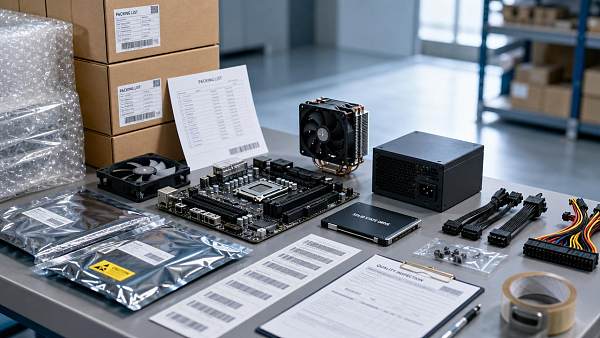
For sensitive electronics, anti-static bags, conductive trays, cushioning density, and carton drop resistance should match the product profile. Heavy heat sinks, desktop power supplies, and metal enclosures require packaging designed against internal movement. Smaller parts need clear inner labels to prevent picking errors during distribution. Mixed-SKU cartons should be avoided unless the buyer explicitly requests them and carton mapping is documented.
Labeling is just as important as cushioning. Outer carton labels should match the invoice, packing list, and internal SKU references exactly. Barcodes must scan correctly. Country-of-origin marking, serial labels, and compliance marks should be checked before sealing. If a distributor receives inventory with inconsistent carton data, the result may be delayed receiving, wrong stock allocation, and unnecessary return requests even when the physical products are acceptable.
ESD handling also deserves explicit control. Electrostatic damage may not create immediate visible defects, which makes it especially costly for channel partners. Products can fail only after installation, leading the end customer to blame the distributor. A professional computer parts exporter should be able to explain grounding measures, protected workstations, compliant packaging materials, and handling instructions used during packing and final inspection.
What documentation and traceability records should be included before shipment?
Strong documentation turns a shipment into a manageable commercial transaction instead of a future argument. At shipment stage, a computer parts exporter should provide a clean packing list, invoice, carton count, part-number mapping, and any required test or compliance documents. Depending on the product, this may also include serial number ranges, lot numbers, date codes, certificate references, or approved specification sheets.
The best exporters create a direct bridge between physical goods and records. That means each carton, pallet, or lot can be traced back to inspection status and source batch. When a distributor later reports a missing accessory, interface mismatch, or failure pattern, both sides can quickly isolate affected inventory. This is far more efficient than broad assumptions that force complete shipment holds or blanket replacements.
For channel businesses working across multiple markets, document accuracy also supports customs compliance and after-sales transparency. Incorrect harmonized descriptions, incomplete product naming, or inconsistent quantity declarations can create delays that customers may misinterpret as supplier unreliability. In this sense, documentation quality is part of product quality. A computer parts exporter that is technically strong but administratively weak still creates channel risk.
What are the most common mistakes that increase returns for distributors and wholesalers?
One common mistake is assuming all returns come from manufacturing defects. In reality, many are caused by wrong model shipment, accessory omission, retail box damage, label mismatch, or firmware inconsistency. If the exporter and distributor focus only on defect rate, they may ignore the operational errors that drive customer complaints.
A second mistake is failing to define acceptance criteria before production or before shipment. Terms such as “same as last order” are too vague for electronics supply. The buyer and computer parts exporter should align on revision control, packaging method, carton labeling, allowed substitutions, and inspection standard. Without that alignment, both parties may believe they are correct when a dispute occurs.
A third mistake is inadequate claim feedback loops. If distributors simply report “high failure rate” without sharing serial ranges, photos, installation conditions, or return reasons by category, root-cause analysis becomes slow and emotional. The better practice is to classify returns into transport damage, wrong item, cosmetic issue, functional failure, compatibility problem, and paperwork issue. That helps a computer parts exporter improve the right control point instead of reacting blindly.
Another frequent issue is overconsolidation. To save freight, some shipments combine fragile, heavy, and static-sensitive items without proper internal separation. This may lower logistics cost on paper while sharply increasing replacement rates. For a distributor, one damaged shipment can erase the margin benefit of several well-priced orders.
How can a distributor build a practical checklist with a computer parts exporter?
The most useful checklist is short enough to apply every time and specific enough to catch real risk. Start by dividing controls into five groups: product identity, functional verification, packaging protection, document accuracy, and traceability. Then adapt the details by SKU family. SSDs, fans, power units, memory, and cables do not fail in the same way, so one generic checklist is not enough.
A distributor should ask the computer parts exporter to confirm each shipment against agreed checkpoints such as approved BOM or part number, visible condition, quantity, serial range where relevant, ESD-safe packing, carton drop protection, barcode readability, and complete documentation. For higher-value or higher-return categories, add photo evidence or random functional test records. This does not need to be complex; it needs to be repeatable.
It is also wise to define escalation rules. For example, what happens if one sampled unit fails, if a carton label differs from the invoice, or if packaging materials are temporarily substituted? Pre-agreed rules help both parties act quickly without delaying every order. Over time, this turns the exporter relationship from transactional sourcing into controlled supply partnership.
Quick checklist distributors can request before release
- Part number, revision, and quantity verified against PO
- No unapproved component or firmware substitution
- Functional sampling completed for applicable categories
- ESD-safe and transit-appropriate packaging confirmed
- Inner and outer labels match carton list and invoice
- Lot, date code, or serial traceability retained
- Photos or inspection evidence available on request
When is a stricter quality control program worth the extra cost?
Stricter control is usually worth the cost when products are high value, technically sensitive, fast moving, or difficult to return economically. For example, if the buyer serves enterprise integrators, e-commerce channels with strict seller ratings, or multi-country distribution networks, one inconsistent batch can trigger reputational damage well beyond the replacement value. In those cases, a more rigorous program from the computer parts exporter often produces better total cost performance.
The same is true when lead times are tight. If replacement stock takes weeks to replenish, preventing one avoidable claim may be more valuable than reducing inspection effort. Buyers should evaluate quality control cost against return freight, channel penalties, inventory lockup, engineer time, and lost reorders. The math usually favors prevention.
What should you clarify before moving forward with a computer parts exporter?
Before placing or expanding orders, distributors, wholesalers, and agents should clarify a few operational questions: Which product families require functional tests, what substitutions are acceptable, how carton labels will be formatted, what traceability level is available, how claims will be classified, and what evidence is needed for corrective action. These details are more valuable than broad promises of “good quality.”
A dependable computer parts exporter helps buyers reduce uncertainty before shipment, not just solve problems after arrival. That is the core advantage for channel partners who need stable inventory, lower claim rates, and stronger customer trust. If you need to confirm a practical quality checklist, packaging method, traceability scope, inspection level, shipment cycle, or cooperation workflow, those are the right topics to discuss first before finalizing price and volume.

The Archive Newsletter
Critical industrial intelligence delivered every Tuesday. Peer-reviewed summaries of the week's most impactful logistics and market shifts.