Monday, May 22, 2024

How to Select the Right Hardware for EV Charging Stations
by
Published
Views:
Selecting the right hardware for EV charging stations is critical for seamless integration with Electric Vehicles, renewable energy systems, and smart Mobility infrastructure. As global demand surges, procurement teams and technical evaluators must prioritize high-performance electronics, semiconductors, and sensors that meet ISO/IATF standards while ensuring durability. This guide empowers decision-makers—from automotive engineers to project managers—to navigate ADAS compatibility, injection molding quality, and computer parts integration for future-proof charging solutions.
Key Hardware Components for EV Charging Stations
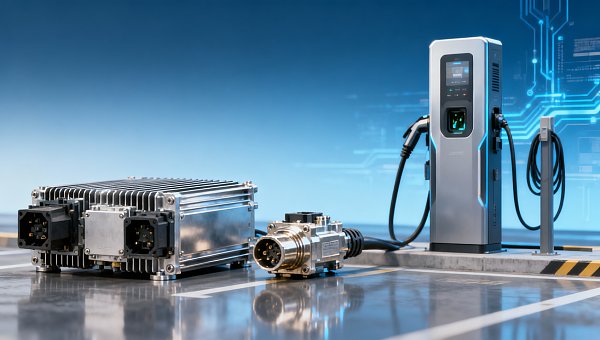
EV charging stations require a sophisticated blend of mechanical, electrical, and digital components. The core hardware typically includes power conversion modules (AC/DC), contactors, circuit protection devices, and communication interfaces. High-voltage cables and connectors must withstand 400–1000V DC with IP65 or higher ingress protection.
Critical subsystems to evaluate:
- Power electronics: IGBT or SiC-based converters (3.3–350kW range)
- Control units: ARM Cortex or x86 processors with CAN FD/Ethernet
- Safety components: Residual Current Devices (RCDs) meeting IEC 62955
- Thermal management: Liquid cooling for >50kW stations
Material Selection Criteria
Industrial-grade polymers for enclosures should achieve UL94 V-0 flame rating while maintaining -40°C to +85°C operational range. Metal components require salt spray resistance exceeding 500 hours per ASTM B117.
Technical Specifications Comparison
The table below benchmarks Level 2 vs. DC fast charging hardware configurations:
DC fast chargers require 3–5 times more semiconductor content but deliver 10–15x faster charging. Procurement teams should balance upfront costs ($15,000–$75,000 per unit) against operational lifespan (8–12 years).
Certification & Compliance Checklist
Global deployments demand adherence to regional standards. Key certifications include:
- North America: UL 2202, UL 2251, NEC Article 625
- Europe: IEC 61851, EN 62196
- China: GB/T 18487, GB/T 20234
- Japan: CHAdeMO 3.0, JIS C 8815
EMC/Environmental Testing
Components must pass 8–12 weeks of validation including:
- IEC 61000-4-3 (Radiated Immunity)
- ISO 16750-3 (Mechanical Shock)
- IP65/67 water ingress tests
Procurement Decision Framework
Technical evaluators should assess suppliers across 5 critical dimensions:
Leading manufacturers achieve <95% first-pass yield in production audits. Request IATF 16949 certification documentation for automotive-grade components.
Future-Proofing Considerations
With charging standards evolving every 3–5 years, prioritize hardware supporting:
- Plug & Charge (ISO 15118)
- V2G/V2H bidirectional power flow
- 300–1000V battery architectures
- OCCP 2.0 backend integration
Modular Architecture Benefits
Scalable designs allow power stacking from 50kW to 350kW through 3–5 power module additions. This reduces CapEx by 15–25% compared to fixed-configuration units.
Technical Consultation Services
Our cross-industry benchmarking platform provides:
- Component-level failure mode analysis (FMEA)
- ISO 15118 conformance testing
- Supply chain risk assessment for semiconductors
- Total Cost of Ownership modeling
Request a hardware specification review to validate your charging station design against 12 international standards. Our engineering team can optimize your bill of materials for performance, compliance, and supply chain resilience.

The Archive Newsletter
Critical industrial intelligence delivered every Tuesday. Peer-reviewed summaries of the week's most impactful logistics and market shifts.