Monday, May 22, 2024

Jotun to Expand Suzhou R&D Center with $330M Investment for EV Battery Coatings
by
Published
Views:
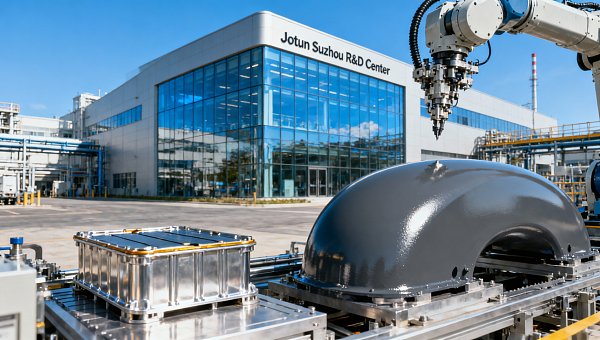
On May 21, 2026, Norwegian coatings group Jotun announced a $330 million expansion of its Suzhou R&D and production base in China, focusing on high-performance coatings for electric vehicle (EV) battery enclosures and thermal management systems. This development signals growing strategic alignment between global specialty materials providers and China’s EV supply chain — particularly for enterprises involved in hardware components, precision tooling, and thermal interface materials.
Event Overview
On May 21, 2026, Jotun confirmed a $330 million investment to expand its Suzhou R&D and manufacturing facility. The project prioritizes the development of advanced coatings for EV battery housings and thermal management systems. Publicly disclosed information specifies that the expansion will drive increased procurement of Chinese-sourced hardware components—including high-temperature-resistant sealing parts and thermal interface materials—as well as tooling insights such as high-precision coating fixtures.
Impact on Specific Industry Segments
Direct Trade Enterprises
These firms act as intermediaries between Jotun and Chinese component suppliers. Their role may evolve from transactional distribution to technical coordination, especially where coating process compatibility requires joint validation with fixture or seal manufacturers. Impact manifests in tighter delivery windows, more frequent engineering feedback loops, and potential shifts toward consignment or VMI inventory models.
Raw Material Procurement Enterprises
Suppliers of substrate-compatible resins, ceramic fillers, or functional additives used in thermally stable coatings may see renewed interest—particularly if Jotun’s formulation work emphasizes localized raw material qualification. However, no public statement confirms changes to Jotun’s upstream sourcing strategy; impact remains contingent on downstream technical specifications issued during the expansion phase.
Contract Manufacturing & Precision Fabrication Firms
Enterprises producing high-precision coating jigs, custom thermal interface pads, or battery enclosure sub-assemblies face direct demand implications. Jotun’s emphasis on ‘tooling insights’ suggests co-development expectations—not just part supply. Impact centers on design-for-coating (DFC) integration, tolerance validation protocols, and documentation traceability aligned with automotive-grade quality standards (e.g., IATF 16949).
Supply Chain Service Providers
Logistics, testing labs, and certification consultants supporting EV battery material compliance (e.g., UL 94, ISO 16750-3, GB/T 31467.3) may experience increased inquiry volume. Jotun’s stated focus on thermal management systems implies new test case requirements—especially around thermal cycling durability and adhesion under humidity/condensation conditions.
What Relevant Enterprises or Practitioners Should Monitor and Act On
Track official technical specification releases from Jotun’s Suzhou team
While the investment announcement confirms strategic direction, detailed performance requirements (e.g., maximum operating temperature, dielectric strength, cure schedule compatibility) have not yet been published. Enterprises should monitor Jotun’s China-facing technical bulletins and supplier portal updates—not just press releases—for actionable parameters.
Assess exposure to targeted hardware categories: high-temp seals and thermal interface materials
The announcement explicitly names these two component types as priority procurement areas. Companies supplying variants meeting automotive-grade thermal stability (>150°C continuous), low outgassing, and flame-retardant certifications should review current qualification status against Jotun’s known global material standards—and prepare internal gap assessments.
Distinguish between signal and execution timeline
This is a capital commitment announcement—not a procurement tender. Construction, equipment commissioning, and process validation will likely extend over 24–36 months. Near-term action should focus on capability mapping and relationship readiness—not speculative capacity expansion.
Prepare for joint technical engagement, not just commercial bidding
Jotun’s reference to ‘tooling insights’ implies expectation of early-stage collaboration on fixture design, coating thickness control, and edge coverage optimization. Suppliers should identify internal cross-functional teams (process engineering + application lab + QA) capable of participating in pre-qualification technical workshops.
Editorial Perspective / Industry Observation
Observably, this move reflects broader industry recalibration: global coatings players are shifting R&D gravity toward localized battery system integration challenges—not just generic corrosion protection. Analysis shows the $330 million figure is substantial for a single-site R&D upgrade, suggesting Jotun anticipates multi-year technology leadership positioning in EV thermal coating applications. It is currently more accurate to interpret this as a strong strategic signal than an immediate market shift—its real-world impact depends on how rapidly Jotun transitions from lab-scale formulation to qualified, volume-ready coating systems validated by Tier 1 battery pack integrators. Continued attention is warranted because coating performance at battery module level increasingly intersects with functional safety (ISO 26262 ASIL-B considerations) and lifecycle reliability metrics—areas where material suppliers rarely engage directly today.
Concluding, this investment underscores the deepening material-system interdependence within the EV battery value chain. It does not signify a sudden market opening, but rather a structured, long-horizon commitment to solving application-specific coating challenges in thermal management—a domain where material performance, mechanical integration, and process repeatability converge. Current interpretation should emphasize preparedness over reaction: readiness to respond to technical specifications, not anticipation of near-term volume orders.
Source Disclosure:
Main source: Official Jotun press release dated May 21, 2026.
Note: Technical specifications, supplier qualification timelines, and final scope of local hardware procurement remain unconfirmed and require ongoing monitoring.

The Archive Newsletter
Critical industrial intelligence delivered every Tuesday. Peer-reviewed summaries of the week's most impactful logistics and market shifts.