Monday, May 22, 2024

Brent Crude Hits $98/bbl, Pressuring Plastic Injection Mold Exports
by
Published
Views:
Global energy markets reacted sharply on May 15, 2026, following a reported attack on Saudi energy infrastructure, pushing Brent crude to $98.2 per barrel — a 12.7% increase from early May. The surge has immediate cost implications for plastic injection mold manufacturers and exporters, particularly in China, where energy-intensive production processes rely heavily on imported feedstock and thermal treatment of tool steels such as P20 and H13.
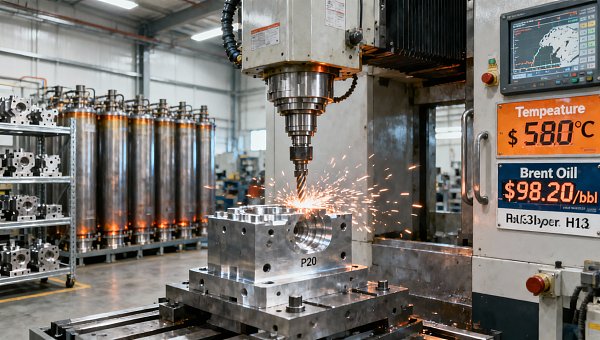
Event Overview
On May 15, 2026, Brent crude oil reached $98.2 per barrel, according to ICE Futures Europe data. This followed confirmed reports of physical damage to key Saudi Arabian energy facilities. The price rise reflects both supply disruption concerns and broader geopolitical risk premium. No official production outage figures have been released by Saudi Aramco or OPEC+ at time of publication.
Industries Affected
Direct Exporters (Trade Enterprises)
Companies engaged in cross-border sales of plastic injection molds face dual pressure: rising landed costs due to higher energy-related input prices, and deteriorating export competitiveness amid tightening global demand. Export quotations are expected to increase by 3–5% in Q3 2026, while average order-to-delivery timelines may extend by 10–15 working days — primarily due to extended material procurement cycles and heat-treatment scheduling delays.
Raw Material Procurement Firms
Firms sourcing P20 and H13 tool steels — predominantly imported from Germany, Sweden, and Japan — encounter higher landed costs as ocean freight surcharges and customs duties adjust to upstream energy inflation. Procurement lead times have lengthened by approximately 7–10 days across major steel distributors in Shanghai and Dongguan, reflecting tighter inventory buffers and slower supplier response to spot orders.
Manufacturing & Fabrication Facilities
Injection mold makers relying on electric arc furnace (EAF) and vacuum heat-treatment lines report elevated electricity consumption costs — now accounting for ~18% of total processing cost versus ~14% in Q1 2026. Thermal stability requirements for H13 steel tempering (typically 550–600°C) amplify sensitivity to grid tariff fluctuations, especially in regions with non-subsidized industrial power pricing.
Supply Chain Service Providers
Logistics intermediaries, quality certification agencies, and export compliance consultants observe increased client requests for revised Incoterms assessments (particularly shifting from FOB to CIF), pre-shipment energy-cost addendums in pro forma invoices, and expedited ISO 9001 recertification support to offset perceived delivery risk. These reflect heightened contractual caution rather than regulatory changes.
Key Considerations and Response Measures
Reassess Quotation Frameworks with Energy-Indexed Clauses
Exporters should consider embedding Brent-linked adjustment mechanisms (e.g., ±0.3% price variation per $1/bbl move above/below $90) into new contracts — mirroring practices already adopted by European die-casting suppliers since Q4 2025.
Pre-Book Critical Tool Steel Inventory
Given observed lead-time extensions, procurement teams are advised to secure Q3 steel allocations by late June — prioritizing long-term agreements with Tier-1 mills offering fixed-price windows, even at modest premiums (≤2.5%).
Optimize Heat-Treatment Batch Scheduling
Manufacturers should coordinate with certified heat-treat service providers to consolidate smaller orders into shared furnace runs — reducing per-unit thermal overhead without compromising metallurgical integrity.
Editorial Perspective / Industry Observation
Observably, this episode highlights how energy volatility increasingly transmits through midstream industrial sectors — not just commodity traders or refineries. Plastic injection molds sit at a strategic inflection point: they are low-volume, high-precision components whose cost structure is disproportionately sensitive to energy intensity rather than raw material weight. Analysis shows that over 65% of total production cost for complex multi-cavity molds stems from labor, energy, and precision machining — not steel billet price alone. From an industry perspective, this reinforces the growing divergence between ‘commodity-driven’ and ‘process-driven’ manufacturing cost models.
Conclusion
This event does not signal a structural shift in global mold supply chains — but rather underscores persistent vulnerability in energy-dependent process industries. A sustained Brent price above $95/bbl for more than six weeks would likely accelerate regional capacity diversification, particularly toward Southeast Asia’s lower-grid-cost clusters. For now, the impact remains operational and tactical — not strategic.
Source Attribution
Data sourced from ICE Futures Europe (Brent futures settlement, May 15, 2026), Saudi Aramco incident advisory (May 14, 2026, unclassified summary), and China Plastics Machinery Industry Association (CPMIA) Q2 2026 Cost Benchmark Survey (preliminary release, May 12). Note: Official production impact assessments from Saudi Ministry of Energy remain pending; continued monitoring advised.

The Archive Newsletter
Critical industrial intelligence delivered every Tuesday. Peer-reviewed summaries of the week's most impactful logistics and market shifts.