Monday, May 22, 2024

How to estimate landed costs for CNC machining tools in Latin America
by
Published
Views:
How to estimate landed costs for CNC machining tools in Latin America
A competitive supplier quote can become an expensive purchase once freight, import duties, taxes, and customs fees enter the calculation. For procurement teams sourcing CNC machining tools in Latin America, estimating landed cost requires more than comparing unit prices. Destination-country rules, tariff classification, Incoterms, and exchange-rate exposure can all change the final budget.
The practical challenge is separating three figures that are often confused: the cash needed to receive the shipment, the cost retained after eligible tax recovery, and the operating cost of using the tools. Each answers a different purchasing question. Keeping them separate makes supplier comparisons more defensible and prevents a seemingly cheaper import from consuming an unexpected share of working capital.
Define what is being imported—and where the estimate ends
“CNC machining tools” is a purchasing category, not a single customs classification. It may mean solid-carbide end mills, indexable inserts, boring bars, toolholders, measuring accessories, or complete CNC machine tools. These products can have different tariff treatments, documentation requirements, freight profiles, and handling costs.
Build the estimate at SKU level where classification or origin differs. Record the tool’s function, material, construction, manufacturer part number, country of origin, quantity, net weight, and packed dimensions. A description such as “CNC accessories” is too vague for reliable classification. Technical drawings or catalog sheets can help a customs broker distinguish a cutting tool from a holder or machine component.
Also define the delivery endpoint. A port-arrival estimate is not comparable with delivery to a machining plant inland. For repeat purchases, use a consistent boundary: received at the named facility, including customs clearance and domestic transport, but excluding production consumption. If the purchase is a complete machine, identify rigging, unloading, installation, and commissioning separately rather than burying them in “delivery.”
Build a cost bridge instead of adding a flat import percentage
A blanket uplift on the supplier price is convenient but unreliable. Freight does not necessarily scale with invoice value, brokerage may include minimum charges, and taxes can apply to bases that include other charges. Use individual cost lines with an owner, a source, and a validity date.
Gross landed cash requirement = supplier invoice + logistics not already included + duties and import taxes + clearance and destination charges.
Net landed acquisition cost = gross landed cash requirement − import taxes confirmed as recoverable. Financing costs associated with delayed recovery should be shown separately or added under an agreed accounting policy.
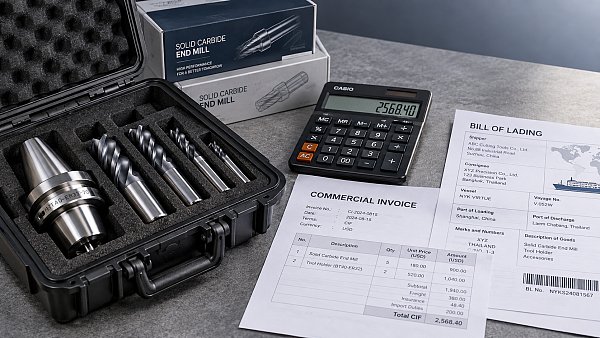
These are budgeting formulas, not customs valuation rules. The customs value and each tax base must be calculated under destination-country requirements. Do not assume that the commercial invoice alone is the duty base, or that every tax applies to the same amount.
Resolve classification, origin, and tax treatment before approving the order
A supplier’s HS code is a useful starting point, not a substitute for destination-country review. The Harmonized System provides an international framework, but national tariff extensions and interpretations still matter. Ask the importer’s broker to validate the classification against the actual product specification and explain any uncertainty before shipment.
Country of dispatch and country of origin are different facts. A tool shipped from a distributor’s warehouse does not automatically acquire that country’s origin. Preferential duty treatment depends on the applicable trade agreement, the product-specific origin rule, and acceptable supporting documentation. Model the ordinary duty treatment unless the preference can be substantiated.
Latin America should not be treated as one customs market. For Mexico, confirm the current tariff classification, applicable restrictions, and origin requirements through official resources such as SAT and SNICE, supported by the customs broker. For Brazil, obtain an NCM-based calculation and review federal and state-level tax treatment with local specialists. For Chile, verify the tariff and any agreement-based preference through the national customs authority.
The point is not to maintain a regional spreadsheet of supposedly permanent rates. It is to keep a dated, country-specific calculation tied to the importing entity, customs regime, product, and origin. Check whether trade remedies, licensing, or other controls affect the exact goods; do not assume ordinary duty is the only border measure.
A recoverable tax still needs funding
Import VAT or similar taxes may be creditable under local rules, but eligibility depends on the importer’s status, documentation, and use of the goods. Finance should confirm both recoverability and the expected timing. A recoverable amount belongs in the cash forecast even when it is excluded from the net acquisition-cost comparison. If recovery is uncertain, flag the amount rather than automatically deducting it.
Normalize Incoterms before comparing suppliers
Comparing an EXW quote with a DAP quote without adjustment rewards whichever supplier has left more costs outside the price. Require the Incoterms version and a precise named place. “Delivered to Mexico” does not identify a usable cost boundary.
Under EXW, the buyer generally takes on extensive transport responsibilities, and export clearance arrangements can be awkward for a foreign buyer. FCA may provide a clearer handover for many containerized or air shipments. Under DAP, the seller arranges delivery to the named destination, but import clearance and import duties and taxes generally remain with the buyer.
DDP needs particular scrutiny. Confirm who will legally act as importer, how taxes will be documented, and whether the arrangement supports any intended tax credit. A “tax included” price is not enough. Incoterms allocate specified responsibilities and risks; they do not resolve tax eligibility, product conformity, or payment terms.
For every quote, mark each cost as included, excluded, or unconfirmed. This simple exercise catches both missing charges and double counting—for example, adding international freight again when it is already included in the supplier’s price.
Price the actual shipment, not just its weight
Small tooling orders can carry disproportionate clearance and handling costs because some charges apply per shipment rather than per tool. Consolidation may reduce those fixed costs, but only if the savings exceed additional inventory, waiting time, and possible stockout exposure.
Ask forwarders to quote from the same packing list and service scope. Air and courier pricing may use chargeable weight rather than net weight. Sea freight can introduce terminal charges and minimum billing that make a low headline freight rate misleading for a small shipment.
- Confirm whether destination handling, customs advances, and final-mile delivery are included.
- Record storage allowances, free time, and charges triggered by delayed clearance.
- Check cargo insurance scope, deductible, and exclusions against the shipment’s value and handling risks.
- Confirm whether wood packaging requires applicable phytosanitary treatment or marking.
For urgent replacement tools, compare the premium for expedited shipping with the documented operational exposure. Keep that exposure outside the landed-cost calculation itself: it explains the purchasing decision but is not a freight invoice.
Make uncertainty visible without inflating every line
A useful estimate has a base case and a downside case. Vary the inputs that could realistically change: freight validity, exchange rates, customs treatment awaiting confirmation, or storage caused by missing documents. Avoid a single unexplained contingency percentage that conceals what the team still needs to resolve.
Exchange-rate exposure deserves its own schedule. Supplier deposits, final payments, freight settlement, and customs payments may occur on different dates and use different conversion conventions. Budget with the treasury-approved planning rate, then show a sensitivity. The customs authority’s valuation exchange rate may differ from the bank rate used to pay the supplier.
Allocate shipment costs using a stated method. Weight or volume may suit freight, value may suit insurance, and customs duties should follow the relevant goods lines. Dividing every charge equally across SKUs can distort tool-level profitability and reorder decisions.
Use landed cost to compare equivalent tooling—not merely cheaper invoices
A defensible comparison requires technical equivalence. Confirm dimensions, substrate, coating, application range, holder compatibility, and inspection documentation before treating two tools as interchangeable. A lower landed price does not establish a lower cost per accepted part; tool life, cutting conditions, and scrap require separate application evidence.
This is where Global Industrial Matrix (GIM)’s cross-sector intelligence and technical benchmarking approach fits procurement work. Its perspective connects precision tooling with automotive, electronics, smart agriculture, and industrial infrastructure, helping frame comparisons around verifiable specifications and supply-chain risks. Technical benchmarking complements—but does not replace—local customs and tax advice.
Before releasing the purchase order, retain the supplier quote, packing assumptions, classification review, origin evidence, freight offer, tax calculation, and exchange-rate basis in one estimate file. Assign an owner to every unresolved charge. After receipt, reconcile the estimate against actual invoices and customs entries. The next order should start from those verified costs, not from the same assumptions that caused the previous variance.

The Archive Newsletter
Critical industrial intelligence delivered every Tuesday. Peer-reviewed summaries of the week's most impactful logistics and market shifts.