Monday, May 22, 2024

Hydraulic Press for Forging: Key Specs Before Machine Selection
by
Published
Views:
Selecting a hydraulic press for forging is not just a matter of tonnage. It requires disciplined review of frame rigidity, stroke control, pressure stability, energy efficiency, automation readiness, and long-term maintainability.
For technical evaluation, the right specification framework helps separate marketing claims from measurable performance. It also reduces equipment risk across heavy industrial, automotive, tooling, mobility, and infrastructure supply chains.
What Defines a Hydraulic Press for Forging?
A hydraulic press for forging uses controlled hydraulic force to deform heated or cold metal between dies. It delivers pressure through cylinders, guided platens, and a rigid structural frame.
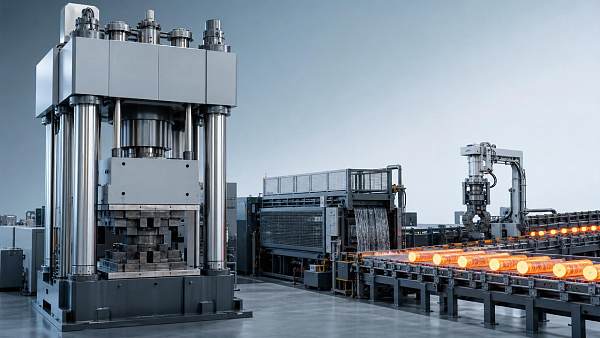
Unlike mechanical presses, hydraulic systems can sustain force through the stroke. This makes them useful for deep deformation, large parts, and variable forming cycles.
The essential question is not whether the machine can reach a peak number. The question is whether it can hold usable force with repeatable accuracy.
Which applications need this press type?
A hydraulic press for forging suits open-die forging, closed-die forging, extrusion, upsetting, coining, and precision forming. It is common in alloy steel, aluminum, titanium, and superalloy workflows.
It also supports cross-sector production. Typical parts include shafts, gears, flanges, connectors, structural brackets, battery components, and high-strength industrial hardware.
- Open-die forging for large billets and repair-grade parts.
- Closed-die forging for repeatable geometries and tighter tolerances.
- Cold forging where surface finish and dimensional control matter.
- Hot forging where controlled deformation reduces internal defects.
How Much Tonnage Is Enough for Forging?
Tonnage is the most visible specification, but it is often misunderstood. A hydraulic press for forging must match material strength, contact area, temperature, and die geometry.
Oversizing wastes capital and energy. Undersizing creates incomplete fill, excessive dwell time, die damage, and unstable part quality.
What should be calculated before selection?
Start with projected forging load, not nominal machine capacity. Include material flow stress, projected area, friction factor, temperature window, and safety margin.
For closed-die work, flash resistance can increase required force. For cold forging, higher yield strength usually demands stronger structure and better pressure control.
- Define maximum part envelope and projected area.
- Confirm material grade and forging temperature.
- Estimate forming force under worst-case conditions.
- Apply a realistic service factor for production variation.
- Validate bed size, daylight, stroke, and tool height.
A reliable hydraulic press for forging should offer capacity reserves without encouraging careless process design. Force capability and process control must be evaluated together.
Why Do Frame Rigidity and Alignment Matter?
Frame rigidity determines how much the press deflects under load. Excessive deflection causes uneven die contact, off-center loading, poor repeatability, and premature tool wear.
A hydraulic press for forging may use a four-column, C-frame, monoblock, or pre-stressed frame structure. Each design has different stiffness and access characteristics.
What is the risk of poor alignment?
Poor alignment creates eccentric loading. This can damage guides, cylinders, seals, tie rods, dies, and foundations over time.
In precision forging, small alignment errors become dimensional errors. These errors often appear as taper, flash imbalance, part twist, or uneven grain flow.
Ask for deflection data at rated load. A serious hydraulic press for forging specification should define allowable angular deviation, ram parallelism, and lateral guidance performance.
Which frame indicators deserve attention?
- Rated load deflection across the working area.
- Tie-rod pre-stress or frame welding quality.
- Ram guide length, material, and lubrication method.
- Foundation requirements and vibration transfer.
- Resistance to off-center loading during real cycles.
How Important Are Stroke Control and Pressure Stability?
Stroke control affects fill, grain flow, repeatability, and cycle time. Pressure stability affects how consistently force is applied during deformation.
A hydraulic press for forging should control position, speed, pressure, dwell, and return movement with traceable accuracy.
Which control parameters are practical?
Evaluate approach speed, pressing speed, return speed, pressure ramp, dwell time, decompression behavior, and bottom stop repeatability.
Servo-hydraulic control can improve repeatability and energy use. However, the benefits depend on valve response, sensor quality, software logic, and hydraulic circuit design.
For demanding applications, the hydraulic press for forging should support recipe control. This allows each alloy, die set, and part family to run with validated parameters.
What data should be recorded?
- Actual force curve during forming.
- Ram position and speed profile.
- Oil temperature, pressure fluctuation, and cycle time.
- Alarm history, overload events, and maintenance warnings.
- Part recipe, operator input, and batch traceability.
Data capture helps compare design intent against real performance. It also supports quality audits, process improvement, and predictive maintenance planning.
What Energy and Maintenance Factors Affect Lifecycle Cost?
Initial price rarely tells the full cost story. A hydraulic press for forging consumes energy, hydraulic oil, seals, filters, cooling capacity, and maintenance labor.
Lifecycle cost depends on utilization rate, duty cycle, idle energy, heat generation, component accessibility, and spare part availability.
Where can energy losses occur?
Traditional hydraulic systems may waste energy when pumps run constantly. Heat then increases cooling demand and accelerates oil degradation.
Variable displacement pumps, servo drives, accumulators, and optimized circuits can reduce waste. The right choice depends on cycle rhythm and force profile.
A modern hydraulic press for forging should publish power demand under realistic cycles, not only installed motor power.
Which maintenance features reduce downtime?
- Accessible valves, pumps, filters, and manifolds.
- Condition monitoring for oil cleanliness and temperature.
- Standardized seals, hoses, cylinders, and sensors.
- Clear lubrication points and maintenance intervals.
- Remote diagnostics for alarms and parameter review.
Maintainability is especially important in multi-shift environments. A stopped hydraulic press for forging can interrupt upstream heating and downstream machining schedules.
How Should Automation Readiness Be Evaluated?
Automation readiness is no longer optional for many forging cells. It affects safety, repeatability, labor intensity, and integration with digital production systems.
A hydraulic press for forging should be reviewed as part of a complete cell. Heating, transfer, lubrication, trimming, inspection, and cooling must align.
What interfaces should be checked?
Check PLC architecture, industrial communication protocols, safety circuits, robot access, die change systems, and data export formats.
Common requirements include Ethernet-based communication, interlocked guarding, light curtains, emergency stop logic, and compatibility with plant-level monitoring platforms.
The selected hydraulic press for forging should support stable integration without custom engineering for every basic signal exchange.
What safety considerations are critical?
- Validated safety PLC or relay architecture.
- Controlled ram stopping and decompression behavior.
- Guarding for hot workpieces and moving transfer arms.
- Lockout procedures for die service and hydraulic repair.
- Compliance with applicable ISO and regional safety standards.
FAQ Checklist for Hydraulic Press for Forging Selection
This checklist turns a hydraulic press for forging comparison into a technical decision. It also helps identify hidden gaps before contract approval.
What Common Mistakes Should Be Avoided?
The most common mistake is buying on rated tonnage alone. Forging quality depends on stiffness, controls, tooling, thermal stability, and process discipline.
Another mistake is ignoring the hydraulic system’s heat behavior. High oil temperature reduces efficiency, shortens seal life, and creates pressure instability.
A third mistake is treating foundation design as an afterthought. A heavy hydraulic press for forging requires proper anchoring, load distribution, and vibration control.
How can selection risk be reduced?
Request sample cycle data, acceptance testing procedures, hydraulic diagrams, control architecture, maintenance manuals, and reference applications with similar forging loads.
Define acceptance criteria before delivery. Include force accuracy, position repeatability, oil temperature rise, noise level, safety function, and production cycle validation.
For critical programs, run trial forging with real material and dies. A qualified hydraulic press for forging should prove performance under realistic conditions.
Conclusion: Build the Specification Around Measurable Performance
A successful hydraulic press for forging selection starts with the part, material, die, and process window. Machine tonnage is only one part of the specification.
Frame rigidity, pressure stability, stroke control, safety design, automation readiness, and maintainability determine whether the machine performs reliably over years.
Global Industrial Matrix supports technical benchmarking through structured equipment comparison, cross-sector data review, and standards-based performance analysis.
Before selecting a hydraulic press for forging, build a documented scorecard. Compare verified data, request measurable acceptance tests, and align the machine with long-term production reliability.

The Archive Newsletter
Critical industrial intelligence delivered every Tuesday. Peer-reviewed summaries of the week's most impactful logistics and market shifts.