Monday, May 22, 2024

Luhua Chemical Launches Disaster Prevention Week; CNC Tool Exporters Start Safety Compliance Self-Checks
by
Published
Views:
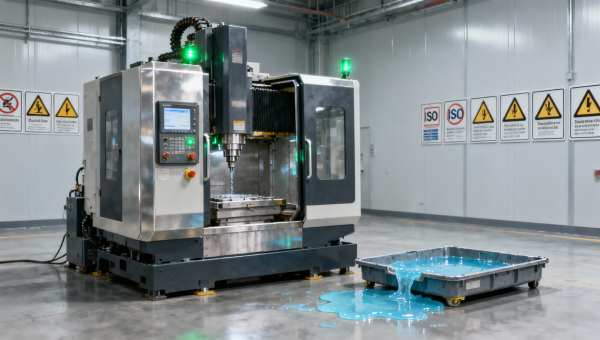
From May 11 to May 17, 2026, Luhua Chemical Group conducted its national Disaster Prevention and Mitigation Awareness Week — a timely initiative aligned with the Ministry of Emergency Management’s newly issued Guidance on Production Safety Compliance for Export Industrial Product Enterprises (2026 Edition). This development directly affects CNC machining tools exporters, especially those shipping to the EU, as it triggers mandatory self-assessments covering coolant leak response, laser interlock functionality, and updated CE Machinery Directive requirements (EN ISO 13857:2026), with completion required by end-June 2026 to avoid delays in EUDR-related conformity assessments.
Event Overview
Luhua Chemical held its Disaster Prevention and Mitigation Awareness Week from May 11 to May 17, 2026. The campaign covered 12 key areas including fire alarm response procedures, safe operation of special equipment, and hazardous chemical storage management. The activity coincides with the official release of the Ministry of Emergency Management’s Guidance on Production Safety Compliance for Export Industrial Product Enterprises (2026 Edition), which explicitly references CNC machining tools exporters and specifies three technical self-check items tied to EU market access: numerical control machine coolant leakage emergency response, effectiveness of laser safety interlocks, and compliance with EN ISO 13857:2026 (an update under the CE Machinery Directive). Exporters must complete these checks by June 30, 2026, or risk impacting their EU Due Diligence Regulation (EUDR) compliance review timelines.
Industries Affected
Direct Exporters of CNC Machining Tools
These enterprises face direct regulatory linkage: the Guidance identifies them by product category and assigns concrete technical verification deadlines. Non-completion of the specified self-checks may delay EUDR-related conformity assessments — a prerequisite for continued EU market access under the regulation’s supply chain due diligence framework.
Contract Manufacturers Supplying CNC Tools to Exporters
As upstream production partners, contract manufacturers are operationally responsible for implementing coolant leak protocols and validating laser interlock systems. Their internal process documentation and test records may be requested during downstream exporters’ EUDR audits — making their compliance posture a de facto extension of the exporter’s legal accountability.
CE Certification Bodies & Technical Consultants Supporting Exporters
The reference to EN ISO 13857:2026 — a newly updated standard — signals potential recalibration of certification scope and testing protocols. These service providers may need to update internal checklists and validation methodologies before mid-2026 to support clients’ deadline-driven submissions.
What Relevant Enterprises or Practitioners Should Focus On and How to Respond Now
Monitor Official Interpretations of the 2026 Guidance
The Ministry of Emergency Management has not yet published implementation FAQs or sector-specific annexes. Enterprises should track official notices through provincial emergency management bureaus and the Ministry’s website — particularly any clarifications on whether the self-check requirement applies only to EU-bound shipments or extends to other regulated markets.
Prioritize Verification of Three Specified Technical Items
Rather than broad safety overhauls, current action should focus narrowly on: (1) documented coolant leak detection and containment procedures; (2) functional testing logs for laser safety interlocks (including failure-mode verification); and (3) design file updates confirming alignment with EN ISO 13857:2026’s revised safety distance parameters. These are the only items explicitly cited in the Guidance.
Distinguish Between Policy Signal and Enforceable Requirement
Analysis shows the Guidance functions primarily as an administrative coordination tool — not a standalone legal mandate. Its enforceability depends on integration into existing export inspection frameworks (e.g., customs pre-shipment verification or EUDR audit checklists). Enterprises should treat it as a high-probability signal of upcoming operational scrutiny, not as an immediate penalty-triggering rule.
Prepare Documentation for Upcoming EUDR Audit Cycles
Since the Guidance ties self-check completion to EUDR assessment timelines, exporters should consolidate all relevant technical records — including dated test reports, revision-controlled drawings, and staff training logs — into a dedicated EUDR readiness folder. This avoids last-minute compilation when notified of an upcoming audit.
Editorial Perspective / Industry Observation
Observably, this initiative reflects a broader trend of domestic industrial safety governance converging with international regulatory expectations — particularly where export compliance intersects with environmental and occupational safety standards. The timing (immediately preceding the EU’s expanded EUDR enforcement phase) suggests coordinated policy signaling rather than isolated domestic action. Analysis shows it is currently best understood as a preparatory signal: no penalties or enforcement mechanisms are described in the Guidance itself, and no public record indicates imminent inspections targeting CNC tool exporters specifically. However, its inclusion of precise technical benchmarks (e.g., EN ISO 13857:2026) implies that regulators expect firms to already possess baseline familiarity with evolving EU harmonized standards — elevating the importance of proactive technical surveillance over reactive compliance.
In summary, this development marks a procedural checkpoint — not a regulatory inflection point — for CNC machining tools exporters serving the EU. It underscores how domestic safety campaigns can rapidly acquire cross-border compliance relevance when anchored to internationally recognized technical standards. For affected enterprises, the most pragmatic stance is to treat the May–June 2026 window as a low-risk opportunity to align internal controls with emerging audit expectations — rather than as an urgent threat requiring structural overhaul.
Source: Ministry of Emergency Management of the People’s Republic of China — Guidance on Production Safety Compliance for Export Industrial Product Enterprises (2026 Edition); Luhua Chemical Group’s official announcement of its Disaster Prevention and Mitigation Awareness Week (May 11–17, 2026).
Note: Implementation details, enforcement mechanisms, and potential extensions to non-EU markets remain unconfirmed and require ongoing observation.

The Archive Newsletter
Critical industrial intelligence delivered every Tuesday. Peer-reviewed summaries of the week's most impactful logistics and market shifts.