Monday, May 22, 2024

Amazon EU Enforces Toy Safety Compliance for Teething Toys
by
Published
Views:
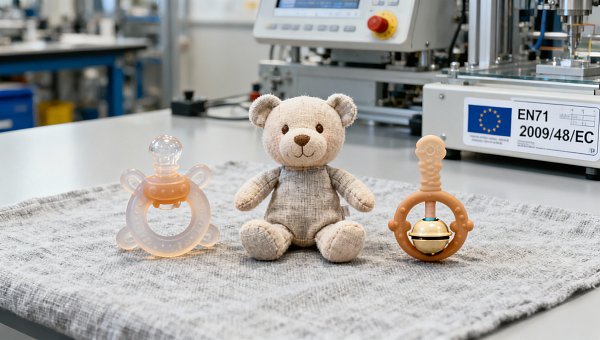
Starting 1 May 2026, Amazon’s European marketplace will require all plush and rattle-style infant teething products sold via FBA to comply fully with the EU Toy Safety Directive 2009/48/EC. This development directly affects manufacturers, brands, and distributors of baby oral care products targeting the EU — particularly those based in China — and signals a tightening of regulatory enforcement at the platform level.
Event Overview
Effective 1 May 2026, Amazon Europe mandates that all plush and rattle-type teething toys offered through Fulfillment by Amazon (FBA) must be verified by an independent third-party laboratory and accompanied by a Declaration of Conformity (DoC). The assessment covers chemical safety (e.g., phthalates, heavy metals), physical and mechanical properties (e.g., small parts, sharp edges, tensile strength), and labeling requirements. This requirement applies uniformly to all Chinese manufacturers and brand owners using FBA in the EU.
Industries Affected by Segment
Direct Exporters & Brand Owners
These entities face immediate listing eligibility risk: non-compliant listings may be suspended or removed post-1 May 2026. Impact manifests in delayed time-to-market, increased pre-launch testing costs, and potential inventory write-offs if existing stock lacks valid DoC and test reports aligned with 2009/48/EC.
Contract Manufacturers & OEMs
OEMs producing teething toys for EU-bound brands must now embed compliance verification into production workflows — including material sourcing controls, batch-level mechanical testing, and documentation handover. Failure to provide compliant documentation may trigger contractual liability or loss of orders.
Testing & Certification Service Providers
Third-party labs accredited under EU Notified Body frameworks are likely to see increased demand for EN71-1, EN71-2, EN71-3, and EN71-12 testing. However, capacity constraints and lead-time extensions may arise — especially for labs serving high-volume China-based clients.
FBA Logistics & Compliance Support Providers
Warehousing and compliance advisory services supporting FBA sellers must update their onboarding checklists to include DoC validation, report authenticity verification (e.g., lab accreditation status), and label compliance review — adding a layer of pre-fulfillment gatekeeping.
Key Focus Areas and Recommended Actions
Monitor official Amazon Seller Central communications and EU Commission updates
While the 1 May 2026 enforcement date is confirmed, Amazon may issue supplementary guidance on acceptable lab accreditations, DoC templates, or grace period conditions for pending submissions. Sellers should subscribe to official policy notifications and audit Seller Central announcements weekly starting Q1 2026.
Prioritize verification for high-volume SKUs and FBA-reliant listings
Given resource constraints, companies should triage: begin third-party testing first for best-selling plush/rattle teething items already in FBA or scheduled for Q2 2026 restock. Avoid blanket testing across legacy SKUs unless actively selling into the EU.
Distinguish between policy signal and operational readiness
This requirement reflects Amazon’s alignment with EU market surveillance trends — not new legislation, but stricter platform-level enforcement of existing law. Companies should treat it as an operational compliance checkpoint, not a legislative shift requiring product redesign unless current specifications fail EN71 thresholds.
Validate lab accreditation and reporting scope before submission
Reports must be issued by an EU Notified Body (or equivalent under mutual recognition agreements) and explicitly reference EN71-1, EN71-2, EN71-3, and EN71-12. Generic “toy safety” certificates without clause-level coverage will not satisfy Amazon’s validation system.
Editorial Perspective / Industry Observation
Observably, this move represents a platform-driven escalation in supply chain due diligence — not a change in legal obligation, but a material increase in enforcement rigor at the point of marketplace access. Analysis shows Amazon is shifting from reactive takedowns to proactive gatekeeping, mirroring broader EU digital platform accountability trends under the Digital Services Act (DSA). From an industry perspective, it functions less as an isolated policy update and more as a leading indicator: similar requirements may extend to other baby product categories (e.g., soothers, activity gyms) where functional overlap with toy definitions exists. Continued attention is warranted not only for compliance execution, but also for how Amazon interprets ‘intended use’ and ‘play value’ in borderline infant products.
Conclusion: This enforcement action underscores that regulatory compliance for infant products in the EU is no longer solely a customs or post-import concern — it is now embedded in digital marketplace access rules. For affected businesses, the most pragmatic interpretation is that DoC and test report readiness is now a prerequisite for FBA eligibility, not a post-sale documentation exercise. Preparedness hinges on early engagement with accredited labs, disciplined SKU prioritization, and continuous monitoring of Amazon’s policy implementation details.
Source: Amazon Seller Central Policy Announcement (confirmed effective date: 1 May 2026); EU Toy Safety Directive 2009/48/EC; EN71 series harmonized standards.
Note: Ongoing observation is recommended for any clarifications Amazon may issue regarding transitional arrangements, acceptable lab jurisdictions, or technical scope interpretations (e.g., whether ‘teething-only’ function exempts certain items from full toy classification).
The Archive Newsletter
Critical industrial intelligence delivered every Tuesday. Peer-reviewed summaries of the week's most impactful logistics and market shifts.