Monday, May 22, 2024

Crop monitoring systems miss problems that satellites cannot see
by
Published
Views:
As crop monitoring becomes central to Modern manufacturing and industrial sustainability, many teams still rely on satellite data that misses field-level risks. For decision-makers across Global manufacturing, smarter crop monitoring must connect tech hardware, Engineering standards, and Industrial infrastructure to reveal what satellites cannot see and support more reliable operations, sourcing, and long-term performance.
That gap matters far beyond the farm. For operators, technical evaluators, procurement teams, quality managers, and financial approvers, crop monitoring systems now influence raw material security, ESG reporting, water use planning, machinery deployment, and supplier risk control. In sectors where agriculture intersects with electronics, mobility, environmental infrastructure, and precision tooling, relying on incomplete visibility can delay decisions by days, increase inspection costs by 10%–25%, and allow localized failures to spread before intervention begins.
Global Industrial Matrix (GIM) addresses this challenge from a cross-sector perspective. Instead of treating crop monitoring as a stand-alone digital tool, GIM frames it as part of a larger industrial system that links sensors, autonomous equipment, environmental controls, communications hardware, and benchmark-driven performance criteria. The result is a more useful approach for enterprises that need traceable field intelligence, practical implementation guidance, and stronger alignment between operational realities and board-level decisions.
Why satellite-only crop monitoring leaves critical blind spots
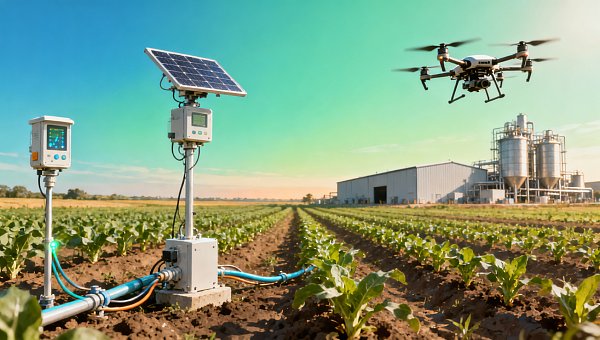
Satellite imaging has transformed large-area observation, but it was never designed to solve every field-level problem. A satellite pass may occur every 3–5 days under ideal conditions, and cloud cover can reduce usable image windows even further during key growth periods. For industrial buyers and farm-linked manufacturing planners, this means a problem can develop between passes and remain invisible until it has already affected yield, moisture consistency, or harvest timing.
Spatial resolution is another limitation. Even when imagery is technically available, pixels often average conditions across multiple square meters. That is useful for regional vegetation trends, but far less effective for identifying irrigation leaks along a specific line, wheel-track compaction in a limited corridor, uneven nutrient uptake inside one management zone, or disease pressure starting along a field edge. These are exactly the kinds of issues that influence input costs, equipment scheduling, and downstream quality control.
For manufacturing-linked crop supply chains, hidden variability creates broader business risk. A processor sourcing biomass, starch crops, fibers, oilseeds, or specialty inputs may see only the final quality deviation, not the origin of the deviation. If crop stress is detected 7–10 days too late, the impact can appear later as unstable moisture, inconsistent density, contamination exposure, or poor throughput in industrial processing lines.
What satellites commonly miss
- Sub-canopy moisture imbalance that does not immediately change top-level vegetation index readings.
- Localized pest or disease hotspots affecting less than 5% of a field during the first stage of spread.
- Mechanical issues such as blocked nozzles, uneven seeding, compaction strips, or drainage failures.
- Short-lived stress events caused by heat spikes, power interruptions, or pump instability over 6–24 hours.
These blind spots explain why high-performance crop monitoring systems increasingly combine satellite imagery with ground sensors, machine data, drone inspection, and infrastructure-level diagnostics. A layered system does not replace remote sensing; it makes remote sensing actionable. For teams responsible for capital allocation and operational continuity, that distinction is essential.
Operational consequence by stakeholder group
Operators need faster alerts and clearer field tasks. Technical evaluators need measurement reliability, integration protocols, and calibration logic. Business reviewers need to understand how a monitoring gap affects contract performance, inventory exposure, and supplier variability. Financial approvers need a decision model showing whether reducing one missed event per season justifies system investment over 12–36 months.
What a modern crop monitoring system should include beyond imagery
A useful crop monitoring system should be built as an evidence stack rather than a single dashboard. In most commercial settings, that stack includes four layers: remote observation, in-field sensing, machinery telemetry, and infrastructure data. Together, these layers create traceable visibility from plant condition to water movement, equipment behavior, and environmental compliance. This structure is especially relevant in industrial ecosystems where agricultural output feeds larger manufacturing or processing operations.
Ground sensors are often the first missing layer. Soil moisture probes, EC sensors, weather stations, tank and pump monitors, and flow meters can provide readings every 15 minutes to 1 hour. That frequency is dramatically more actionable than waiting several days for the next usable satellite image. When linked to threshold-based alerts, these sensors help teams intervene before visible crop decline appears.
Machinery data is the second underused layer. Autonomous tractors, sprayers, irrigation controllers, and harvesting platforms already generate operational signals on pressure, application rate, route consistency, fuel draw, and downtime. If these data streams stay isolated, teams miss the connection between equipment performance and crop variability. Integrated monitoring can reveal whether a stressed zone reflects biology, a hardware fault, or an infrastructure issue.
Core system layers and decision value
The table below outlines how different monitoring layers contribute to faster diagnosis and stronger procurement or project decisions.
The strongest systems are also standards-aware. Data integrity, enclosure selection, connectivity stability, and maintenance planning matter as much as sensor count. Enterprises evaluating crop monitoring for industrial supply chains should look for hardware and network components that can operate across heat, dust, vibration, and moisture, while supporting interoperable data exchange with ERP, quality, or sustainability reporting systems.
Selection checkpoints
- Confirm whether the system can collect at least 4 data types, not just imagery.
- Check field-to-dashboard latency; under 30 minutes is often practical for critical alerts.
- Verify sensor calibration and maintenance intervals, commonly every 6–12 months.
- Ensure integration with machine telemetry, GIS layers, and reporting workflows.
For GIM-aligned buyers, this multi-layer view supports better benchmarking across agriculture, electronics, mobility hardware, and environmental infrastructure. It turns crop monitoring from a narrow agronomy tool into a measurable industrial control function.
How to evaluate crop monitoring systems for procurement and risk control
Procurement teams often compare crop monitoring systems on software appearance first and technical fit second. That sequence creates risk. In B2B deployment, the more reliable path is to assess infrastructure compatibility, sensing coverage, serviceability, data traceability, and lifecycle cost before reviewing interface design. A dashboard can look advanced while still failing under weak connectivity, difficult maintenance conditions, or poor field calibration.
A practical evaluation model should cover at least five dimensions: sensing depth, response speed, integration readiness, field durability, and decision usefulness. For example, if a system offers image-based stress maps but cannot tie those maps to irrigation events, machine logs, or quality incidents, it adds visibility without accountability. That may be acceptable for light monitoring, but not for procurement-led sourcing assurance or enterprise-scale sustainability management.
Cost should also be measured correctly. The lowest upfront bid may create hidden labor expenses if field teams must manually inspect every alert or export files from multiple devices. In many operations, the true economic comparison is not license fee versus license fee, but total annual operating effort across hardware service, data review, exception handling, and yield-loss avoidance.
Procurement decision matrix
The following matrix helps project managers, technical reviewers, and financial approvers compare options using business-relevant criteria.
This type of comparison is especially useful for distributors, system integrators, and multi-site enterprises. It clarifies whether a crop monitoring platform is suitable for a single demonstration project or scalable across 10, 20, or more operational locations. It also supports more consistent communication between technical and commercial teams during vendor review.
Common evaluation mistakes
- Assuming image quality equals decision quality.
- Ignoring maintenance labor and replacement cycle for field hardware.
- Buying a closed platform that cannot exchange data with existing systems.
- Skipping pilot validation across at least 1 full growth stage or 8–12 weeks.
A disciplined procurement framework helps organizations move from attractive technology to bankable operational value. For enterprises under pressure to justify capex, reduce sourcing variability, or document sustainability outcomes, that distinction is central to approval.
Implementation roadmap: from pilot monitoring to scalable industrial visibility
A crop monitoring system creates value only when implementation is staged correctly. Many projects fail not because the sensors are weak, but because the deployment sequence is rushed. A strong rollout usually follows 5 phases: site assessment, pilot design, integration setup, threshold tuning, and scale-up review. Depending on site complexity, this can take 6–16 weeks before the system reaches stable operational use.
The site assessment should map field zones, water infrastructure, equipment routes, communications coverage, and data users. This is where project managers identify whether they need LoRaWAN, cellular gateways, edge computing nodes, or mixed connectivity. A poorly planned network layer can cause 20% or more data gaps, which then undermines confidence in the whole platform.
Pilot design should focus on representative risk, not maximum area. It is often smarter to instrument 10%–20% of a site covering different soil, slope, irrigation, or machinery conditions than to spread hardware thinly over the full operation. That approach produces more meaningful calibration data and clearer lessons for expansion.
Suggested deployment sequence
- Define 3–5 operational objectives such as water efficiency, early stress detection, or harvest timing accuracy.
- Install core sensing points and verify connectivity for 2–4 weeks before activating automated rules.
- Integrate machine logs, weather feeds, and field maps into one review workflow.
- Set alert thresholds and assign ownership for response within 2–12 hours depending on severity.
- Review season results against baseline labor, input use, downtime, and quality variance.
Quality and safety managers should be involved early, especially where crop output enters regulated processing or sustainability reporting. They can define evidence requirements, retention periods, and exception logging. This reduces future disputes over whether a field event was detected, documented, and addressed within acceptable process windows.
Implementation risks that deserve early control
Three risks are common. First, teams deploy sensors without a maintenance calendar, leading to drifting data after 6–9 months. Second, they collect more data than users can interpret, creating alert fatigue. Third, they fail to connect field intelligence to business workflows such as sourcing approval, contractor dispatch, or budget review. A system that cannot trigger action becomes a reporting burden rather than an operational asset.
This is where GIM’s cross-disciplinary benchmarking matters. When smart agri-tech is evaluated alongside electronics reliability, industrial infrastructure resilience, and standards-oriented quality methods, implementation becomes more predictable. The goal is not just visibility, but an auditable chain from measurement to decision.
FAQ: practical questions buyers and technical teams ask most often
The questions below reflect the most common concerns from operators, engineering reviewers, distributors, and enterprise decision-makers evaluating crop monitoring systems in mixed industrial environments.
How do I know whether satellite data is enough for my operation?
If your decisions can tolerate delays of 3–7 days and you only need broad regional trends, satellite data may be sufficient. If you manage irrigation, equipment-intensive field operations, specialty crops, contract quality targets, or high-value industrial feedstocks, satellite-only monitoring is usually not enough. In those cases, at least one in-field sensing layer is recommended.
What is a realistic payback logic for crop monitoring systems?
Payback is rarely based on one benefit alone. Most enterprises justify investment through a combination of reduced field inspection labor, lower water or input waste, earlier fault detection, fewer quality deviations, and better planning accuracy. Reviews are commonly built over 12, 24, or 36 months rather than one season, especially when infrastructure and integration costs are included.
Which technical indicators should be prioritized during vendor comparison?
Focus first on data frequency, field durability, calibration process, communication stability, integration method, and alert handling workflow. Resolution alone should not dominate the decision. A system with hourly, reliable, field-level data can be more valuable than a visually impressive platform with delayed or inconsistent updates.
How long does deployment usually take?
A basic pilot can begin within 2–4 weeks if the site is prepared and hardware is available. A more integrated rollout involving sensors, telemetry, dashboards, and workflow mapping often takes 6–16 weeks. Multi-site standardization may require a full season to align thresholds, reporting formats, and support procedures.
Crop monitoring systems are no longer just agronomy tools; they are decision infrastructure for modern industry. When enterprises depend on stable agricultural inputs, sustainability metrics, and hardware-driven operations, visibility must extend beyond what satellites alone can provide. A stronger system combines remote sensing, field instrumentation, machine intelligence, and practical implementation discipline.
GIM helps organizations evaluate that broader picture with technical benchmarking across smart agri-tech, electronics, mobility systems, environmental infrastructure, and precision industrial standards. If you are assessing crop monitoring for sourcing assurance, operational efficiency, or project-scale deployment, now is the right time to compare architectures, define evaluation criteria, and build a solution that reveals what satellites cannot see. Contact us to discuss your use case, request a tailored framework, or explore more cross-sector solutions.
- electronics
- tech hardware
- Mobility
- sensors
- Agri-Tech
- autonomous tractors
- crop monitoring
- industrial sustainability
- Precision tooling
- Technical benchmarking
- Smart Agri-Tech
- Operational efficiency
- Global manufacturing
- Modern manufacturing
- Engineering standards
- Industrial infrastructure
- Environmental infrastructure
The Archive Newsletter
Critical industrial intelligence delivered every Tuesday. Peer-reviewed summaries of the week's most impactful logistics and market shifts.