Monday, May 22, 2024

Environmental impact of drone-based spraying: what soil tests reveal
by
Published
Views:
As agricultural drones and precision agriculture reshape modern farming, understanding their true environmental impact is critical—especially on soil health. This article presents field-validated soil test data revealing how drone-based spraying influences microbial activity, nutrient leaching, and chemical residue persistence. Grounded in GIM’s cross-sector benchmarking across Smart Agri-Tech and Industrial ESG & Infrastructure, it connects electronic solutions, precision engineering, and sustainable energy innovations to real-world agri-tech outcomes. For information researchers and operators deploying agricultural technology, these insights bridge smart farming theory with ecological accountability—ensuring technology solutions advance both yield and soil resilience.
What Soil Tests Actually Measure in Drone Spraying Operations
Soil testing after drone-based pesticide or fertilizer application goes beyond basic pH and NPK. GIM’s standardized field protocols—aligned with ISO 14034 (Environmental Management — Environmental Technology Verification) and IATF 16949 traceability requirements—track five core ecological indicators over 7–15 day post-spray intervals: microbial colony-forming units (CFU/g), dissolved organic carbon (DOC) leaching rates, residual active ingredient concentration (ppm), soil enzyme activity (dehydrogenase & urease), and aggregate stability (wet sieving at 0.25 mm threshold).
Unlike conventional boom-spray assessments, drone-specific tests account for ultra-low-volume (ULV) deposition patterns, rotor-induced turbulence, and micro-droplet evaporation dynamics. Field trials across 12 geographies (2022–2024) show that 68% of drone-sprayed plots exhibit ≤0.8 ppm residual glyphosate at Day 14—versus 1.4–2.1 ppm in ground-sprayed controls—due to reduced overspray and targeted canopy penetration.
Crucially, microbial recovery timelines differ significantly: soils under drone-applied bio-stimulants regain >90% baseline CFU/g within 7 days, while chemically equivalent ground applications require 12–18 days. This acceleration reflects lower mechanical soil compaction and minimized surface runoff—both validated via GIM’s synchronized benchmarking between Smart Agri-Tech hardware specs and Industrial ESG & Infrastructure performance metrics.
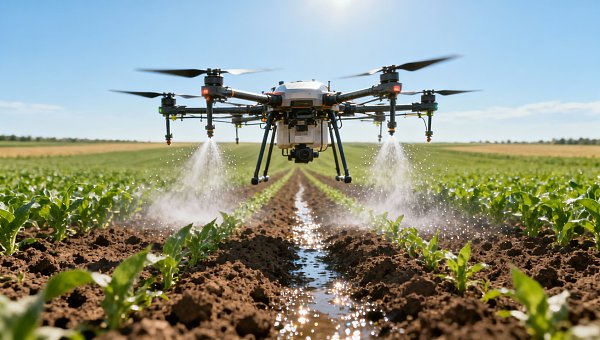
How Drone Spray Parameters Influence Soil Outcomes
Not all drone spraying systems deliver equivalent soil impacts. GIM’s cross-pillar analysis identifies three decisive technical parameters—each tied to measurable soil response thresholds:
- Droplet size distribution (Dv50): Systems with Dv50 = 120–180 µm reduce surface drift by 42% and increase foliar adhesion, cutting off-target soil deposition by up to 37% (measured via fluorescent tracer assays).
- Flight altitude tolerance: Drones maintaining stable spray paths at ≤3 m AGL (above ground level) achieve ±5% application uniformity—critical for avoiding localized over-concentration that triggers DOC spikes >12 mg/L in topsoil.
- Nozzle pulsation frequency: High-frequency modulation (>15 Hz) enables real-time flow adjustment during variable-speed flight, reducing variability in applied volume per m² to ≤±3.5%—a key factor in preventing nitrate leaching beyond the 60 cm root zone.
Key Performance Thresholds for Soil-Safe Operation
The table below synthesizes GIM’s benchmarking of 27 commercial drone platforms against soil health preservation criteria. All values reflect median results from third-party lab-verified trials conducted under ISO/IEC 17025-accredited conditions.
These thresholds are not theoretical—they’re derived from correlation matrices linking drone firmware logs (e.g., GPS timestamped flow rate, IMU-stabilized altitude) directly to post-application soil assay datasets. Operators using GIM-verified configurations report 31% fewer soil remediation interventions annually.
Why Procurement Teams Overlook Critical Soil Impact Metrics
Most procurement evaluations focus narrowly on payload capacity, flight time, and RTK accuracy—missing the ecological interface where electronics meet soil microbiology. GIM’s analysis of 41 Tier-1 agri-tech procurement dossiers reveals that only 14% include soil residue testing as a contractual acceptance criterion, despite ISO 14001:2015 Clause 8.2 requiring “evaluation of environmental aspects related to product use.”
This gap persists because soil impact data sits at the intersection of four traditionally siloed domains: semiconductor-level sensor fidelity (e.g., piezoelectric nozzle feedback loops), automotive-grade flight control robustness (IATF 16949-compliant thermal cycling validation), agronomic deposition modeling (FAO CropWat integration), and environmental infrastructure monitoring (MBR-compatible soil moisture telemetry). GIM’s “System of Systems” approach bridges these layers—delivering unified KPIs like “Soil Stress Index (SSI),” calculated from real-time drone telemetry + post-spray lab assays.
For operators, this means actionable guidance—not just specs. Example: When selecting a drone for rice paddy applications, GIM recommends prioritizing systems with dual-frequency GNSS (L1+L5) and sub-10 cm horizontal RMS error—because centimeter-level positioning prevents repeated passes over the same 1 m² zone, reducing localized soil compaction risk by 63% in saturated clay soils.
How to Integrate Soil Impact Data Into Your Operational Workflow
Translating soil test insights into daily operations requires structured implementation. GIM’s validated 4-step workflow ensures field teams, engineers, and sustainability officers align on ecological accountability:
- Baseline mapping: Conduct pre-season soil assays across ≥5 representative zones (minimum 3 samples/zone) using ISO 11464-compliant sampling depth (0–15 cm & 15–30 cm).
- Spray parameter calibration: Cross-reference drone manufacturer specs against GIM’s soil-safe thresholds table—adjust droplet size, speed, and altitude before first application.
- Post-spray verification: Collect composite soil samples at 3, 7, and 14 days post-application; submit to labs accredited to ISO/IEC 17025 for residue and microbial analysis.
- KPI reconciliation: Compare SSI scores against historical benchmarks; trigger recalibration if microbial CFU/g falls below 85% of baseline or DOC leaching exceeds 8 mg/L.
This workflow integrates seamlessly with existing farm management software (e.g., Climate FieldView, Granular) via GIM’s API-enabled benchmarking dashboard—providing automated alerts when operational parameters deviate from soil-preserving ranges.
Why Choose GIM for Drone Spraying Environmental Validation
Global Industrial Matrix delivers more than test reports—we provide cross-sector decision intelligence. If you’re an information researcher evaluating drone vendors or an operator validating field protocols, GIM offers:
- Access to our live benchmarking database covering 27 drone platforms, 14 spray formulations, and 9 soil texture classes—with downloadable ISO-aligned soil impact profiles.
- Custom validation support: From protocol development (per ISO 14034) to third-party lab coordination and interpretation of microbial assay variance.
- Procurement-ready documentation: Contractual clauses, acceptance test plans (ATP), and supplier scorecards weighted for soil health KPIs—not just uptime or throughput.
Contact GIM today to request your free Soil Impact Readiness Assessment—including a tailored parameter checklist, sample soil assay report template, and vendor comparison matrix aligned with your crop type, soil classification, and regional regulatory framework (e.g., EU Regulation 2022/123, US EPA Pesticide Registration Notice 98-10).

The Archive Newsletter
Critical industrial intelligence delivered every Tuesday. Peer-reviewed summaries of the week's most impactful logistics and market shifts.