Monday, May 22, 2024

How to Evaluate an Agricultural Drone Supplier Beyond Flight Specs
by
Published
Views:
Choosing an agricultural drone supplier should extend beyond payload, range, and flight time. The stronger decision often comes from evaluating manufacturing discipline, service depth, software compatibility, and long-term operational resilience.
In cross-industry environments, drone sourcing now intersects electronics, batteries, data systems, ESG expectations, and field service infrastructure. That makes agricultural drone supplier assessment a broader industrial benchmarking exercise, not a simple product comparison.
A capable agricultural drone supplier reduces downtime, supports compliance, and helps protect asset value over several seasons. This guide explains how to judge suppliers through real operating scenarios and risk-based sourcing criteria.
When large-area spraying is the main scenario, consistency matters more than headline specs
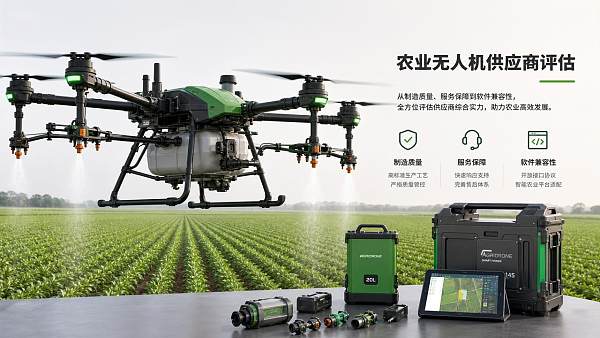
For broad-acre spraying, aircraft endurance is only one variable. The agricultural drone supplier must also prove stable frame quality, repeatable nozzle performance, and dependable parts availability across seasonal demand peaks.
In this scenario, uneven spray distribution creates agronomic and financial losses. Ask for batch-level QC records, pump calibration procedures, vibration testing data, and field repair turnaround commitments.
Key checks for spraying operations
- Uniformity data for flow rate, droplet size, and swath overlap
- Chemical resistance of hoses, seals, tanks, and connectors
- Availability of replacement pumps, arms, landing gear, and flight controllers
- Battery lifecycle performance under hot, humid, and dusty conditions
- Documented maintenance intervals and service training materials
A reliable agricultural drone supplier should share failure-rate trends, not only marketing claims. If support teams cannot explain common field faults, future uptime risk is already visible.
When mapping and crop analytics drive value, software integration becomes the real differentiator
Some deployments prioritize imaging, multispectral data, and decision support. In these cases, the agricultural drone supplier must be evaluated like a hardware-software systems partner.
Sensor quality alone is insufficient. The supplier should demonstrate clean data pipelines, GIS compatibility, API support, firmware update discipline, and export formats that fit farm management platforms.
Questions that reveal software maturity
- Can raw and processed data be exported without vendor lock-in?
- How often are firmware and mission-planning tools updated?
- What cybersecurity controls protect flight logs and field maps?
- Does the platform integrate with third-party agronomy or ERP systems?
- Is technical support available for sensor calibration and data troubleshooting?
For analytics-heavy use, an agricultural drone supplier with weak software governance can create hidden costs. Data silos, delayed updates, and poor interoperability often reduce the return on precision agriculture programs.
When regulation is strict, certification readiness should shape supplier selection
In regulated markets, technical performance means little without documentation. A serious agricultural drone supplier should support traceability, test records, and conformity evidence aligned with target jurisdictions.
This includes battery transport compliance, radio certification, safety manuals, chemical handling guidance, and operator training support. Documentation gaps can delay deployment even if aircraft performance appears strong.
Certification and compliance indicators
- Serial-level traceability for core assemblies
- Test procedures for battery safety and charging systems
- Country-specific regulatory support packages
- Quality management alignment with ISO-based processes
- Clear warranty terms tied to documented operating conditions
The best agricultural drone supplier will discuss compliance as an operating requirement, not an afterthought. That mindset usually reflects stronger internal engineering control and better long-term reliability.
When remote regions are involved, service infrastructure outweighs brochure performance
Remote deployments expose the true quality of after-sales systems. A promising aircraft can become a stranded asset if the agricultural drone supplier lacks spare parts planning, diagnostic support, or repair coverage.
Evaluate response times, local stocking models, distributor competence, and training quality. Service capability should cover batteries, propulsions systems, pumps, sensors, and software recovery procedures.
Field support signals worth validating
- Mean time to ship critical spare parts
- Availability of remote diagnostics and multilingual manuals
- On-site commissioning or partner service networks
- Training modules for operators and maintenance technicians
- Escalation path for recurring system failures
A dependable agricultural drone supplier should quantify service performance with SLA-style metrics. If support commitments remain vague, downtime exposure is likely underestimated.
Different agricultural scenarios require different supplier evaluation priorities
Not every use case values the same capabilities. The right agricultural drone supplier for spraying may not be the best fit for mapping, orchard work, or multi-region deployment.
A practical scorecard helps compare each agricultural drone supplier objectively
A weighted scorecard reduces bias from demos and brand visibility. It also supports cross-functional review when sourcing touches electronics, agronomy, logistics, and compliance teams.
Recommended evaluation categories
This approach makes agricultural drone supplier selection more defensible. It also aligns with broader industrial benchmarking practices used across advanced manufacturing sectors.
Common mistakes happen when buyers focus only on aircraft features
A frequent mistake is treating the drone as a standalone machine. In reality, the agricultural drone supplier is providing a layered system of airframe, batteries, software, service, and compliance support.
Another mistake is ignoring supplier maturity. Fast-growing vendors may show strong demos but weak process control, limited traceability, or unstable channel support.
Some evaluations also underestimate battery management. Charging safety, cycle life, storage procedures, and replacement planning strongly affect operating cost and field readiness.
Finally, many teams skip scenario-based trials. A credible agricultural drone supplier should support real-field validation under local terrain, weather, crop, and workflow conditions.
The best next step is a structured, scenario-based supplier review
The strongest sourcing outcome comes from matching operating scenarios with measurable supplier capabilities. Flight specs remain relevant, but they should not dominate the decision alone.
Start by defining the main field scenario, required software environment, support geography, and compliance threshold. Then compare each agricultural drone supplier using evidence, not presentation claims.
For organizations benchmarking industrial systems across agriculture, electronics, and infrastructure, this method improves transparency and reduces lifecycle risk. A well-vetted agricultural drone supplier becomes a strategic operating partner, not just a hardware source.
The Archive Newsletter
Critical industrial intelligence delivered every Tuesday. Peer-reviewed summaries of the week's most impactful logistics and market shifts.