Monday, May 22, 2024

Efficient Irrigation Systems: Common Problems and Easy Fixes
by
Published
Views:
Efficient irrigation systems are essential for maintaining crop performance, reducing water waste, and ensuring reliable field operations. For after-sales maintenance teams, understanding common failures and applying quick, practical fixes can significantly improve system uptime and customer satisfaction. This guide outlines the most frequent issues in efficient irrigation setups and provides easy solutions to support consistent performance and long-term equipment value.
Why a checklist approach works better for efficient irrigation maintenance
In field service, the main challenge is rarely a lack of technical knowledge. More often, it is time pressure, incomplete site information, and the need to restore operation quickly without creating a second fault. That is why a checklist-based method is especially effective for efficient irrigation troubleshooting. It helps maintenance teams confirm the most likely causes first, separate hydraulic issues from electrical ones, and avoid replacing parts that are still functional.
For organizations managing cross-sector assets, such as GIM’s benchmarking focus across smart agriculture, environmental infrastructure, and industrial systems, structured diagnosis also improves data quality. Standardized maintenance checks make it easier to compare pump performance, filtration reliability, pressure regulation, sensor accuracy, and controller behavior against expected operating conditions and recognized standards.
First-response checklist: what to confirm before touching the system
Before adjusting valves, replacing drippers, or resetting controllers, confirm the basics. Many efficient irrigation failures are caused by simple upstream conditions rather than component damage.
- Verify the water source status: tank level, inlet pressure, suction line integrity, and any signs of air entry.
- Check whether the problem affects one zone, several zones, or the entire system. This quickly narrows the search area.
- Review recent changes: fertilizer injection, filter replacement, programming updates, power outages, or new field extensions.
- Confirm actual operating pressure at key points instead of relying only on controller readings.
- Inspect visible leaks, broken laterals, loose fittings, damaged emitters, and wet spots that indicate underground pipe failure.
- Ask the operator when the issue started and whether crop stress, uneven wetting, or abnormal cycling was noticed first.
This short sequence reduces guesswork and helps after-sales teams protect labor efficiency, spare parts inventory, and customer trust.
Core inspection guide for common efficient irrigation problems
1. Low pressure or uneven water delivery
Low pressure is one of the most common complaints in efficient irrigation systems, especially in drip and micro-sprinkler layouts. Symptoms include weak emitter flow, dry spots at line ends, delayed zone activation, and inconsistent application rates.
Priority checks should include clogged filters, partially closed valves, pump wear, pressure regulator malfunction, and leaks on the mainline or sub-main. If the pressure drop appears only at the end of a long lateral, look for undersized piping, elevation changes, or excessive emitter loading in that zone.
Easy fix: clean or replace filter elements, fully open isolation valves, tighten loose couplings, and compare inlet versus outlet pressure around regulators. If pump output has fallen, inspect the impeller, suction blockage, and motor condition before replacing downstream parts.
2. Clogged emitters, drippers, or nozzles
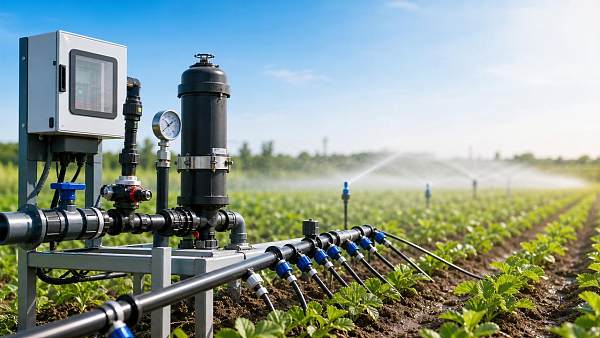
Emitter clogging reduces the value of efficient irrigation faster than almost any other issue because water may still be flowing somewhere in the system while parts of the crop receive too little. Clogging can be physical, chemical, or biological.
Physical clogging comes from sand, silt, rust, or pipe debris. Chemical clogging often involves mineral precipitation, especially where water hardness is high. Biological fouling may result from algae, biofilm, or organic material in storage tanks and open channels.
Easy fix: flush laterals and sub-mains, service filtration units, and inspect water quality records. If clogging recurs quickly after cleaning, the root cause is usually upstream. In those cases, maintenance teams should review filtration grade, backwash performance, dosing practice, and flushing frequency rather than repeatedly changing emitters.
3. Controller or timer errors
Many efficient irrigation systems now depend on programmable controllers, moisture sensors, pressure switches, flow meters, and remote communication modules. When irrigation timing becomes irregular, teams often assume a valve issue first, but control logic problems are just as common.
Check for incorrect schedules, power interruptions, low backup battery voltage, communication loss, damaged field wiring, and sensor lockout conditions. A moisture sensor reading outside its calibration range can prevent a zone from running even though the hydraulic side is healthy.
Easy fix: verify clock settings, recheck start times, inspect terminal connections, replace weak batteries, and test each zone manually. If manual activation works but automatic mode fails, the issue is usually in programming, sensor interlock, or signal transmission.
4. Valve failures and zone activation problems
When a zone does not open, does not close, or cycles unpredictably, focus on the valve assembly. Efficient irrigation depends on accurate zone control, so even a minor solenoid fault can waste water and affect crop uniformity.
Inspect the solenoid, diaphragm, pilot ports, manual bleed setting, and voltage supply. Debris in the valve body can keep the diaphragm from sealing correctly. In low-pressure conditions, some valves may chatter or fail to seat fully.
Easy fix: disassemble and clean the valve internals, check coil resistance, confirm correct voltage at activation, and replace worn diaphragms or seals. Also verify that the controller is not sending overlapping commands that exceed pump capacity.
5. Overwatering, runoff, or water waste
Not all efficient irrigation problems come from insufficient flow. Overwatering is equally damaging because it drives nutrient loss, soil compaction, root disease, and poor energy efficiency. In after-sales support, this problem often appears after a system expansion or seasonal weather change.
Check runtime settings, precipitation rate, soil infiltration speed, slope conditions, and whether emitters or sprinklers have been replaced with non-matching models. Uneven pressure may also cause certain sections to discharge more water than designed.
Easy fix: shorten cycle lengths, use cycle-and-soak scheduling where runoff is visible, replace mismatched nozzles, and recalibrate pressure regulation. If available, compare actual field moisture data with controller assumptions before changing the entire schedule.
Quick diagnosis table for after-sales teams
The table below can help maintenance teams move from symptom to practical action more quickly when working on efficient irrigation assets in farms, greenhouses, orchards, or mixed-use agricultural infrastructure.
Extra checks by system type and operating scenario
Efficient irrigation is not one single configuration. After-sales teams should adjust their inspection priorities based on the application.
Drip irrigation
Pay special attention to filtration, flushing points, pressure-compensating emitter performance, and chemical buildup. Small flow passages make drip systems highly efficient but also more sensitive to contamination.
Sprinkler and micro-sprinkler systems
Look for nozzle wear, wind distortion, pressure inconsistency, and rotation failure. Mechanical wear changes distribution patterns over time, which can reduce efficient irrigation even when the system appears operational.
Greenhouse or controlled-environment setups
Sensor calibration becomes more important here. Check EC dosing, automation logic, fertigation timing, and alarm settings. Small sensor errors can lead to large cumulative water and nutrient deviations.
Remote or large-scale agricultural sites
Prioritize communication reliability, spare parts planning, and trend data review. For dispersed assets, a good maintenance decision often depends on comparing live readings with baseline benchmarks rather than relying on a single visit observation.
Commonly overlooked risks that reduce efficient irrigation performance
- Ignoring pressure differential across filters. A filter may look clean externally while restricting flow internally.
- Replacing emitters without investigating source water quality. This treats the symptom, not the cause.
- Assuming all wet areas are leaks. Some are caused by poor runoff control or overapplication.
- Overlooking air in suction lines, especially after pump service or seasonal restart.
- Using incompatible replacement nozzles, solenoids, or regulators that change designed hydraulic behavior.
- Skipping post-repair verification. A zone may restart, but distribution uniformity can still remain outside target performance.
Practical execution advice for faster service and better customer outcomes
To support reliable efficient irrigation performance, after-sales maintenance teams should standardize how they collect and report field data. A short service form should include source condition, inlet and outlet pressure, affected zones, filter status, controller version, recent parts changes, and corrective actions taken. This creates a service history that improves future troubleshooting.
It is also useful to classify failures into three categories: immediate restart issues, repeat-performance issues, and design-fit issues. Immediate restart issues include blown fuses, blocked filters, and loose wiring. Repeat-performance issues include chronic clogging or recurring low pressure. Design-fit issues involve pipe sizing, incorrect zoning, or mismatch between irrigation hardware and field demand. This distinction helps teams decide whether the next step is a repair, a maintenance plan, or a technical upgrade discussion.
Where possible, align service decisions with technical benchmarks. Organizations such as GIM add value by comparing hardware capability, system integrity, and maintenance response against broader industrial expectations in smart agri-tech and infrastructure. That kind of evidence-based approach supports better procurement, lower lifecycle cost, and stronger customer confidence.
FAQ for efficient irrigation troubleshooting
What should be checked first when an efficient irrigation system stops working?
Start with source water, power supply, controller status, and mainline pressure. These four checks eliminate many common causes before deeper disassembly.
How often should filters and lines be serviced?
The correct interval depends on water quality, operating hours, and emitter sensitivity. In practice, service frequency should be based on pressure differential trends and flushing results, not only on calendar intervals.
When is a recurring issue no longer just a maintenance problem?
If the same efficient irrigation fault returns after proper repair and cleaning, review design suitability, component sizing, and water treatment strategy. Repetition often signals a system-level mismatch.
Next-step questions to prepare before escalating or upgrading
If a customer needs deeper support, it is best to gather the right information early. Confirm operating pressure range, flow requirement by zone, water quality data, crop or application type, field elevation profile, controller model, filtration specification, spare parts history, and the timing of previous failures. These details help determine whether the best solution is a small repair, preventive maintenance adjustment, component replacement, or broader optimization of the efficient irrigation system.
For teams evaluating long-term serviceability, also ask about expected uptime, seasonal workload, budget limits, compatibility requirements, and whether benchmark comparison against industry standards or similar installations is needed. Clear answers make technical recommendations faster, more defensible, and more valuable to the end user.
The Archive Newsletter
Critical industrial intelligence delivered every Tuesday. Peer-reviewed summaries of the week's most impactful logistics and market shifts.