Monday, May 22, 2024

How Crop Data Improves Irrigation Timing and Yield Control
by
Published
Views:
Why crop data changes irrigation decisions on real operations
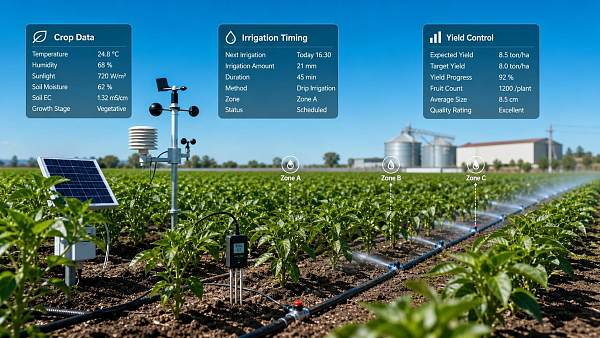
Fixed irrigation calendars break down when weather, soil variation, and crop stage move faster than weekly plans. That is where crop data starts to matter.
Used well, crop data turns plant response into timing signals. Water is applied when roots can convert it into growth, not when the schedule simply says so.
The operational value is broader than water savings. Better timing improves yield control, stabilizes field performance, and reduces avoidable stress during critical growth windows.
In integrated industrial agriculture, irrigation is also connected to energy demand, pump loading, nutrient delivery, and equipment utilization. That makes crop data a management tool, not just an agronomy metric.
This is especially relevant in platforms such as GIM, where smart agri-tech is evaluated alongside electronics, automation, infrastructure, and technical benchmarking. Irrigation timing now sits inside a larger system of operational integrity.
Actual field conditions rarely create one uniform irrigation need
Different sites can grow the same crop and still need different irrigation logic. The reason is not only climate. It is also about field layout, sensor quality, equipment response, and production targets.
A high-value horticulture block usually treats crop data as a daily control input. A broadacre operation may use it as a zone-level trigger for limited water windows.
Protected cultivation adds another layer. Greenhouse systems can react faster, but they also magnify mistakes because the environment is tightly managed.
More importantly, crop data does not stand alone. The same leaf temperature reading means something different when pump pressure is unstable or drainage is already constrained.
In practice, the better approach is to read crop data together with soil moisture, local weather, irrigation capacity, and expected yield uniformity.
What changes from one scenario to another
The table shows why crop data cannot be interpreted with one rule set. Timing quality depends on what the operation is trying to protect.
When yield control matters more than total water volume
In many operations, the goal is not the lowest water use. The real goal is stable output, predictable quality, and fewer losses during sensitive growth phases.
For cereals, that may mean prioritizing irrigation near flowering and grain fill. For fruit crops, it often means balancing vegetative growth against fruit sizing and finish.
Here, crop data helps separate visual stress from economically significant stress. Not every dry signal needs immediate action, but some delayed responses directly reduce marketable yield.
A useful pattern is to define control bands. One band protects growth, another protects quality, and a third triggers intervention when stress is no longer acceptable.
This kind of yield control is easier when crop data is benchmarked against equipment performance, telemetry reliability, and known field variability rather than isolated sensor readings.
Signals worth watching before changing irrigation timing
- Crop stage progression, because the same moisture deficit has different consequences across the season.
- Rate of canopy temperature change, which often reveals stress earlier than visible wilting.
- Recovery after the last irrigation event, since slow recovery may point to deeper root or distribution issues.
- Uniformity across zones, because average values can hide yield loss in weaker sections.
High-frequency systems need a different reading of crop data
In greenhouse and precision fertigation settings, timing decisions are more granular. Small errors repeat quickly, so crop data becomes part of near-real-time control.
That sounds ideal, but fast systems create a common mistake. Teams react to every signal change without checking whether the plant trend is real or just temporary environmental noise.
A short radiation spike, for example, can shift leaf measurements for a limited period. If irrigation timing follows that spike alone, root-zone balance may drift.
A better method is to pair crop data with confirmation thresholds. One signal suggests adjustment, while a second signal confirms the trend before the system changes runtime or pulse frequency.
This is where cross-disciplinary benchmarking matters. Reliable irrigation timing depends on sensor calibration, controller logic, valve response, and data integrity across the full automation chain.
Water-limited operations usually judge crop data differently
Where water is constrained, the question changes from “When should everything be irrigated?” to “Which acres or zones should be protected first?”
In this setting, crop data supports prioritization. Some zones recover well after mild stress. Others lose yield quickly and need earlier intervention.
That distinction matters for pumping schedules, reservoir planning, and energy use. Irrigation timing becomes a resource allocation decision, not just a plant care decision.
Operations with mixed soil types often benefit from ranking zones by three factors: crop sensitivity, expected return, and hydraulic limitations. Crop data then guides where the next unit of water creates the best outcome.
This approach also aligns with broader industrial risk control. The same discipline used in manufacturing benchmark systems applies here: define thresholds, test consistency, and avoid assumptions across nonuniform assets.
Where misreads usually happen before implementation
One frequent misread is treating crop data as a replacement for field context. It is not. Good data still fails when emitter uniformity, soil compaction, or drainage defects are ignored.
Another mistake is copying thresholds between sites. Two farms may use the same crop data platform, but rooting depth, salinity pressure, and irrigation response can differ sharply.
There is also a budgeting error. Some teams compare sensor cost with water savings alone. In reality, crop data often earns value through yield stability, lower rework, and fewer emergency irrigation cycles.
A less visible issue is standardization. If timestamps, calibration routines, or zone naming are inconsistent, irrigation timing analysis becomes difficult to trust at scale.
For that reason, operations benefit from the same technical discipline seen in other engineered systems: verified data inputs, documented thresholds, and repeatable review cycles.
Practical checks before depending on crop data
- Confirm that sensors represent real production zones, not only convenient installation points.
- Check whether irrigation equipment can actually execute the timing precision the data recommends.
- Review how crop data integrates with weather, flow, and soil records over the same timeline.
- Define who validates threshold changes after abnormal seasons or equipment adjustments.
A workable path from data collection to better irrigation timing
The strongest results usually come from a phased approach. Start with a limited number of zones where crop data can be compared against known irrigation outcomes.
Then separate indicators into operational groups: early warning signals, decision signals, and validation signals. That prevents every data point from carrying the same weight.
Next, tie crop data to practical rules. Decide when a timing adjustment changes only schedule length, when it changes sequence, and when it triggers full intervention.
It also helps to compare performance across seasons and assets. In a system-oriented environment like GIM, that means linking irrigation outcomes with hardware reliability, environmental infrastructure, and benchmarked operating standards.
The most useful next step is not more data by itself. It is a clearer scenario map: which fields need rapid control, which blocks need stress tolerance, and which constraints limit execution. From there, crop data becomes a practical guide for irrigation timing and stronger yield control.
The Archive Newsletter
Critical industrial intelligence delivered every Tuesday. Peer-reviewed summaries of the week's most impactful logistics and market shifts.