Monday, May 22, 2024

How much water does drip irrigation save compared with sprinklers?
by
Published
Views:
Drip irrigation can use substantially less water than sprinklers, but there is no single percentage that applies to every field or landscape. Savings are often greatest when drip replaces an inefficient sprinkler system that loses water to wind, evaporation, runoff or watering between plants. The difference can be small when the existing sprinklers already distribute water uniformly and are scheduled carefully.
For someone comparing a proposed conversion with an existing system, the practical question is not simply which equipment has the higher efficiency rating. It is how much less water must be supplied to maintain the same crop production or landscape condition. That comparison depends on the plants, weather, soil, system design and management.
What water-saving percentages actually compare
Drip irrigation water savings data can describe several different things: water pumped, water applied to a field, water reaching the root zone, or water used per unit of crop yield. These measures are related, but they are not interchangeable. A percentage is useful only when the starting point and the outcome are clear.
A frequently cited theoretical comparison uses application efficiency: the share of applied irrigation water that becomes available for the intended root-zone use. Suppose, purely as an illustration, a sprinkler system has an application efficiency of 75% and a drip system achieves 90%. To deliver the same useful amount of water, the sprinkler system would need 100 units for every 75 units delivered, while drip would need about 83.3 units. The calculated reduction in applied water is approximately 17%, not 15% or 90%.
Those efficiencies are assumptions for explaining the calculation, not performance guarantees. Actual results may differ considerably. A poorly maintained drip system can waste water through leaks, excessive run times or deep drainage, while a well-managed sprinkler system can perform efficiently. Comparing equipment labels alone will not establish the savings at a particular site.
The basic calculation is:
Water saved (%) = (sprinkler water use − drip water use) ÷ sprinkler water use × 100
Use comparable volumes and periods. For example, comparing one hot, dry season under sprinklers with one cool, wet season under drip would mix the effect of the irrigation method with changes in weather and rainfall. A meaningful comparison also checks that the irrigated area, plant cover and acceptable results remain similar.
Where drip can reduce water use
Sprinklers distribute water through the air and across an area. Drip emitters release water at or near the soil surface, or below it in a subsurface installation. This difference changes where losses may occur and how precisely irrigation can be matched to plants.
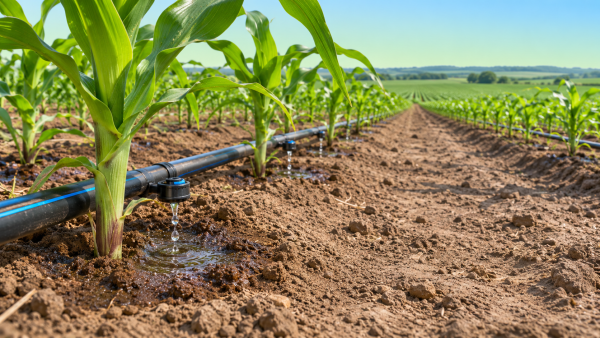
Localized wetting is especially relevant in widely spaced crops, tree rows and planting beds. Sprinklers may water bare spaces between plants; a drip layout can concentrate water closer to their roots. The potential advantage is less clear for closely spaced turf or a dense crop canopy where most of the ground area needs moisture.
Drip also permits frequent, smaller applications. That can help match irrigation to the soil’s ability to absorb and store water, particularly where a long sprinkler cycle would cause runoff. Frequent irrigation is not automatically efficient, however: too many cycles can keep the surface wet, and long cycles can move water below the root zone.
Why the same conversion can produce different results
The existing sprinkler system sets the baseline
A conversion from sprinklers with overspray, leaks and poor scheduling has more avoidable water use to remove than a conversion from a properly designed and maintained system. Some apparent drip savings may therefore come from repairs and better scheduling rather than from the change in delivery method alone.
Before estimating savings, inspect the current system. Look for water landing on roads or paths, persistent puddles, dry patches within otherwise wet areas, and sprinklers operating during strong winds. Check whether pressure and nozzle performance are consistent across the irrigated zone. These observations do not provide a savings percentage, but they show where a comparison should begin.
Soil and root depth determine useful run time
Sandy soils generally take in water quickly but hold less moisture than finer-textured soils. Clay soils can absorb water more slowly, increasing the risk of surface pooling or runoff if application exceeds infiltration. Soil layers and compaction can also restrict movement, regardless of the irrigation equipment.
Root depth matters because water below the active roots may not be available to plants when needed. A drip line left on for too long can push water deep into the soil even when the surface looks relatively dry. Conversely, watering only a shallow zone can leave deeper roots under-supplied. Soil moisture measurements or careful inspection at several depths provide better feedback than surface appearance alone.
Plant cover and irrigation objectives affect the comparison
A young orchard has more exposed soil between plants than a mature orchard with a larger root system and canopy. The amount of ground that needs wetting can change over time, so a layout and schedule suitable at planting may need adjustment later. In landscapes, shrubs, trees and turf also have different rooting patterns and irrigation requirements; putting them on one schedule can obscure the performance of either system.
Crop quality and yield belong in the comparison too. A lower meter reading is not necessarily a successful saving if plants are stressed beyond acceptable limits. Equally, a change in water use may reflect a deliberate change in production goals rather than the irrigation method itself.
Estimating savings for a specific field or landscape
A practical estimate starts with a baseline rather than a generic percentage. Collect water-use records for the existing sprinkler zones, identify the area served, and note the season, plant type and condition. A dedicated meter is useful because a whole-property bill may include unrelated water uses. Where records are incomplete, measured flow and run time can help estimate irrigation volume, although leaks or variable pressure may make a simple calculation less reliable.
- Define the comparison. Identify the same irrigated area, plants and performance target for both systems. Separate zones with different crops, sun exposure or soil conditions where possible.
- Measure the baseline. Record sprinkler water use over a representative period, along with rainfall, irrigation run times and visible problems. Account for repairs or unusual events that would distort the record.
- Estimate the drip requirement. Base it on plant water demand, the proposed wetted area, emitter layout and an appropriate irrigation schedule. Do not assume that the system’s rated efficiency will be achieved in the field.
- Compare under similar conditions. Use equivalent periods or adjust the interpretation for differences in weather, rainfall, plant size and operating practices. Keep the comparison in the same units.
- Check the outcome. Review soil moisture and plant or crop performance alongside meter readings. Investigate a large reduction before treating it as a saving: it may indicate under-irrigation or a measurement error.
When only a theoretical efficiency estimate is available, show the assumed values and calculation rather than presenting the result as measured performance. For example, changing the assumed sprinkler efficiency from 75% to a higher value would reduce the calculated advantage in the earlier illustration. The estimate is only as useful as the assumptions behind it.
A side-by-side comparison can be informative where similar zones are available, but the zones still need similar soils, exposure and plants. Record differences rather than assuming adjacent areas respond identically. A full season or other representative period is generally more informative than a few days immediately after installation, when settings may still be adjusted.
Conditions that can erode drip savings
Clogging is a central maintenance issue. Sediment, biological growth or chemical deposits can restrict emitters. Some plants may receive too little water while the operator increases the run time to compensate, causing other locations to receive too much. Filtration suited to the water source, flushing provisions and inspection of emitter flow are therefore part of the water-saving strategy, not optional extras.
Pressure variation can also cause uneven application. Long lines, elevation changes and unsuitable pressure control may leave some emitters delivering more than others. A design should account for the site and the operating range of the components; a single flow reading at the beginning of a line does not establish uniform delivery across the zone.
Leaks and damaged tubing can offset savings without being immediately visible, especially under mulch or in subsurface systems. Unexpected meter readings, persistently wet areas or declining pressure are reasons to inspect the network. Subsurface leaks may be harder to locate, so access, monitoring and repair provisions deserve attention before installation.
Finally, drip does not remove the need to account for rainfall. An automatic controller that continues its normal schedule after substantial rain can waste water regardless of emitter efficiency. Schedules should respond to weather and soil conditions, with enough flexibility to change run times as plants grow and seasonal demand shifts.
When sprinklers may remain a reasonable choice
Drip is not always the most practical way to irrigate an entire area. Sprinklers can suit dense ground cover, closely spaced plants or situations where uniform coverage across the whole surface is important. They may also serve purposes beyond root-zone irrigation, such as crop establishment or cooling in some applications. Those uses should be identified before replacing a system, because a drip network may not perform the same function.
Water quality and maintenance capacity matter as well. A site with challenging water quality may require substantial filtration and ongoing attention to keep drip emitters working properly. Where those requirements cannot be met, expected savings may not materialize. Existing sprinklers may instead benefit from nozzle repairs, pressure correction, improved coverage and scheduling changes.
The most defensible answer to “how much water will drip save?” is therefore a range based on a documented sprinkler baseline and stated assumptions, followed by measurement after any change. Compare total applied water and plant outcomes together; a lower volume is valuable only when it delivers the intended irrigation result.

The Archive Newsletter
Critical industrial intelligence delivered every Tuesday. Peer-reviewed summaries of the week's most impactful logistics and market shifts.