Monday, May 22, 2024

Smart Agri-Tech Greenhouse Benchmarking: Which KPIs Matter Most?
by
Published
Views:
Smart Agri-Tech Greenhouse Benchmarking: Which KPIs Matter Most?
In smart agri-tech greenhouse benchmarking, the hardest mistake is not choosing the wrong dashboard. It is choosing the wrong unit of comparison. Two greenhouse systems can both claim strong automation, high yield, or low resource use, yet those claims may sit on completely different crop recipes, climate zones, light strategies, and operating assumptions. A technical benchmark only becomes useful when the KPI set reflects how controlled-environment agriculture actually behaves under load: as a coupled system of structure, climate, irrigation, energy, controls, and crop response.
That is why smart agri-tech greenhouse benchmarking should not begin with output volume alone. Yield is visible, but it is downstream of many technical choices. If assessors start with production figures without normalizing for crop type, cultivation cycle, geographic conditions, and level of environmental control, the benchmark quickly turns into a marketing comparison rather than an engineering one.
A stronger approach is to group KPIs around five interacting questions: how stable the climate is, how efficiently inputs are converted into crop output, how reliably automation performs, how resilient the system remains under disturbance, and how comparable the data really is. Those categories align more closely with how procurement teams, greenhouse integrators, and technical auditors evaluate equipment across suppliers.
Climate control KPIs matter because the crop sees variability before it sees averages
Many greenhouse evaluations still overemphasize average temperature and average humidity. Those are necessary, but not enough. Plants respond to excursions, gradients, and recovery times. In practical terms, a greenhouse that holds a target temperature on average but swings sharply at sunrise, after venting, or during irrigation pulses may still underperform in uniformity, disease pressure, and quality consistency.
For that reason, some of the most meaningful KPIs are environmental stability indicators: temperature deviation from setpoint, relative humidity or vapor pressure deficit stability, CO2 concentration consistency, and spatial uniformity across zones. Recovery time after disturbance also belongs in this group. If the system opens vents, shifts shade screens, or responds to cloud transitions, the key question is not only whether it reacts, but how quickly and how accurately it returns to target conditions.
This is where benchmarking often gets distorted. A highly insulated greenhouse in one climate may show lower heating demand, while another relies more heavily on active dehumidification to protect crop health. Without separating climate performance from climate cost, assessors can reward the wrong design. The KPI set should therefore pair environmental stability metrics with the energy required to maintain them.
Resource efficiency KPIs are only credible when tied to a crop basis
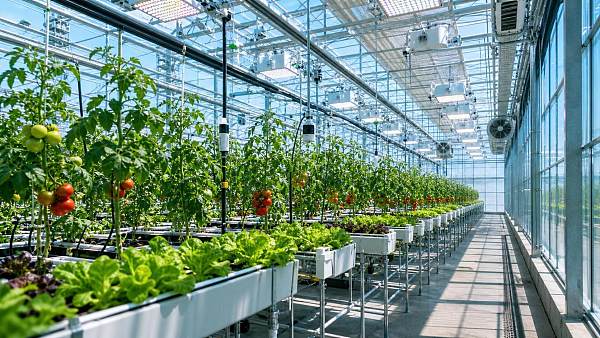
Water, fertilizer, electricity, and thermal energy are the core inputs most teams want to benchmark. The problem is that absolute consumption figures tell very little on their own. A greenhouse producing high-wire tomatoes under supplemental lighting is not comparable to one producing leafy greens under a lighter control regime. Input efficiency must be indexed to something agronomically meaningful: kilograms of marketable output, square meter of productive area, cultivation day, or in some cases mol of delivered light.
Among the most useful KPIs here are water use per kilogram of marketable crop, irrigation recirculation rate where applicable, nutrient solution management stability, electricity use intensity, and heat energy demand normalized by production or area. For lit systems, energy per unit of photosynthetically active radiation delivered can also help distinguish fixture efficiency from broader greenhouse performance, though it still does not replace crop-level productivity metrics.
There is also a practical distinction between efficient input use and merely restricted input use. A system that reduces irrigation volume but increases tip burn, blossom-end rot, or yield volatility is not technically superior. In benchmarking, resource KPIs need to be read alongside crop quality loss, rejection rate, and environmental control stability. Otherwise, the benchmark favors under-supply strategies that look lean in utility data and weak in biological outcomes.
Yield KPIs should reflect consistency, not just peak output
Yield is still central, but the most informative yield KPIs are rarely the headline number used in sales presentations. Technical evaluation teams usually get more value from looking at marketable yield, yield stability across cycles, grade distribution, and loss or reject percentage. These indicators reveal whether the greenhouse can reproduce performance rather than simply reach it once under favorable conditions.
That distinction matters in smart agri-tech greenhouse benchmarking because automation and control systems are often purchased for repeatability. A site that posts high output in one season but shows wide variance in fruit size, inconsistent harvest intervals, or high downgrade rates may have weak integration between sensors, actuators, and crop strategy. In other words, the greenhouse may be capable, but not controllable in a dependable way.
Quality-linked KPIs should not be treated as optional add-ons. Depending on crop type, brix, size uniformity, color development, shelf-life relevant indicators, or defect incidence may be necessary to interpret whether higher productivity is actually valuable. A benchmark that stops at biomass or gross harvest weight misses the commercial side of technical performance.
Automation KPIs need to measure control integrity, not feature count
One common misunderstanding is to equate “smart” with the number of connected devices. In reality, a greenhouse with fewer subsystems but better sensor calibration, more stable communications, and cleaner control logic may outperform a more digitally saturated installation. For benchmarking, the useful question is whether automation reduces uncertainty in operations and crop outcomes.
That leads to a more disciplined set of KPIs: sensor accuracy verification intervals, data completeness, control loop response time, actuator uptime, alarm validity rate, and the percentage of climate or irrigation actions executed automatically versus manually overridden. Manual override frequency is especially revealing. Frequent operator intervention may indicate poor model tuning, weak sensor trust, or an interface that does not support confident decisions.
Interoperability also matters, although it is harder to compress into one number. In complex facilities, greenhouse controls may need to coordinate with fertigation units, energy systems, water treatment modules, and enterprise reporting layers. Benchmarking should therefore include whether data is timestamped consistently, whether subsystems exchange usable signals, and whether historical records are granular enough for root-cause analysis. A platform that generates many charts but poor traceability is operationally weaker than it appears.
Reliability and resilience are often under-measured
In real greenhouse operations, systems are judged not only by performance under ideal setpoints, but by what happens when conditions drift, utilities fluctuate, or components fail. This is why resilience KPIs deserve a formal place in any benchmark. Mean time between failures for critical components, downtime affecting crop climate, backup power coverage for essential controls, irrigation recovery after interruption, and maintenance response windows all help translate design quality into operational risk.
These indicators are particularly relevant for global sourcing and technical due diligence. A greenhouse package may look efficient in a factory acceptance context, but field performance depends on spare-part availability, calibration discipline, local service capability, and fault isolation design. Benchmarking that ignores maintainability tends to overrate technically elegant systems that are difficult to keep stable in production.
A useful benchmark separates comparable KPIs from misleading ones
The table below is not a universal scoring model, but it does show where assessors usually gain signal and where they often collect noise.
Standards help, but they do not remove the need for engineering judgment
In cross-border sourcing and technical review, standards and certification frameworks matter because they create a baseline for safety, quality management, electrical compliance, and documented processes. But greenhouse benchmarking still requires interpretation. ISO-based management systems, component certifications, or test documentation can improve confidence in supplier discipline; they do not automatically validate whole-facility performance under a specific crop strategy.
That is especially true in integrated smart agri-tech environments, where mechanical infrastructure, environmental controls, software logic, and biological outcomes interact. A technically sound benchmark therefore combines three layers: documented specifications, measured operating data, and evidence that the data was captured under comparable production conditions. Remove any one of those layers and the result becomes fragile.
For technical evaluation teams, the practical takeaway is straightforward. The best KPIs are not the most numerous, and not always the most familiar. They are the ones that expose whether a greenhouse can hold its climate targets, convert inputs into marketable crop with discipline, maintain automation credibility, and remain stable when real operating conditions stop being ideal. That is the level at which smart agri-tech greenhouse benchmarking becomes useful for procurement, engineering validation, and long-cycle asset decisions.

The Archive Newsletter
Critical industrial intelligence delivered every Tuesday. Peer-reviewed summaries of the week's most impactful logistics and market shifts.