Monday, May 22, 2024

Smart Farming Technology That Cuts Water Use in 2026
by
Published
Views:
In 2026, smart farming technology for sustainable agriculture is becoming a practical water strategy, not a future concept. Water stress, climate volatility, and compliance pressure are changing how farms invest.
The strongest results now come from connected irrigation, field sensing, and benchmarked operational data. These tools help reduce waste, stabilize output, and support stronger environmental performance across diversified agricultural systems.
For integrated industrial ecosystems, water efficiency in agriculture also affects food processing, energy use, equipment sourcing, and regional infrastructure planning. That is why this topic now matters beyond the farm gate.
What smart farming technology means in 2026
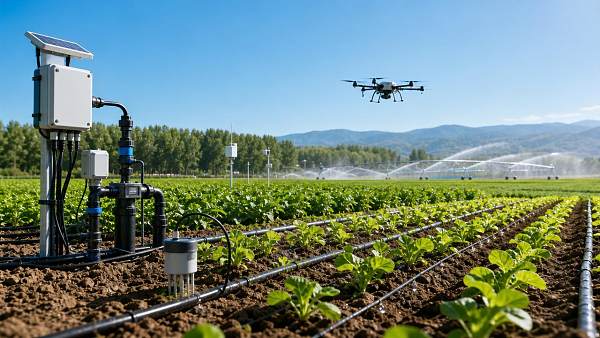
Smart farming technology for sustainable agriculture combines sensors, software, automation, and analytics to improve field decisions. In water management, the goal is precision rather than blanket irrigation.
Instead of watering by fixed schedule, farms use soil moisture readings, weather forecasts, crop stage data, and equipment feedback. Irrigation then matches actual field need more closely.
This shift is important because water loss often happens silently. Overwatering increases pumping costs, nutrient runoff, disease pressure, and uneven plant development across zones.
Modern smart farming technology for sustainable agriculture also links field data with wider operational systems. It can connect irrigation assets, power consumption, maintenance schedules, and ESG reporting.
Core technologies behind water reduction
- Soil moisture sensors that monitor conditions by depth and zone.
- Weather-integrated irrigation controllers that adjust runtime automatically.
- Remote sensing from drones or satellites for crop stress detection.
- Variable-rate irrigation systems for uneven soils and mixed topography.
- Telemetry platforms that track pumps, valves, pressure, and leaks.
- Decision dashboards that combine agronomic and operational benchmarks.
Why water efficiency is now a cross-industry priority
Agriculture no longer sits apart from industrial planning. Water scarcity affects processing plants, cold chain reliability, component demand, and infrastructure investment in water treatment and energy systems.
At the same time, ESG frameworks increasingly expect measurable resource performance. That makes smart farming technology for sustainable agriculture relevant to technical benchmarking and long-term capital planning.
The move toward data transparency also supports stronger procurement and engineering decisions. Verified field performance is more valuable than vendor claims when budgets depend on measurable payback.
Current market signals in 2026
Business value of smart farming technology for sustainable agriculture
The most immediate value is lower water use per unit of output. Yet the broader advantage includes reduced energy demand, improved nutrient control, and better field-level predictability.
Smart farming technology for sustainable agriculture also supports resilience. When weather swings sharply, real-time monitoring helps teams react faster and protect crop quality.
Another major benefit is data credibility. Reliable records support internal audits, environmental reporting, insurance discussions, and financing conversations tied to sustainability performance.
Where measurable gains usually appear
- Lower irrigation runtime and fewer unnecessary watering cycles.
- Reduced pump wear through better pressure and schedule management.
- Less fertilizer loss caused by runoff or deep percolation.
- Improved crop uniformity across zones with different soil conditions.
- Faster identification of leaks, clogging, or underperforming equipment.
For diversified industrial groups, these improvements can influence water treatment demand, maintenance cycles, and lifecycle cost models. The impact is operational, financial, and environmental at once.
Typical application scenarios and system types
Not every farm requires the same architecture. The right design depends on crop value, climate risk, field variability, infrastructure maturity, and reporting requirements.
Integration matters more than device count
Adding isolated sensors rarely delivers full value. Smart farming technology for sustainable agriculture works best when data flows into one operating view.
That unified view should compare agronomic need, water application, equipment status, and expected weather. Integration reduces delayed responses and prevents conflicting field actions.
Practical implementation guidance
Successful adoption usually starts with a baseline. Measure current water use, pumping energy, field variability, and seasonal yield patterns before selecting any digital stack.
Next, identify the biggest loss points. In many cases, the problem is not missing hardware. It is poor scheduling, low visibility, pressure imbalance, or undetected leakage.
Implementation priorities
- Map fields by soil type, slope, crop stage, and water infrastructure.
- Install sensing where decisions change, not only where access is easy.
- Link weather data with irrigation controls and alert thresholds.
- Verify calibration regularly for sensors, meters, and flow devices.
- Use benchmark reporting to compare water use across seasons and blocks.
- Review interoperability before expanding across brands or regions.
Common mistakes to avoid
- Buying devices without a clear water performance objective.
- Ignoring maintenance needs for probes, valves, and communications hardware.
- Using generic thresholds across fields with very different soil behavior.
- Treating pilot results as universal without local validation.
- Separating sustainability reporting from operational decision systems.
A benchmark-driven path forward
In 2026, smart farming technology for sustainable agriculture is no longer defined by novelty. It is defined by verified reduction in water use, stronger field control, and integration with broader industrial systems.
Organizations that move early should focus on evidence. Benchmark sensor accuracy, irrigation responsiveness, equipment compatibility, and reporting reliability before scaling investment.
A disciplined approach turns water efficiency into an operational standard rather than a seasonal experiment. That creates a stronger base for resilience, compliance, and long-term performance.
For deeper evaluation, build a comparison framework covering hardware durability, software interoperability, field performance, and ESG data traceability. This is where technical intelligence creates lasting advantage.

The Archive Newsletter
Critical industrial intelligence delivered every Tuesday. Peer-reviewed summaries of the week's most impactful logistics and market shifts.