Monday, May 22, 2024

Smart Irrigation Systems Manufacturer: Key Features That Cut Water Waste
by
Published
Views:
Choosing a smart irrigation systems manufacturer now requires a broader technical lens. Water scarcity, energy costs, and digital compliance are reshaping irrigation decisions across agriculture, landscaping, and environmental infrastructure.
The strongest platforms no longer compete on timers alone. They compete on verified water savings, sensor precision, platform interoperability, and dependable field performance under changing climate and soil conditions.
Within cross-sector manufacturing, irrigation has become part of a larger control ecosystem. Connectivity, electronics durability, hydraulic efficiency, and benchmarked data quality now influence system value as much as valve actuation.
Water management expectations are shifting faster than standard irrigation controls can handle
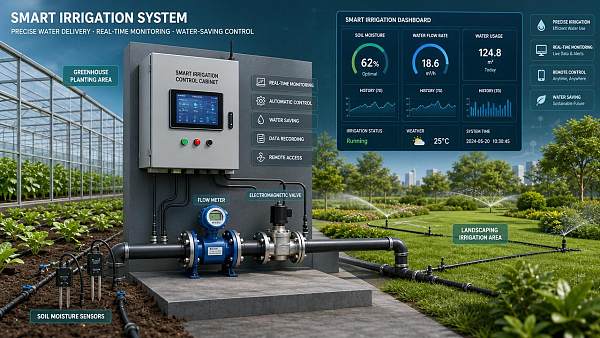
A capable smart irrigation systems manufacturer must respond to a new reality. Irrigation systems are expected to reduce waste, document performance, and integrate with wider digital infrastructure.
This shift is visible across farms, commercial landscapes, greenhouses, and municipal water networks. End users increasingly demand measurable efficiency rather than estimated scheduling improvements.
Conventional controllers often fail in three areas. They overwater during changing weather, ignore soil variability, and isolate irrigation data from broader operational systems.
By contrast, a modern smart irrigation systems manufacturer builds around sensing, analytics, and adaptive control. That architecture is what cuts water waste at the source.
The strongest trend signals point to precision, transparency, and integration
Several market signals explain why intelligent irrigation platforms are gaining strategic importance. These signals come from agronomy, industrial electronics, infrastructure digitization, and sustainability reporting.
- Weather volatility makes fixed schedules inefficient and increasingly risky.
- Water pricing and extraction controls are raising the cost of over-irrigation.
- Remote operations need cloud visibility and alarm-based exception management.
- Sustainability targets require traceable consumption and efficiency metrics.
- Mixed equipment environments demand protocol compatibility and modular upgrades.
These signals favor every smart irrigation systems manufacturer that can validate performance through data. Systems without transparent logic or sensing accuracy are losing relevance.
The features that cut water waste are becoming clearer and more measurable
Not every connected controller delivers real efficiency. The difference lies in how the platform senses conditions, interprets data, and adjusts flow with minimal delay or error.
1. Multi-layer sensing improves irrigation timing
The best systems combine soil moisture, rainfall, temperature, solar radiation, and evapotranspiration inputs. One data source alone cannot reflect root-zone needs across different field conditions.
A reliable smart irrigation systems manufacturer also calibrates sensor behavior for soil texture, salinity, and installation depth. Poor calibration creates false precision and hidden water loss.
2. Adaptive algorithms reduce overwatering
Rule-based automation is useful, but dynamic scheduling is better. Adaptive control changes runtime according to recent weather, forecast shifts, and actual moisture recovery after irrigation events.
This matters when infiltration rates differ across zones. Without zone-specific adaptation, some areas become saturated while others remain under-irrigated.
3. Flow monitoring detects waste in real time
Leaks, blocked emitters, broken valves, and pressure anomalies can waste large volumes quickly. Integrated flow meters and alert logic help stop abnormal consumption before it escalates.
An advanced smart irrigation systems manufacturer typically links flow thresholds to automatic shutoff rules. That feature converts monitoring into direct water protection.
4. Interoperability prevents data silos
Irrigation data gains value when connected to pumps, weather stations, fertigation units, and facility dashboards. Open communication protocols improve visibility and future expansion options.
Compatibility with Modbus, MQTT, LoRaWAN, or API-based cloud environments often signals stronger engineering maturity. Closed ecosystems can limit optimization and raise lifecycle costs.
5. Durable hardware preserves performance in harsh environments
Field reliability depends on enclosure sealing, connector stability, surge protection, and corrosion resistance. Electronics exposed to heat, humidity, dust, and unstable power need robust design margins.
A proven smart irrigation systems manufacturer should document ingress protection, operating temperature range, and mean time between failures where available.
Why these trends are accelerating across the wider industrial landscape
Smart irrigation is no longer isolated within agriculture. It now intersects with industrial ESG, environmental infrastructure, embedded electronics, and remote asset management.
This convergence explains why the choice of smart irrigation systems manufacturer increasingly resembles other industrial technology assessments. Data integrity and systems engineering now matter as much as hydraulic design.
The impact extends beyond irrigation performance alone
Water-saving features influence multiple business functions. Better irrigation control can improve crop consistency, reduce pumping energy, support compliance records, and lower maintenance interventions.
In landscaped or municipal environments, precise control also reduces runoff, erosion, and unnecessary treatment demand. That creates operational value beyond direct water cost reduction.
- Operations benefit from remote diagnostics and fewer site visits.
- Maintenance teams gain early warning of leaks or valve failures.
- Sustainability programs gain documented consumption trends.
- Capital planning improves through modular expansion paths.
What deserves the closest attention when comparing platforms
A high-value smart irrigation systems manufacturer should be assessed against practical engineering benchmarks, not marketing language. Several checkpoints reveal whether a platform can truly cut water waste.
- Sensor accuracy ranges and calibration procedures
- Zone-level control granularity and scheduling flexibility
- Flow anomaly detection speed and automatic response logic
- Interoperability with existing pumps, valves, and SCADA layers
- Data retention, exportability, and dashboard transparency
- Environmental durability and service support structure
- Documented case evidence showing verified savings
These factors help separate advanced irrigation automation from simple connected hardware. They also reduce the risk of selecting a system that cannot scale or integrate later.
A practical judgment framework helps turn trend signals into better decisions
The most effective evaluation path is comparative and evidence-based. Instead of focusing only on features, compare how each smart irrigation systems manufacturer performs across operational scenarios.
This approach supports stronger long-term outcomes. It also aligns irrigation technology decisions with broader industrial benchmarking disciplines used across connected equipment markets.
The next step is to validate savings claims under real operating conditions
Any smart irrigation systems manufacturer can promise efficiency. The more useful step is to request evidence from comparable applications, then test performance against site-specific variables.
Start with a pilot zone, baseline current water use, and compare results over a defined cycle. Include sensor stability, flow events, forecast accuracy, and maintenance burden in the review.
In a market moving toward resilient, data-driven infrastructure, the best irrigation platforms will be those that combine agronomic intelligence with industrial-grade transparency and reliability.

The Archive Newsletter
Critical industrial intelligence delivered every Tuesday. Peer-reviewed summaries of the week's most impactful logistics and market shifts.