Monday, May 22, 2024

What slows down sustainable agriculture on large farms
by
Published
Views:
Sustainable agriculture on large farms is often slowed not by a single issue, but by fragmented systems, rising costs, and uneven adoption of automotive technology, electronic components, and ISO standards. As operations scale, decisions around CNC milling machines, water purification, wastewater treatment, smart power grids, plastic injection molds, and even carbon capture increasingly shape efficiency, compliance, and long-term resilience.
For large farm operators, procurement teams, project managers, and technical evaluators, the challenge is no longer limited to seed, soil, and machinery. It now extends across energy systems, component quality, digital integration, maintenance planning, and environmental infrastructure. When one subsystem underperforms, the entire agricultural operation can lose productivity within a single season.
That is why sustainable agriculture on large farms must be understood as an industrial coordination problem as much as an agronomic one. From autonomous tractors and irrigation pumps to filtration modules and molded parts, performance depends on how well multiple technologies are selected, benchmarked, and deployed under real operating conditions.
For organizations evaluating long-term resilience, the key question is not simply what technology is available, but what slows adoption at scale, where the hidden costs emerge, and how cross-sector benchmarking can reduce risk. The sections below examine the operational bottlenecks, technical gaps, procurement barriers, and implementation priorities that most often delay sustainable agriculture on large farms.
Fragmented systems are the first major brake on sustainable agriculture
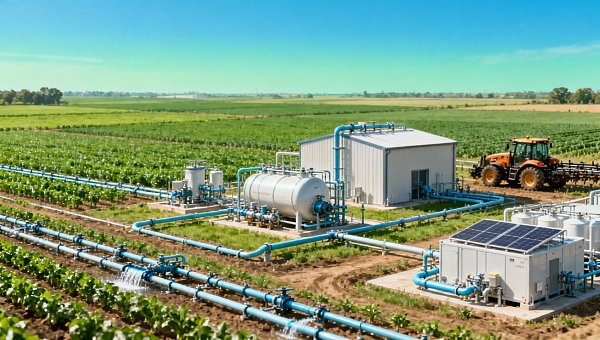
On many large farms, sustainability targets are managed through separate systems that were never designed to work together. Irrigation may run on one platform, machine telemetry on another, and wastewater treatment on a third. Once a farm exceeds 2,000 to 5,000 hectares, this fragmentation begins to create measurable delays in reporting, maintenance, and field response.
The operational result is inconsistent data visibility. A power fluctuation in a pump station may not be linked to declining filtration efficiency. A tractor route optimization tool may not communicate with soil moisture scheduling. In practice, teams spend 10% to 20% more time reconciling information manually, which slows decisions during planting, spraying, irrigation windows, and harvest peaks.
This matters because large-scale sustainable agriculture depends on synchronized performance. If water treatment capacity, equipment uptime, energy consumption, and field operations are measured in isolation, sustainability becomes reactive rather than managed. The farm may purchase efficient hardware yet still miss carbon, water, or yield targets because the surrounding systems are disconnected.
Cross-functional benchmarking is therefore essential. A procurement officer may compare unit price, but a technical evaluator must also review interoperability, spare part availability, service intervals, and compatibility with ISO-aligned quality processes. Without this wider view, capital expenditure often goes toward equipment that performs well individually but poorly as part of an operating ecosystem.
Where fragmentation typically appears
- Separate control systems for irrigation, drainage, and wastewater reuse, often sourced from 3 to 5 vendors.
- Autonomous or semi-autonomous field equipment using incompatible sensor and software protocols.
- Power infrastructure that lacks integration with smart grid monitoring, battery storage, or peak-load planning.
- Environmental compliance data collected quarterly, while operational data is reviewed weekly or daily.
The table below shows how disconnected systems affect sustainability outcomes on large farms and which industrial functions are usually impacted first.
The pattern is clear: farms do not usually fail because one technology is unavailable. They slow down because operational interfaces are weak. For large-scale projects, the winning strategy is often to reduce the number of disconnected decision points from 8 or 10 down to 3 or 4 integrated control layers.
Capital costs rise faster than implementation maturity
A second major constraint is cost escalation without equivalent process maturity. Large farms are under pressure to invest in electric mobility, precision application systems, advanced pumps, water treatment modules, and digitally controlled infrastructure. Yet many operations still evaluate purchases using short-term unit pricing rather than 3-year to 7-year total cost of ownership.
This leads to uneven adoption. A farm may buy autonomous tractors but continue using outdated workshop equipment, low-grade molded components, or undersized electrical protection systems. In those cases, the visible technology is modern, while the supporting industrial backbone remains vulnerable. Sustainable agriculture on large farms then slows because maintenance teams must compensate for weak upstream decisions.
The issue becomes more serious where component quality is inconsistent. For example, CNC-milled parts with loose tolerances, injection-molded housings with poor UV stability, or electronic boards lacking robust ingress protection can shorten service intervals from 24 months to 9 to 12 months in dusty, wet, or vibration-heavy environments. Procurement savings at purchase can become operating losses within one season.
Financial approvers and business leaders therefore need a broader cost model. It should include energy consumption, service labor, water recovery performance, replacement cycles, compliance exposure, and downtime cost per hour. On a large farm, even a 3-hour stoppage in irrigation, cooling, or harvesting during a critical period may outweigh a 5% equipment discount.
Core cost categories that are often underestimated
- Integration engineering time between machines, sensors, and farm management software.
- Replacement of non-standard components when local inventories do not match imported equipment.
- Water and wastewater treatment consumables, including membranes, filters, and cleaning chemicals.
- Power quality corrections for motors, chargers, pump stations, and distributed energy assets.
- Training time for operators, technicians, and safety teams, often 2 to 6 weeks per major rollout.
The table below compares typical procurement lenses with a more resilient evaluation framework suitable for sustainable agriculture at industrial scale.
For large farms, sustainable investment is not about buying the most advanced system in every category. It is about selecting systems whose cost profile, durability, and serviceability fit real operating conditions. That shift in evaluation discipline is often what separates successful scale-up from expensive pilot-stage thinking.
Standards, component quality, and infrastructure readiness remain uneven
Another reason sustainable agriculture on large farms slows down is that implementation quality is highly uneven across regions, suppliers, and project teams. Many operations want to align with ISO-based quality and environmental processes, but they struggle to translate standards into practical decisions on materials, fabrication tolerances, electrical safety, and inspection routines.
This gap is especially visible in mixed-technology environments. A farm may deploy imported power electronics, locally fabricated steel structures, third-party injection-molded enclosures, and outsourced water treatment skids. If each supplier works to a different quality baseline, reliability becomes difficult to predict. Even small tolerance mismatches of ±0.5 mm to ±1.5 mm can affect sealing, vibration performance, or alignment in rotating equipment.
Infrastructure readiness also matters. Smart power grids, backup storage, clean water lines, and wastewater loops must support seasonal surges, not just average demand. During irrigation peaks or post-harvest cleaning cycles, water flow, electrical load, and process throughput can rise by 30% to 60%. Systems sized without that margin frequently underperform when sustainability targets are most critical.
Technical evaluators should therefore treat compliance and infrastructure as operating variables, not paperwork. Quality assurance teams need acceptance criteria before procurement, not after installation. Project managers should verify commissioning checkpoints, inspection frequency, and service responsibilities early in the rollout. These controls reduce hidden variability that otherwise appears only after scale deployment.
Priority checkpoints before final approval
Mechanical and fabrication readiness
- Confirm tolerance expectations for CNC-machined parts, mounting surfaces, and sealing interfaces.
- Review corrosion resistance for humid, fertilizer-rich, or chemical-cleaning environments.
- Validate UV and heat resistance for molded plastics used outdoors for 8 to 12 hours per day.
Electrical and controls readiness
- Check enclosure protection levels, grounding strategy, cable routing, and surge protection.
- Confirm compatibility with farm telemetry systems and remote diagnostics workflows.
- Review spare board availability and service turnaround targets, ideally within 48 to 96 hours.
In practice, farms that standardize even 4 to 6 critical subsystems tend to achieve better uptime than those that optimize every category independently. Consistency in standards, documentation, and inspection often delivers more value than isolated high-spec purchases.
Water, energy, and emissions systems are now central to farm productivity
Sustainable agriculture on large farms is increasingly limited by infrastructure systems that sit outside the traditional farm equipment conversation. Water purification, wastewater treatment, distributed power, and carbon management now influence both compliance and productivity. When these systems are undersized, inefficient, or poorly integrated, the farm absorbs the cost through lower yields, higher input consumption, and operational instability.
Water is the clearest example. Farms using recycled process water, livestock-linked effluent treatment, or intensive irrigation need reliable filtration and treatment capacity. If membrane bioreactor modules, pumps, valves, or control panels are not matched to seasonal load, treatment quality can drift. That increases risk for reuse applications and often forces conservative operating modes that reduce efficiency.
Energy has a similar effect. Electrified fleets, cold storage, pumping networks, and digital monitoring all increase power complexity. A farm that installs chargers, variable-frequency drives, and sensor networks without load balancing or peak-demand controls may face unstable voltage conditions, higher tariffs, or shortened equipment life. In many regions, even a 10% to 15% peak reduction can materially improve operating economics.
Carbon capture is still an emerging area in agriculture, but emissions accounting is already affecting procurement and infrastructure choices. Large operators are being asked to document energy use, fertilizer impacts, water reuse, and waste handling more rigorously. That means sustainability hardware must support reporting, not just physical treatment or energy delivery.
Infrastructure priorities by operational objective
The following framework helps procurement and engineering teams align infrastructure upgrades with measurable sustainability goals instead of isolated equipment spending.
The key conclusion is that environmental infrastructure is no longer a peripheral investment. On large farms, it is part of core production capacity. Farms that treat water, energy, and emissions systems as strategic assets tend to scale sustainability faster and with fewer costly corrections.
How large farms can accelerate adoption without increasing risk
Moving faster does not mean buying everything at once. Large farms usually achieve better results through staged implementation. A practical roadmap often includes 3 phases: baseline benchmarking, targeted infrastructure upgrade, and integrated performance review. This sequence helps technical teams validate assumptions before capital is committed across the entire operation.
In the first phase, decision-makers should map critical bottlenecks across machinery, water, power, components, and compliance workflows. This can often be completed in 2 to 6 weeks depending on site count and supplier complexity. The goal is to identify where sustainable agriculture is actually being slowed: downtime, poor interoperability, input waste, or approval delays.
In the second phase, upgrades should prioritize systems with measurable operational leverage. That may mean replacing weak electrical distribution before adding more autonomous equipment, or stabilizing wastewater treatment before expanding reuse targets. A farm does not gain resilience by digitizing unstable processes; it gains resilience by making its physical and control layers dependable first.
In the final phase, performance data should be reviewed against procurement assumptions. Were service intervals achieved? Did water recovery improve? Has energy variability declined? Were spare parts delivered within the promised window? This step closes the gap between purchase intent and field reality, which is often where sustainable programs lose momentum.
Five implementation principles for decision-makers
- Benchmark subsystems together, not separately, especially water, power, controls, and mobile equipment.
- Use lifecycle cost models over at least 36 months for any high-dependency asset.
- Standardize critical parts and interfaces to reduce supplier and maintenance complexity.
- Build acceptance criteria around operating conditions, not brochure specifications alone.
- Require traceable performance data for quality, uptime, and environmental outputs.
FAQ for procurement and technical teams
How should a large farm prioritize sustainability investments?
Start with systems that affect multiple cost centers at once: water reuse, power stability, maintenance-critical machinery, and digital visibility. If one project can reduce downtime, resource waste, and compliance risk together, it usually delivers stronger value than a narrow technology upgrade.
What procurement indicators matter most?
At minimum, review 4 indicators: interoperability, lifecycle cost, serviceability, and standards alignment. For technical assets, also check spare parts lead time, expected maintenance frequency, environmental durability, and acceptance test criteria.
How long does implementation usually take?
A focused subsystem upgrade may take 4 to 12 weeks from assessment to commissioning. Multi-site integration across water, energy, and machinery can extend to 3 to 9 months, especially where supplier coordination and civil works are involved.
What slows down sustainable agriculture on large farms is rarely a lack of interest. More often, it is the accumulation of fragmented systems, poorly aligned investment logic, uneven component quality, and infrastructure that cannot support scaled environmental performance. The farms that move ahead are the ones that benchmark across disciplines, standardize critical interfaces, and make procurement decisions based on long-term operating reality.
Global Industrial Matrix supports this shift by connecting insights across smart agri-tech, electronics, mobility, environmental infrastructure, and precision tooling. For procurement teams, engineers, quality managers, and strategic decision-makers, that cross-sector view helps reduce supply chain uncertainty and improve technical fit before costly rollout decisions are made.
If you are evaluating how to improve resilience, reduce waste, or benchmark critical systems for large-scale sustainable agriculture, now is the right time to assess the operational gaps behind your current performance. Contact us to discuss your technical priorities, request a tailored benchmarking approach, or explore more solutions for integrated agricultural infrastructure.
- electronics
- electronic components
- Mobility
- automotive technology
- sensors
- Agri-Tech
- autonomous tractors
- wastewater treatment
- water purification
- carbon capture
- smart power grids
- CNC milling machines
- plastic injection molds
- Precision tooling
- Smart Agri-Tech
- ISO standards
- Sustainable agriculture
- Environmental infrastructure

The Archive Newsletter
Critical industrial intelligence delivered every Tuesday. Peer-reviewed summaries of the week's most impactful logistics and market shifts.