Monday, May 22, 2024

Guangdong Ties Tractor Exports to ISO 18853:2026
by
Published
Views:
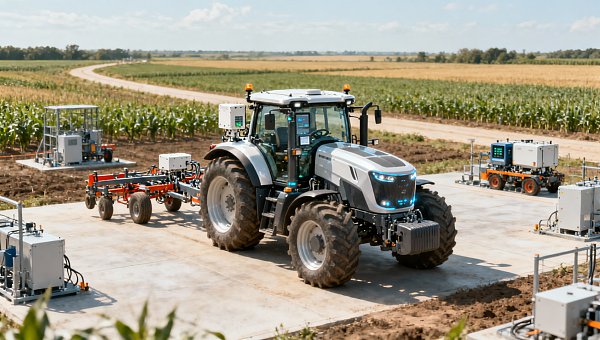
On June 4, 2026, the launch of Guangdong’s embodied intelligence training ground sent a clear compliance signal for agricultural equipment exports: export-oriented Autonomous Tractors are now expected to align mandatorily with ISO 18853:2026 on functional safety for agricultural autonomous mobile platforms. The development matters not only for tractor manufacturers, but also for controller suppliers, certification-related service providers, export teams, and overseas buyers, because the new benchmark is tied directly to technical configuration, bid readiness, procurement screening, and delivery compliance.
What the June 4 announcement confirmed
According to the information provided, Guangdong’s embodied intelligence training ground was launched on June 4, 2026 and explicitly identified ISO 18853:2026, Functional Safety of Agricultural Autonomous Mobile Platforms, as a mandatory export alignment standard.
The standard is described as introducing first-time requirements for export-oriented Autonomous Tractors to integrate three specific functions: real-time soil resistance sensing, implement coupling failure diagnostics, and a remote OTA safety downgrade protocol.
The same information also states that 12 Chinese complete-machine manufacturers have already obtained certification, and that their controller modules, including CAN FD redundant bus configurations, are being the subject of concentrated inquiries from large-farm procurement alliances in Brazil and Kazakhstan.
Where the rule change is likely to be felt first
Export model manufacturers face a narrower compliance window
From an industry perspective, complete-machine exporters are likely to feel the change first because the requirement is framed around export alignment rather than a general product preference. That means model configuration, compliance review, technical documentation, and bid submissions may all need to reflect whether the tractor includes the newly specified functional safety capabilities.
What deserves closer attention is that the requirement is not limited to a label or declaration. The inclusion of real-time soil resistance sensing, implement coupling failure diagnostics, and remote OTA safety downgrade functionality suggests that product specification matching and evidence preparation may become more prominent in export review and customer-side qualification.
Controller and bus-module suppliers move closer to the compliance front line
For controller-module suppliers, the mention of CAN FD redundant bus content indicates that component-level design is closely linked to the export readiness of the full machine. Analysis shows that suppliers in this layer may face more detailed requests from OEM customers on interface consistency, functional safety support, and supporting technical files tied to certification or procurement review.
This also means that procurement discussions may shift from pure price and lead time toward whether the module package can support the required safety functions and whether the supplier can provide documentation that fits customer certification pathways.
Buyers and procurement alliances may tighten technical screening
The concentrated inquiries from large-farm procurement alliances in Brazil and Kazakhstan indicate that the market is already reacting at the sourcing stage. Observably, overseas buyers may place greater emphasis on whether an export model is already certified and whether its controller architecture matches the functional safety expectations tied to ISO 18853:2026 alignment.
For procurement teams, this can affect tender language, pre-qualification checks, and delivery acceptance criteria. Even where detailed enforcement language is not yet provided in the input, buyers may still use the new benchmark as an early screening tool when comparing eligible suppliers.
Certification-related and testing service providers may see a documentation shift
Certification-related companies and testing service providers may also be affected because the new alignment signal points to a more specific review focus. Analysis shows that technical files, test evidence, and system descriptions connected to sensing, diagnostics, and OTA safety downgrade logic may receive closer scrutiny in future certification or conformity workflows.
Since the input does not provide a full enforcement procedure, it is more appropriate to understand this as a practical compliance direction rather than a complete public roadmap. Even so, enterprises involved in certification support will likely need to track how this alignment language is reflected in technical submissions and customer requests.
What companies should check now
Review whether export configurations match the stated safety functions
Companies exporting Autonomous Tractors should first verify whether their export-oriented models already include the three functions named in the provided information, and whether those functions are integrated in a way that can be documented clearly for customers, certification review, and contract discussions.
Prepare technical files for procurement and certification conversations
What deserves closer attention is the readiness of technical documents. Enterprises may need to examine product specifications, controller architecture descriptions, interface documents, and any available compliance materials that explain support for real-time soil resistance sensing, implement coupling failure diagnostics, remote OTA safety downgrade protocols, and CAN FD redundancy where applicable.
Watch for changes in tender wording and buyer qualification requests
Because the input specifically mentions concentrated inquiries from procurement alliances, exporters and supply-chain teams should pay attention to whether future bid documents, RFQs, or buyer qualification lists begin to reference ISO 18853:2026 alignment or ask for evidence linked to the required safety modules.
Track execution language before treating all requirements as settled practice
The provided information confirms a mandatory export alignment signal, but it does not include full implementation detail. Companies should therefore monitor how the requirement is expressed in subsequent official wording, certification practice, and procurement documents before assuming a uniform execution standard across every transaction stage.
How this signal should be read at this stage
Analysis shows that this development is more than a routine product update and less than a fully described enforcement regime. It is best understood as an execution-oriented compliance signal: the export threshold for Autonomous Tractors is being linked more directly to functional safety architecture, and that link is already influencing buyer inquiries.
Observably, the most important point is not only that ISO 18853:2026 has been named, but that the named functions are concrete enough to affect controller selection, product definition, and export documentation. At the same time, the absence of fuller implementation detail in the provided information means the market still needs to watch how certification interpretation, procurement language, and delivery expectations develop.
Why the market is likely to treat this as an early execution benchmark
At this stage, it is more appropriate to understand the June 4 development as an actionable market signal with immediate relevance for export preparation, supplier coordination, and buyer communication. It already points to a more specific compliance baseline for export-oriented Autonomous Tractors, but some aspects of execution still require observation rather than assumption.
A measured reading is therefore warranted: the rule change appears sufficiently concrete to affect product and sourcing decisions now, while the finer points of implementation, review standards, and market-wide adoption should continue to be monitored closely.
Basis of this article
This article is generated from the user-provided news title, event date, and event summary. No specific official source link was provided in the input, so the underlying official publication path still requires further verification.
For this type of development, relevant source categories typically include official notices, regulator releases, customs or trade-administration information, industry association updates, standards organization documents, and reporting by authoritative trade media. Further follow-up is still needed on detailed implementation language, certification interpretation, tender-document changes, market feedback, and how enterprises apply the requirement in practice.

The Archive Newsletter
Critical industrial intelligence delivered every Tuesday. Peer-reviewed summaries of the week's most impactful logistics and market shifts.