Monday, May 22, 2024

Industrial Intelligence for Agriculture: Where It Improves Yield First
by
Published
Views:
Where industrial intelligence for agriculture improves yield first
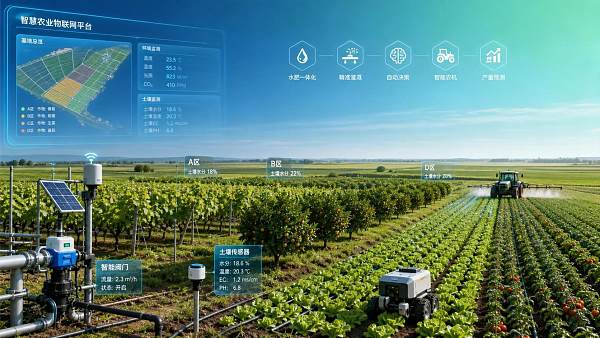
Industrial intelligence for agriculture creates its earliest yield gains where field conditions change faster than manual decisions can keep pace.
That usually means water timing, soil variability, input dosing, and machine performance, not broad digital transformation all at once.
In practice, the strongest returns appear when biological signals, equipment behavior, and infrastructure limits are read together.
This is why industrial intelligence for agriculture is increasingly treated as an operational layer rather than a reporting layer.
A platform view matters here.
Agriculture now overlaps with electronics, mobility systems, filtration, sensing, and compliance standards across the wider industrial chain.
That cross-sector reality is where Global Industrial Matrix fits naturally.
By connecting Smart Agri-Tech with semiconductor performance, precision tooling, environmental infrastructure, and benchmarked hardware data, GIM reflects how yield decisions are actually made.
The question is not whether intelligence systems can help.
The more useful question is where industrial intelligence for agriculture improves yield first, and under which operating conditions those gains hold.
Why the first-use case changes from one operation to another
Different production environments create different bottlenecks, so the first intelligence layer should match the dominant source of yield loss.
A water-stressed orchard does not need the same priority stack as a broadacre grain farm with machinery downtime.
Protected cultivation often gains more from climate control and fertigation precision.
Open-field production may see earlier value from geospatial soil mapping and route optimization.
The common thread is decision latency.
When a delay between signal and action reduces plant performance, industrial intelligence for agriculture tends to produce measurable yield improvement quickly.
A second factor is system integration.
If sensors, irrigation assets, tractors, filtration modules, and control software operate in isolation, data quality may exist without operational impact.
This is where benchmarked interoperability and standards awareness become practical, not theoretical.
What usually determines the earliest gain
- High variability within the same field or block
- Frequent weather-driven adjustments
- High input cost sensitivity per hectare
- Equipment uptime that directly affects planting, spraying, or harvest windows
- Water quality or pressure instability across delivery infrastructure
Water control is often the first place industrial intelligence for agriculture pays back
In many regions, irrigation is the clearest early win because timing errors affect both stress and nutrient uptake.
When irrigation still follows fixed schedules, fields are often overwatered in cool periods and under-supported during sudden heat.
Industrial intelligence for agriculture changes this by linking evapotranspiration, soil moisture layers, pump behavior, and valve response.
The result is not simply lower water use.
The more important result is steadier root-zone conditions during sensitive growth stages.
This matters especially in fruit, vegetables, seed production, and high-value row crops.
A useful judgment point is whether the irrigation problem is agronomic, hydraulic, or both.
Some operations focus on adding sensors while ignoring filtration losses, pump cycling issues, or uneven pressure distribution.
In that case, data becomes precise while water delivery remains inconsistent.
This is one reason cross-domain benchmarking matters.
The performance of MBR-related water infrastructure, control electronics, and field hardware should be evaluated as a connected system.
Soil variability becomes the next priority when averages hide real losses
Many yield gaps are not caused by poor overall management.
They come from treating uneven ground as if it were uniform.
That is where industrial intelligence for agriculture moves beyond monitoring and starts guiding allocation decisions.
Zone-based soil intelligence helps separate low productivity caused by moisture limits, compaction, salinity, drainage, or nutrient lockup.
Without that separation, variable-rate application may look sophisticated while reinforcing the wrong assumptions.
The more common mistake is relying on a single sampling cycle.
Soil response changes with weather, crop rotation, and equipment traffic.
A reliable approach combines historical yield layers, sensor readings, terrain effects, and field operations data.
When this is connected to seeding and fertilizer decisions, industrial intelligence for agriculture can improve yield without blanket input increases.
Input optimization matters most where margins are tight and response windows are short
Fertilizer and crop protection decisions are often the most contested because under-application and over-application both carry risk.
Industrial intelligence for agriculture helps by narrowing the uncertainty around timing, dose, and placement.
In fast-changing conditions, the yield benefit comes less from using more product and more from using it under the right field state.
Leaf condition, disease pressure, canopy density, and microclimate signals can all shift the correct intervention point.
The judgment challenge is that biological response is local, while purchasing decisions are often standardized.
This creates a mismatch between farm-level variability and input planning.
A better fit is to treat intelligence outputs as decision thresholds linked to field zones and crop stage, not as generic dashboards.
That also supports traceability and compliance, especially where environmental reporting requirements are tightening.
When machinery sets the yield ceiling, intelligence should start with uptime
There are operations where irrigation and soil data are strong, yet yield still slips because execution windows are missed.
Planting delays, spray interruption, and harvest breakdowns can erase the value of otherwise good agronomy.
In those cases, industrial intelligence for agriculture should begin with equipment health, route planning, and parts reliability.
Autonomous tractors, guidance systems, electric drivetrains, and smart implements depend on stable electronics, precision tooling, and serviceable control architecture.
This is where GIM’s broader industrial view becomes useful.
Agricultural equipment now shares technical dependencies with automotive mobility platforms and high-performance electronics supply chains.
Benchmarking against standards such as ISO, IATF, and IPC helps distinguish durable machine intelligence from attractive but fragile integration.
Different field conditions change what to prioritize
What gets misread before deployment
A frequent misjudgment is assuming more data automatically means better yield outcomes.
If sensor density rises but action rules stay vague, the system becomes observational rather than operational.
Another mistake is comparing technologies by acquisition cost alone.
Industrial intelligence for agriculture should be judged by maintenance burden, calibration discipline, data compatibility, replacement lead times, and operator response speed.
Similar-looking sites can also mislead planning.
Two farms may share crop type but differ sharply in water quality, topography, labor constraints, or machinery fleet age.
That changes which intelligence layer improves yield first.
The practical lesson is to benchmark site conditions, interfaces, and performance thresholds before scaling architecture across locations.
A practical way to match industrial intelligence for agriculture to the right starting point
A good rollout starts by locating the narrowest yield constraint with the highest repeat impact.
That might be root-zone instability, poor field-zone visibility, inconsistent spray timing, or machine downtime during critical windows.
From there, the better path is disciplined matching rather than broad digitization.
- Map yield loss against water, soil, input, and equipment signals.
- Check whether existing hardware can act on intelligence outputs fast enough.
- Review compatibility with standards, service cycles, and replacement parts.
- Use pilot zones to confirm response quality before wider deployment.
- Track yield effect together with labor load, uptime, and infrastructure stress.
Industrial intelligence for agriculture delivers its earliest yield advantage where decisions are frequent, conditions are variable, and action can be executed immediately.
The real work is identifying which of those conditions matters most on a given site.
A cross-sector benchmark, grounded in verifiable technical data, makes that decision more reliable and far easier to scale.
The Archive Newsletter
Critical industrial intelligence delivered every Tuesday. Peer-reviewed summaries of the week's most impactful logistics and market shifts.