Monday, May 22, 2024

Are Refurbished Electronic Components Safe for Industrial Use?
by
Published
Views:
Are refurbished electronic components safe for industrial use? They can be—but only when their provenance, refurbishment process, verified performance, and intended application support that conclusion. A lower price or immediate availability is not evidence of safety. Neither is a supplier’s statement that a part has been “fully tested.”
For a maintenance manager facing a discontinued drive controller, or a procurement team trying to keep an aging production line running, refurbished electronics can be a practical option. The challenge is distinguishing controlled reuse from an undocumented gamble. That requires looking beyond whether a component works today and asking whether it can operate reliably, within specification, under the conditions your facility will impose.
“Refurbished” describes a process, not a reliability rating
The term covers very different products. A refurbished industrial power supply might have been inspected, repaired with approved replacement parts, tested under load, and released with a serial-numbered report. A supposedly refurbished semiconductor might simply have been removed from a used circuit board, cleaned, and offered for resale.
These are not equivalent purchasing decisions.
- Refurbished assemblies or modules: Products such as PLC modules, human-machine interfaces, industrial computers, and drives that have undergone inspection, servicing, and verification.
- Reclaimed components: Devices recovered from previously assembled equipment. Removal may introduce thermal or mechanical damage, and their service history may be unknown.
- Unused surplus: Older inventory that has not entered service. It is not necessarily refurbished, but storage conditions, authenticity, and solderability still matter.
- Remanufactured equipment: Equipment restored under a defined process to specified performance requirements. The term alone does not establish what those requirements are.
Start by asking the supplier to define exactly what it is selling. If the answer changes between the quotation, product label, and inspection report, pause the purchase. A sound qualification process cannot begin with ambiguous product status.
Let the consequence of failure determine the acceptance threshold
The same refurbished module may be acceptable in one machine and unsuitable in another. A display used for nonessential production information presents a different risk from electronics controlling a press interlock or monitoring a hazardous process.
Evaluate not only the likelihood of failure, but also what happens when it fails. Does the system stop safely? Can an independent protection layer detect the fault? Would failure damage equipment, contaminate product, or expose a worker to danger?
Where failure could cause serious harm, uncertainty itself is a reason to reject a part. Refurbishment should not become a shortcut around an established safety lifecycle, approved bill of materials, or customer qualification requirement.
The evidence that matters before a purchase order
A certificate saying “tested and working” offers little protection if it does not identify the item, methods, and acceptance criteria. Procurement needs evidence that engineering can review—not merely documents that can be filed.
Provenance and identity
Request the manufacturer, exact part number, hardware revision, serial number where applicable, and available date or lot codes. Ask whether the item came from an OEM program, a known installation, surplus inventory, or an unidentified recovery stream.
Service history can be valuable, especially for equipment exposed to heat, vibration, moisture, or corrosive environments. Where that history is unavailable, record the uncertainty rather than treating it as proof of benign use. For discrete components and integrated circuits, reclaimed origin also changes the inspection and testing burden.
Scope of refurbishment
The supplier should describe inspections performed, faults found, repairs made, parts replaced, and any firmware changes. For a drive or power supply, ask how electrolytic capacitors, fans, connectors, and other wear-sensitive items were evaluated. A cleaned enclosure tells you little about the condition of the electronics inside.
Replacement parts must be technically appropriate. Substituting a capacitor based only on capacitance and voltage can overlook ripple-current capability, temperature rating, equivalent series resistance, and expected operating life.
Test records tied to the delivered item
Useful reports identify test conditions, equipment used, measured results, and pass/fail limits. They should connect to the delivered serial number or clearly defined lot. For sampling-based inspection, ask what was sampled, why the plan was chosen, and what defects the method could miss.
Also establish the warranty, return procedure, and failure-analysis arrangements. These do not prove reliability, but they determine whether an unexpected defect becomes a manageable event or a prolonged dispute.
What testing can establish—and what it cannot
A successful power-on test confirms very little about industrial fitness. Equipment that starts normally on a bench may fail after warming up, under peak load, or when communicating with the rest of a control system.
A proportionate qualification process moves from identification to inspection, electrical verification, representative operating tests, and controlled release.
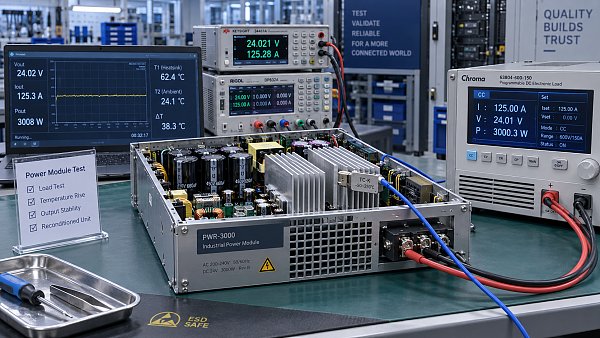
- Visual and physical inspection: Look for corrosion, contamination, damaged connectors, altered markings, poor solder joints, and evidence of excessive rework.
- Electrical checks: Verify relevant parameters against documented limits. Insulation, leakage, grounding, and dielectric tests may be appropriate for certain assemblies, using applicable procedures.
- Functional testing: Exercise the functions that matter in service, including I/O channels, communications, protection features, and fault responses.
- Load and thermal testing: Evaluate performance under representative demand and temperature conditions, particularly for power supplies and drives.
- Authenticity investigation: Use suitable specialist methods when counterfeit or misrepresented parts are a credible risk. These may include marking analysis, X-ray inspection, or destructive analysis of selected samples.
Testing must match the device. A reclaimed integrated circuit requires different methods from a refurbished operator panel. Applying the same generic checklist to both creates the appearance of control without equivalent assurance.
Burn-in or extended operation can reveal some early failures, but it does not establish remaining service life. Excessive stress can also consume useful life. Likewise, testing a sample cannot demonstrate that every item in a mixed-origin batch is authentic or undamaged.
The objective is to reduce relevant uncertainty, not to collect the longest possible test report.
Standards provide a framework, not a blanket approval
Standards are useful when their scope matches the purchasing problem. They become misleading when a general certification is presented as proof that a specific refurbished component is safe.
ISO 9001 addresses quality management systems; it does not certify the reliability of an individual part. IATF 16949 addresses automotive quality management requirements and does not automatically authorize refurbished electronics in a vehicle application.
IPC-A-610 provides acceptance criteria for electronic assemblies, while IPC-7711/7721 addresses rework, modification, and repair practices. These can support workmanship assessment, but acceptable workmanship is not the same as verified lifetime performance.
For electronic-part supply chains, standards such as SAE AS5553 and AS6081 may be relevant to counterfeit avoidance and detection, depending on the organization and procurement context. Safety-related applications may involve IEC 61508 or sector-specific standards; their requirements cannot be replaced by an ordinary supplier bench test.
Verify the applicable edition, contractual requirements, and certification scope. Ask whether the documented process actually covers the product, facility, and activity involved. Repairs or substitutions may also affect existing approvals, so obtain OEM or compliance guidance where necessary.
Qualification does not end at the receiving dock
Once a candidate passes supplier review, it still needs to fit the installation. Confirm hardware revision, firmware version, communications protocols, electrical ratings, and configuration requirements. “Same part number” does not always mean interchangeable behavior across revisions.
Environmental compatibility deserves particular attention. Electronics in an automotive plant, a greenhouse control cabinet, and a wastewater installation may face very different combinations of vibration, condensation, chemicals, dust, and electrical noise. A component’s original rating must suit the actual installation; refurbishment does not improve that rating by default.
For networked controllers and industrial computers, include cybersecurity checks. Remove previous credentials and configurations, establish trusted firmware where supported, and confirm that security updates remain available. A functionally sound device can still introduce operational risk through unsupported software.
Release the item through change control, with a defined commissioning test and rollback plan. Where feasible, introduce it in a noncritical or redundant position before broader deployment. Record its status in the maintenance system so future technicians do not mistake it for a new, fully traceable OEM item.
Compare lifecycle cost, not just the invoice
Refurbished electronics can support obsolete systems, reduce unnecessary replacement, and keep usable hardware out of the waste stream. Those benefits are meaningful only if the equipment remains dependable enough for its role.
Compare acquisition cost with inspection, qualification, installation, spare inventory, possible downtime, and disposal costs. Include the burden of supporting obsolete firmware or an aging architecture. A cheaper module may be a sensible bridge to a planned upgrade, but a poor basis for extending an unsupported system indefinitely.
This is where cross-sector benchmarking adds value. Global Industrial Matrix (GIM) approaches manufacturing as an interconnected system spanning electronics, mobility, smart agriculture, environmental infrastructure, and precision tooling. That perspective helps procurement teams frame component decisions around technical requirements, supply-chain exposure, and operational consequences rather than price alone.
Benchmarking should support—not replace—the site-specific engineering decision. No general comparison can account for every installation’s safety function, operating duty, or compliance obligations.
A defensible decision has a clear owner
Before approving refurbished industrial electronics, assign responsibility for acceptance. Procurement verifies supplier commitments and traceability; engineering defines technical suitability; quality reviews evidence; maintenance establishes monitoring and replacement arrangements. Safety or compliance specialists must participate when the application requires them.
Reject or quarantine items with unexplained identity discrepancies, undocumented substitutions, unsuitable ratings, inconsistent test records, or unresolved authenticity concerns. Do not allow production urgency to turn a missing answer into an assumed pass.
Refurbished electronic components are safe for industrial use only when the evidence and application justify their acceptance. For lower-risk functions, controlled refurbishment can be a practical sourcing strategy. For safety-critical duties or poorly documented recovered parts, the threshold must be much higher—and sometimes the right decision is to buy new, seek an OEM-supported replacement, or redesign the system. Keeping a line running matters. Knowing why it can keep running safely matters more.

The Archive Newsletter
Critical industrial intelligence delivered every Tuesday. Peer-reviewed summaries of the week's most impactful logistics and market shifts.