Monday, May 22, 2024

Electronic Components Specifications: Key Ratings to Check First
by
Published
Views:
Electronic Components Specifications: Key Ratings to Check First
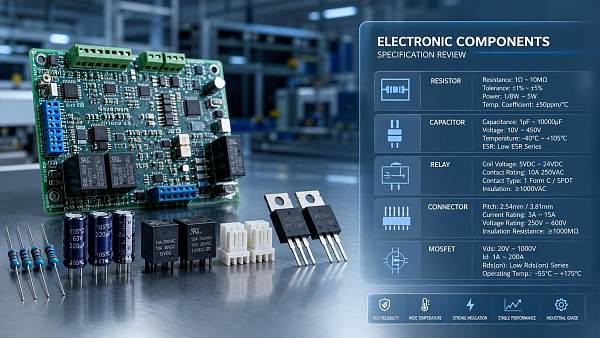
For quality and safety work, electronic components specifications are never just catalog details.
They are the first filter for failure prevention, compliance control, and supplier approval.
A resistor, relay, capacitor, connector, or MOSFET may look acceptable on paper.
But if core ratings do not match real operating stress, the part becomes a hidden risk.
This matters even more in mixed industrial systems.
Power electronics, control boards, sensors, and safety circuits now sit inside harsher, faster, more connected environments.
That is why reviewing electronic components specifications should start with the ratings most likely to cause field failure.
The practical goal is simple.
Confirm that the selected part can survive actual voltage, current, heat, insulation stress, and production variation.
Why Electronic Components Specifications Must Be Checked Early
Early review saves time because most downstream issues begin with an unrealistic assumption.
Teams often compare nominal ratings, then overlook surge events, enclosure heat, contamination, or startup current peaks.
In real procurement and validation cycles, that gap creates avoidable scrap, rework, warranty exposure, and certification delay.
Strong electronic components specifications review also improves supplier conversations.
Instead of asking whether a part is equivalent, teams can ask whether its critical ratings remain valid in the target application.
That shift sounds small, but it changes decision quality.
The First Ratings to Check Before Approval
When reviewing electronic components specifications, start with the ratings that define safe operating limits.
1. Voltage Rating
Voltage rating is one of the fastest ways to reject an unsuitable part.
Check continuous voltage, peak voltage, transient tolerance, and isolation voltage where relevant.
A capacitor rated near the nominal bus voltage may still fail during switching spikes or abnormal line conditions.
For connectors and relays, creepage and clearance requirements also affect the real voltage margin.
2. Current Rating
Current rating should never be read without thermal context.
Catalog values may assume open air, defined conductor size, or short duty cycles.
In a sealed cabinet, current capability can drop sharply.
Always compare steady current, inrush current, surge current, and fault current exposure.
3. Temperature Rating
Temperature limits define whether the part remains stable over time.
Review ambient range, junction temperature, storage limits, and temperature rise during operation.
Electronic components specifications often look acceptable until nearby heat sources are added to the model.
Power resistors, semiconductors, and magnetic parts are especially sensitive here.
4. Tolerance and Accuracy
Tolerance affects both performance and process capability.
A resistor with wide tolerance may pass incoming inspection but still shift circuit behavior outside control limits.
For sensors and timing devices, initial accuracy is only the starting point.
Drift over temperature, aging, and load conditions must be reviewed too.
5. Insulation and Dielectric Performance
For safety-critical assemblies, insulation ratings deserve immediate attention.
Check dielectric strength, insulation resistance, comparative tracking data, and isolation test conditions.
This is where electronic components specifications connect directly to electric shock prevention and fire risk control.
How to Read Ratings in Real Operating Conditions
Good review does not stop at the datasheet headline.
Electronic components specifications only become useful when mapped to the actual system profile.
That means looking at operating modes, fault scenarios, environmental exposure, and service life expectations together.
- Use worst-case voltage, not average voltage.
- Use measured enclosure temperature, not room temperature.
- Check derating curves for current, power, and temperature.
- Include startup, surge, vibration, humidity, and contamination.
- Review end-of-life behavior, not only initial performance.
This is also where many substitutions fail.
An alternate source may match nominal values while missing derating margin under the exact application profile.
Common Gaps Found During Specification Review
Across industrial sourcing and validation work, several review gaps appear again and again.
- Using absolute maximum ratings as normal design targets.
- Ignoring test conditions behind published current values.
- Missing thermal coupling between adjacent components.
- Comparing part numbers without checking revision changes.
- Assuming compliance marks cover every installation environment.
- Skipping insulation review in low-voltage control circuits.
These gaps are rarely dramatic at the approval stage.
They become visible later through nuisance trips, thermal damage, dielectric breakdown, or unexplained instability.
A Practical Review Table for Electronic Components Specifications
This kind of table helps teams standardize reviews across categories and suppliers.
Where Standards and Cross-Sector Benchmarking Matter
Electronic components specifications should be checked against more than a datasheet and purchase order.
Standards context matters because application risk is rarely isolated to one component family.
In modern manufacturing, electronics interact with mobility systems, environmental equipment, smart agriculture platforms, and industrial controls.
That is where GIM adds value.
By benchmarking hardware against ISO, IATF, IPC, and sector-specific requirements, GIM supports more defensible specification review.
The advantage is not just better data.
It is the ability to see how the same rating behaves across different operating ecosystems.
That perspective improves supplier qualification, alternate sourcing, and long-term risk control.
A Simple Approval Workflow That Holds Up in Practice
A workable process for electronic components specifications review does not need to be complicated.
- Define the actual operating envelope, including abnormal events.
- Collect current datasheets, test notes, and certification evidence.
- Check voltage, current, temperature, tolerance, and insulation first.
- Apply derating rules and compare against measured conditions.
- Document any gap, mitigation, or supplier clarification required.
- Approve only after the part fits the real use case, not the nominal one.
This workflow keeps decisions traceable and easier to defend during audits or incident review.
Final Takeaway
The best place to prevent failure is the specification review stage.
When electronic components specifications are checked in real context, weak parts are identified before they reach the line or the field.
Start with voltage, current, temperature, tolerance, and insulation performance.
Then connect those ratings to derating, standards, environment, and supplier evidence.
That approach makes electronic components specifications a practical control tool, not just a document check.

The Archive Newsletter
Critical industrial intelligence delivered every Tuesday. Peer-reviewed summaries of the week's most impactful logistics and market shifts.