Monday, May 22, 2024

How to Compare Wholesale IC Chip Components Without Overpaying
by
Published
Views:
Comparing wholesale IC chip components is no longer just about finding the lowest quote. For procurement professionals, the real challenge is balancing price, quality, traceability, and supply continuity without exposing operations to hidden risks. This guide explains how to evaluate suppliers and technical benchmarks more effectively, so you can make smarter sourcing decisions and avoid overpaying in a volatile global market.
Why do buyers often overpay for wholesale IC chip components?
Many procurement teams assume overpaying happens only when a supplier inflates unit price. In reality, the bigger problem is total acquisition cost. A batch of wholesale IC chip components may look competitive on paper, yet become expensive once you factor in yield loss, incoming inspection failures, long lead times, documentation gaps, or emergency spot buys caused by unstable supply.
In electronics and cross-industry manufacturing, price volatility is often tied to wafer capacity, packaging constraints, geopolitical restrictions, logistics disruptions, and uneven channel transparency. A buyer who compares only the quoted price per piece may miss whether the parts are factory-authorized, excess inventory, broker-sourced, refurbished, or from a gray-market channel. That is where hidden cost enters the deal.
For procurement officers, the smarter question is not “Who is cheapest today?” but “Which source delivers verified value with acceptable risk?” This is especially important when wholesale IC chip components support automotive electronics, industrial controls, smart agriculture systems, environmental monitoring equipment, or infrastructure hardware where failure costs are much higher than purchase cost.
What should you compare first before requesting quotes?
Before comparing suppliers, standardize the requirement. A surprising number of sourcing errors happen because buyers request quotes for an incomplete part description. The same functional device can have multiple package types, temperature grades, qualification levels, moisture sensitivity ratings, date code preferences, and lifecycle statuses. If those details are unclear, quote comparisons become misleading.
Start by locking down the exact manufacturer part number, approved alternates, package outline, RoHS or REACH requirements, target application, annual usage, and acceptable lead time range. Then define whether your sourcing strategy allows franchised distributors, independent distributors, or only direct authorized channels. This single step can eliminate a large portion of invalid comparisons in wholesale IC chip components sourcing.
It is also helpful to separate strategic demand from urgent demand. A spot-buy requirement for a line-down event should not be benchmarked the same way as a twelve-month scheduled procurement plan. The channel mix, pricing logic, and acceptable premiums are different.
Quick comparison checklist before RFQ
How can you tell whether a low quote is actually a good deal?
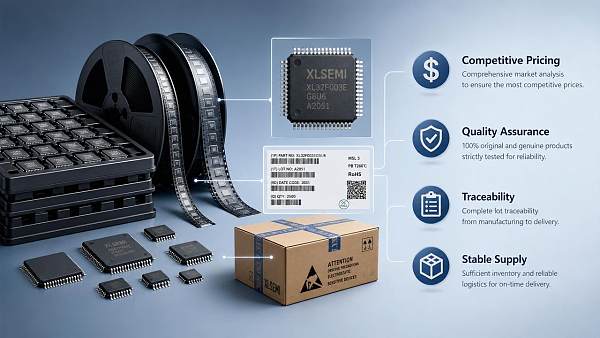
A low quote for wholesale IC chip components is only attractive if the supply is genuine, usable, and delivered within your risk tolerance. Ask for the source pedigree: original manufacturer, authorized distributor, excess from an OEM, or open-market broker inventory. Then review documentation such as certificates of conformity, packing photos, lot codes, moisture barrier packaging details, and traceability records.
Buyers should also compare testing obligations. Some low-priced offers become expensive because the purchaser must pay for third-party authenticity testing, decapsulation, X-ray, solderability, or electrical validation. If one supplier includes stronger quality assurance while another shifts all verification costs to you, the headline price loses meaning.
Another warning sign is unusual inconsistency between quantity and lead time. If a supplier claims immediate availability for high-demand parts at below-market pricing, verify whether that inventory is truly on hand, already reserved elsewhere, or subject to substitution risk. In wholesale IC chip components procurement, unrealistic convenience often deserves closer scrutiny, not quicker approval.
Which technical and commercial benchmarks matter most when comparing suppliers?
Procurement decisions improve when commercial review is tied to technical benchmarking. This is where a broader industrial intelligence approach adds value. Instead of reviewing quotes in isolation, compare supplier capability against recognized standards, application demands, and lifecycle realities.
For wholesale IC chip components, the most practical benchmarks usually include traceability depth, inspection protocol, quality management alignment, packaging control, and responsiveness under shortage conditions. Depending on the end use, buyers may also consider alignment with IPC handling practices, ISO-based quality systems, or sector-specific frameworks such as IATF for automotive-related programs.
Commercially, compare not only unit price but also terms that influence long-term value: payment structure, NCNR exposure, cancellation flexibility, buffer stock options, liability on nonconforming goods, and documented escalation procedures. A supplier with slightly higher pricing may still provide lower total cost if they support stable planning, stronger compliance, and fewer procurement escalations.
Practical supplier benchmarking points
- Traceability from source to shipment
- Documented anti-counterfeit process
- Storage and ESD handling controls
- Responsiveness to engineering change or obsolescence
- Lead time reliability versus quoted promise
- Support for cross-sector compliance needs
What are the most common mistakes when buying wholesale IC chip components?
The first mistake is treating all stock as equal. Components with the same part number can differ in source credibility, storage condition, age, packing integrity, and prior handling history. Without that context, a buyer may approve inventory that later causes assembly defects or field risk.
The second mistake is ignoring lifecycle status. If a part is nearing end-of-life, an attractive quote may still be poor value if it cannot support future builds. Procurement should confirm whether the device is active, NRND, obsolete, or dependent on limited die-bank supply. This matters across electronics, mobility systems, agricultural automation, and environmental equipment where long support cycles are common.
The third mistake is failing to align sourcing with the application’s risk level. Low-cost channels may be acceptable for non-critical repair scenarios, but not for mission-critical control boards or regulated products. A disciplined sourcing policy should match part criticality with verification intensity.
The fourth mistake is comparing offers too late in the buying cycle. When production is already under pressure, buyers lose leverage and accept premiums they would have avoided with earlier demand visibility and alternate planning. Better forecasting is often one of the best defenses against overpaying for wholesale IC chip components.
How should procurement teams balance price, risk, and continuity?
A practical way to balance these priorities is to segment purchases into at least three categories: strategic recurring parts, constrained or high-risk parts, and urgent exception buys. Each category should have different comparison logic. Strategic recurring parts benefit from annual benchmarking, supplier scorecards, and volume negotiation. Constrained parts need broader market intelligence, lifecycle review, and secondary source planning. Urgent buys require fast validation rules to control emergency premiums.
This is where data-led benchmarking platforms can support better decisions. When procurement teams can compare cross-sector demand signals, supplier reliability patterns, and technical compliance indicators, they gain a more realistic view of fair market value. That reduces dependence on isolated quotations and helps identify whether a premium is justified by scarcity or simply caused by poor visibility.
For buyers working across industrial electronics, automotive subsystems, smart agri-tech controls, or infrastructure monitoring equipment, a unified evaluation method matters. It prevents one department from chasing the lowest cost while another absorbs the quality fallout. In that sense, the best approach to wholesale IC chip components is not only transactional sourcing, but system-level procurement governance.
Decision guide for different purchase situations
What questions should you ask suppliers before placing an order?
Strong supplier questioning reduces both cost and uncertainty. Ask where the inventory originated, whether the stock is physically available, what traceability documents can be shared before payment, and whether lot mixing is involved. Confirm packaging condition, date code range, return policy, and whether any third-party testing has already been performed.
Also ask operational questions that affect total value: Can the supplier support scheduled releases? Do they provide shortage alerts? How quickly do they communicate PCN or obsolescence notices? Can they suggest approved alternates when the market tightens? These questions move the conversation beyond price and reveal whether the supplier can support continuity.
For procurement leaders sourcing wholesale IC chip components globally, it is wise to document these questions in a repeatable scorecard. That allows fairer comparison across regions and channels and helps internal stakeholders understand why the cheapest offer is not always the most economical choice.
How can you build a smarter long-term sourcing strategy instead of chasing quotes?
The most effective strategy combines market awareness, technical validation, and supplier segmentation. Build a preferred source list for recurring wholesale IC chip components, maintain secondary options for constrained parts, and review demand patterns with engineering before shortages become urgent. When possible, benchmark critical devices against alternative manufacturers and package-compatible substitutes early in the design or maintenance cycle.
Procurement teams also benefit from using cross-sector intelligence rather than siloed data. Demand shocks in automotive electronics, industrial automation, precision tooling controls, or smart environmental systems can affect availability far beyond one category. Organizations such as Global Industrial Matrix support this broader view by connecting supplier evaluation with technical benchmarking, standards awareness, and supply chain transparency across multiple industrial pillars.
If you need to move from quote comparison to a more resilient sourcing process, begin by clarifying a few core points with suppliers and internal stakeholders: the exact part and approved alternates, the required traceability level, the acceptable lead time, the application risk level, the forecast horizon, and the testing responsibility. Those questions create a stronger basis for evaluating wholesale IC chip components without overpaying and help procurement make decisions that remain defensible long after the order is placed.

The Archive Newsletter
Critical industrial intelligence delivered every Tuesday. Peer-reviewed summaries of the week's most impactful logistics and market shifts.