Monday, May 22, 2024

MCU Power Consumption Data: How to Read It Right
by
Published
Views:
For technical evaluators, mcu power consumption data can mislead when context is missing. Datasheet numbers often look precise, yet they depend on voltage, frequency, peripherals, temperature, and test method.
A low-current headline figure may reflect deep sleep only. Another device may show higher current because its benchmark includes RAM retention, RTC operation, or faster wake-up support.
In cross-sector manufacturing, these differences matter. Better reading of mcu power consumption data improves hardware benchmarking, design stability, battery estimation, and sourcing confidence across electronics, mobility, agri-tech, and infrastructure systems.
What MCU Power Consumption Data Actually Represents
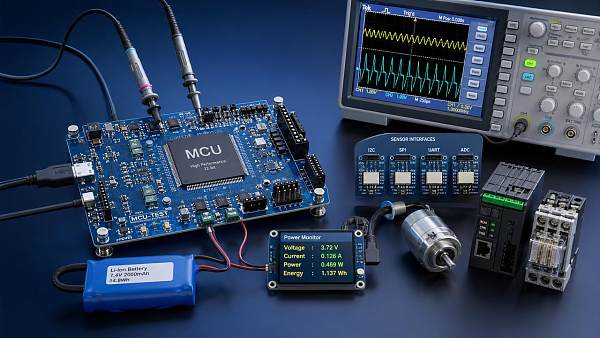
At its core, mcu power consumption data describes electrical demand under defined operating conditions. It is not a single truth. It is a set of measured values tied to a specific state.
Most MCU datasheets separate consumption into active mode, idle mode, sleep mode, standby, and shutdown. Some also publish current per MHz, which helps compare architecture efficiency.
The most useful reading starts with units. Current is usually shown in mA or µA. Power may appear in mW. Sometimes vendors emphasize current, leaving users to calculate power later.
That calculation is simple: power equals voltage multiplied by current. However, interpretation is not simple, because identical current at different voltages does not represent identical energy cost.
Core variables behind the number
- Supply voltage during the test
- Clock frequency and clock source
- Code execution from Flash or RAM
- Enabled peripherals and memory blocks
- Temperature and process variation
- Measurement method and silicon revision
Without these qualifiers, mcu power consumption data is incomplete. A fair comparison must normalize the conditions before any device ranking is attempted.
Why Direct Comparison Often Fails in Real Projects
Direct comparison fails because vendors present numbers for different goals. One supplier may optimize marketing visibility. Another may document realistic operating states with stricter technical detail.
This is common in industrial benchmarking. In mixed systems, the MCU may manage sensors, communications, motor control, safety monitoring, or low-duty telemetry. Each workload changes the meaning of the data.
A single active current figure says little about true field energy use. Duty cycle, wake-up frequency, peripheral bursts, and conversion tasks often dominate total consumption.
Typical comparison errors
When reviewing mcu power consumption data, always ask whether the published state matches the final use case, not whether the number merely looks lower.
Key Reading Framework for MCU Power Consumption Data
A practical framework starts with condition matching. First, identify the intended workload. Then map every datasheet figure to a real device state in the target system.
Step 1: Read the operating mode definitions
Vendors use similar terms differently. “Stop,” “standby,” or “deep sleep” can include different retention blocks, oscillator states, and wake-up paths. Read the definitions before using the numbers.
Step 2: Normalize voltage and frequency
If one MCU is measured at 1.8 V and another at 3.3 V, direct current comparison is weak. Normalize to power or compare current-per-MHz at matched conditions.
Step 3: Check what stays on
GPIO pull states, SRAM retention, watchdog, RTC, ADC bias, and communication blocks can all affect reported current. Hidden always-on functions often explain unexpected gaps.
Step 4: Separate typical from maximum
Typical figures help ranking. Maximum figures support risk control. For industrial deployment, both matter, especially under thermal stress, low battery conditions, or process spread.
Step 5: Estimate energy over time
The best interpretation of mcu power consumption data is energy per task. Measure current during sleep, wake, compute, communication, and return-to-sleep transitions.
Industry Relevance Across Complex Equipment and Infrastructure
In multi-disciplinary manufacturing, MCU efficiency influences more than battery life. It affects thermal design, regulator sizing, enclosure constraints, maintenance intervals, and system reliability.
This makes mcu power consumption data important in benchmarking components that sit inside larger mechanical and digital systems.
Representative cross-sector signals
- Automotive modules need predictable sleep current for parked vehicle battery protection.
- Smart agriculture nodes rely on low standby power for seasonal field autonomy.
- Industrial ESG monitoring devices need efficient data logging and wireless burst transmission.
- Precision equipment controllers must balance power, noise, and response time.
Across these sectors, poor interpretation can lead to underperforming batteries, overdesigned power rails, and false equivalence between chips that behave very differently in service.
Application Value and Business Impact
Correct use of mcu power consumption data creates measurable value during design evaluation and supplier comparison. It shifts decisions from headline figures to verified operating reality.
This improves benchmarking quality in several ways. It reduces redesign risk, clarifies total energy budget, and supports more stable lifecycle planning for globally sourced electronic subsystems.
Where the value appears
Typical MCU Categories and Reading Priorities
Different MCU classes require different reading priorities. The same mcu power consumption data fields do not carry equal weight in every architecture or application.
- Ultra-low-power MCUs: focus on standby current, retention options, wake-up latency, and RTC operation.
- Mainstream control MCUs: focus on active current per MHz, Flash execution cost, and peripheral gating.
- Connectivity MCUs: include radio bursts, memory buffering, and protocol stack overhead.
- Safety-oriented MCUs: include watchdogs, redundancy checks, and diagnostic background consumption.
- Motor-control MCUs: include timer load, ADC sampling, PWM operation, and real-time response constraints.
A realistic benchmark should reflect the category, not only the nominal low-power specification listed in summary tables.
Practical Review Checklist and Common Cautions
Before freezing a design, apply a structured review. This turns raw mcu power consumption data into a usable engineering decision tool.
- Match each datasheet mode to a real operational state.
- Recalculate power at the actual system voltage.
- Model duty cycle instead of relying on static current.
- Include startup, oscillator stabilization, and communication bursts.
- Use lab measurements to validate supplier figures.
- Review errata for revisions affecting low-power behavior.
One caution is especially important. Bench tests on clean evaluation boards rarely match final assemblies with sensors, regulators, leakage paths, and harsh environmental variation.
Another caution concerns optimization tradeoffs. Lower sleep current may come with slower wake-up, reduced retention, or firmware complexity. Efficiency must be judged at system level.
Next-Step Approach for Better Benchmarking
The right approach to mcu power consumption data is disciplined comparison, not quick selection. Build a normalized table, define identical test conditions, and rank devices by energy-per-function.
For broader industrial analysis, combine datasheet review with board-level measurement, lifecycle availability checks, and standards-aligned benchmarking. This produces more resilient engineering and sourcing outcomes.
When interpreted correctly, mcu power consumption data becomes more than a specification line. It becomes a reliable basis for cross-sector technical decisions, lower risk, and stronger system performance.
If deeper benchmarking is needed, create a side-by-side evaluation matrix covering voltage, frequency, active modes, sleep states, retention settings, and measured task energy before final device approval.

The Archive Newsletter
Critical industrial intelligence delivered every Tuesday. Peer-reviewed summaries of the week's most impactful logistics and market shifts.