Monday, May 22, 2024

Sensors Manufacturer Selection: Accuracy vs. Unit Cost
by
Published
Views:
Choosing the right sensors manufacturer is rarely a simple trade-off between accuracy and unit cost. For procurement teams operating across complex industrial supply chains, the real challenge is balancing measurement reliability, compliance, lifecycle value, and sourcing risk. This article explores how buyers can evaluate sensor suppliers more strategically to reduce total cost and protect long-term operational performance.
In cross-industry manufacturing environments, sensor performance affects far more than a single device specification. It can influence line uptime, calibration frequency, warranty exposure, traceability, and even the ability to meet ISO, IATF, or IPC-related quality expectations. For buyers comparing a sensors manufacturer across electronics, mobility, agri-tech, infrastructure, and precision tooling applications, the better question is not “Which quote is cheaper?” but “Which supplier lowers operational risk over 12 to 36 months?”
Why Accuracy and Unit Price Must Be Evaluated Together
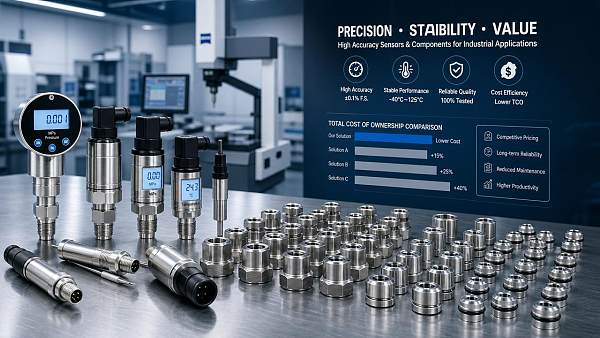
A low quoted price can look attractive during sourcing, especially when annual demand exceeds 5,000 or 10,000 units. Yet in most industrial settings, a sensor with unstable output, narrow environmental tolerance, or inconsistent batch quality can create costs that are 3 to 10 times higher than the initial unit savings. This is why procurement teams should evaluate a sensors manufacturer through a total-cost lens rather than a piece-price lens.
Accuracy matters differently by application. In EV power management, a small drift in current or temperature sensing may affect safety margins and energy efficiency. In filtration systems, pressure and flow sensor deviation may trigger poor process control and unplanned maintenance. In autonomous equipment and smart agriculture, position, proximity, and environmental sensors must stay reliable across vibration, dust, moisture, and seasonal temperature swings from -20°C to 70°C.
Where buyers often underestimate hidden cost
Many sourcing decisions still prioritize a 5% to 12% unit price difference without fully costing the downstream impact. If a lower-cost sensor increases calibration intervals from every 12 months to every 6 months, or raises field returns from 0.3% to 1.5%, the procurement gain disappears quickly. The same applies when a supplier cannot maintain lot-to-lot consistency over a 24-week production horizon.
- Higher scrap rates due to unstable readings during incoming inspection or assembly
- More frequent recalibration, often adding 2 to 6 service hours per maintenance cycle
- Unexpected line stoppages caused by sensor drift, connector mismatch, or sealing failure
- Longer supplier corrective action cycles when documentation is incomplete
- Greater compliance risk in regulated or quality-audited production programs
A practical framework for comparing offers
The table below helps procurement teams compare a sensors manufacturer beyond quotation price. It is particularly useful when multiple vendors appear similar on the surface but differ in process capability, traceability, and service responsiveness.
The key insight is that the best sensors manufacturer for a procurement team is often not the one with the lowest invoice cost, but the one that protects process stability. In industrial programs with annual quality targets below 1% defects, documentation, consistency, and response time can be just as valuable as tighter accuracy specifications.
When higher accuracy is actually unnecessary
Not every use case justifies premium tolerance. If the process window is broad and environmental variation is modest, a sensor rated at ±1% may perform as effectively as one rated at ±0.25%, especially when the control system already applies software compensation. Buyers should confirm the required performance threshold with engineering before approving a higher-cost design.
How to Assess a Sensors Manufacturer for Industrial Procurement
Supplier evaluation becomes more reliable when procurement uses a repeatable scorecard. For mixed-sector buyers working with electronics assemblies, mobility systems, water treatment skids, or agricultural equipment, at least 6 factors should be reviewed: technical fit, manufacturing control, compliance readiness, delivery resilience, after-sales support, and commercial flexibility.
1. Technical fit and application alignment
A capable sensors manufacturer should clearly explain where its sensing technology performs best. Buyers should request performance data for the intended medium, temperature range, vibration load, ingress exposure, and signal interface. A pressure sensor for wastewater duty, for example, faces very different contamination and maintenance demands than one used in battery cooling or clean electronics assembly.
At minimum, compare 4 technical items: measurement range, accuracy class, response time, and environmental durability. In many programs, procurement should also verify connector standardization, mounting compatibility, EMC behavior, and expected calibration stability over 12 to 24 months.
2. Production consistency and quality control
A strong sensors manufacturer does more than produce acceptable prototypes. It can also maintain consistency across repeated production lots. Ask how the supplier handles incoming material inspection, in-process testing, end-of-line verification, and traceability retention. A mature supplier should be able to describe sampling plans, nonconformance handling, and change notification procedures in practical terms.
- Review pilot lot results before approving volume release.
- Check whether lot traceability is retained for at least 12 months or the required contract period.
- Confirm how design or component changes are communicated, ideally 60 to 90 days in advance.
- Assess corrective action turnaround for field issues, such as 5 to 10 working days for initial containment.
3. Compliance, documentation, and cross-border sourcing readiness
For global buyers, documentation quality often determines whether a supplier is manageable at scale. A sensors manufacturer serving cross-sector industrial programs should be ready to support standard declarations, material disclosures, test records, packaging controls, and labeling requirements. This becomes especially important when goods move across multiple customs regions or into OEM-driven quality systems.
Below is a practical document checklist that procurement teams can use during supplier onboarding and quarterly vendor reviews.
If a supplier struggles to provide structured documentation during the quote stage, the same weakness usually appears later in audits, corrective actions, and customs support. In practice, strong paperwork often correlates with stronger process discipline.
4. Lead time, MOQ, and supply chain resilience
A technically capable sensors manufacturer can still be a risky choice if lead times are unstable. Buyers should compare standard production lead time, expedite options, minimum order quantity, and component dependency. For many industrial sensor categories, normal lead time may range from 3 to 8 weeks, but custom configurations can extend to 10 to 16 weeks.
Procurement should also ask whether key sensing elements, housings, or connectors come from single-source inputs. If one critical component has a 20-week replenishment cycle, that risk should be visible in sourcing strategy. In volatile markets, a supplier with a slightly higher price but better inventory planning may be the safer commercial decision.
Building a Cost Model That Reflects Real Lifecycle Value
To compare suppliers fairly, procurement should move from unit price comparison to lifecycle cost modeling. This is especially important when sensors are deployed in systems where downtime, field service, or warranty claims are expensive. A $2 savings on a part may look significant at 20,000 units, but one extra maintenance visit per 500 machines can erase that benefit quickly.
Include these cost layers in your sourcing model
- Purchase price by volume tier, such as 1k, 5k, and 20k units
- Incoming inspection time per lot or per 1,000 units
- Calibration or verification frequency over 12, 24, and 36 months
- Expected field replacement rate and service labor cost
- Downtime cost per failure event in critical production systems
- Administrative cost for claims, returns, and corrective action follow-up
This approach helps buyers identify where a sensors manufacturer creates value beyond the RFQ. In many industrial categories, lifecycle cost is driven less by the initial component invoice and more by three factors: failure frequency, service complexity, and supply continuity.
A simple example procurement teams can use
Assume Supplier A is 8% cheaper per unit than Supplier B on a 10,000-piece annual buy. However, Supplier A requires twice-yearly calibration while Supplier B requires yearly verification only. If each maintenance event costs 1.5 labor hours plus line coordination time, the lower-priced option may become more expensive within the first 12 months. This is where collaboration between procurement, maintenance, and engineering pays off.
Common Procurement Mistakes When Selecting a Sensors Manufacturer
Even experienced sourcing teams can make avoidable mistakes when technical and commercial reviews are disconnected. In complex manufacturing ecosystems, these mistakes usually appear during ramp-up, vendor transition, or regional expansion.
Mistake 1: Buying to datasheet only
A datasheet is necessary, but it does not replace application validation. Two products with similar stated accuracy can behave differently under vibration, humidity, pressure spikes, or electrical noise. Buyers should request samples, pilot-lot data, or controlled validation over 2 to 6 weeks before locking in a long-term supply contract.
Mistake 2: Ignoring service responsiveness
When issues occur, response speed matters. A sensors manufacturer that answers within 24 to 48 hours and provides structured fault analysis can reduce production disruption significantly. Slow support may increase containment time, expedite freight cost, and internal troubleshooting labor.
Mistake 3: Over-specifying performance
Some procurement teams approve premium-grade sensors because “higher spec feels safer.” In reality, paying for ultra-tight tolerance that the system does not need can inflate cost by 10% to 30% without measurable process benefit. The right decision depends on actual process window, control architecture, and maintenance strategy.
Mistake 4: Underestimating supplier concentration risk
A single-source sensors manufacturer may be manageable for low-risk applications, but for strategic programs procurement should assess backup capacity, alternate sites, and material substitution controls. In sectors with seasonal demand or geopolitical shipping disruptions, this review is no longer optional.
How GIM Supports Better Supplier Benchmarking Decisions
For procurement teams dealing with sensor sourcing across multiple industrial sectors, the challenge is rarely access to quotes alone. The harder task is comparing suppliers in a way that connects technical performance, commercial exposure, and operational continuity. This is where structured benchmarking becomes valuable.
Global Industrial Matrix (GIM) helps buyers and industrial decision-makers evaluate component and hardware supply options through a cross-sector lens. By aligning sensor-related sourcing decisions with broader manufacturing realities in electronics, mobility, smart agriculture, ESG infrastructure, and precision tooling, GIM supports more informed trade-offs between accuracy, durability, lead time, and total procurement risk.
What procurement teams should take away
The most effective sensors manufacturer is the one that fits the application, supports compliance, maintains process consistency, and reduces lifecycle cost. That decision cannot be made on price alone. A disciplined review of 6 to 8 supplier criteria, supported by pilot validation and documentation checks, will usually produce better long-term value than chasing the lowest unit quote.
If your team is comparing sensor suppliers for industrial, automotive, environmental, or electronics programs, GIM can help you benchmark sourcing options with greater clarity. Contact us to discuss your procurement priorities, request a tailored evaluation framework, or learn more about cross-sector supplier intelligence that supports resilient manufacturing decisions.

The Archive Newsletter
Critical industrial intelligence delivered every Tuesday. Peer-reviewed summaries of the week's most impactful logistics and market shifts.